
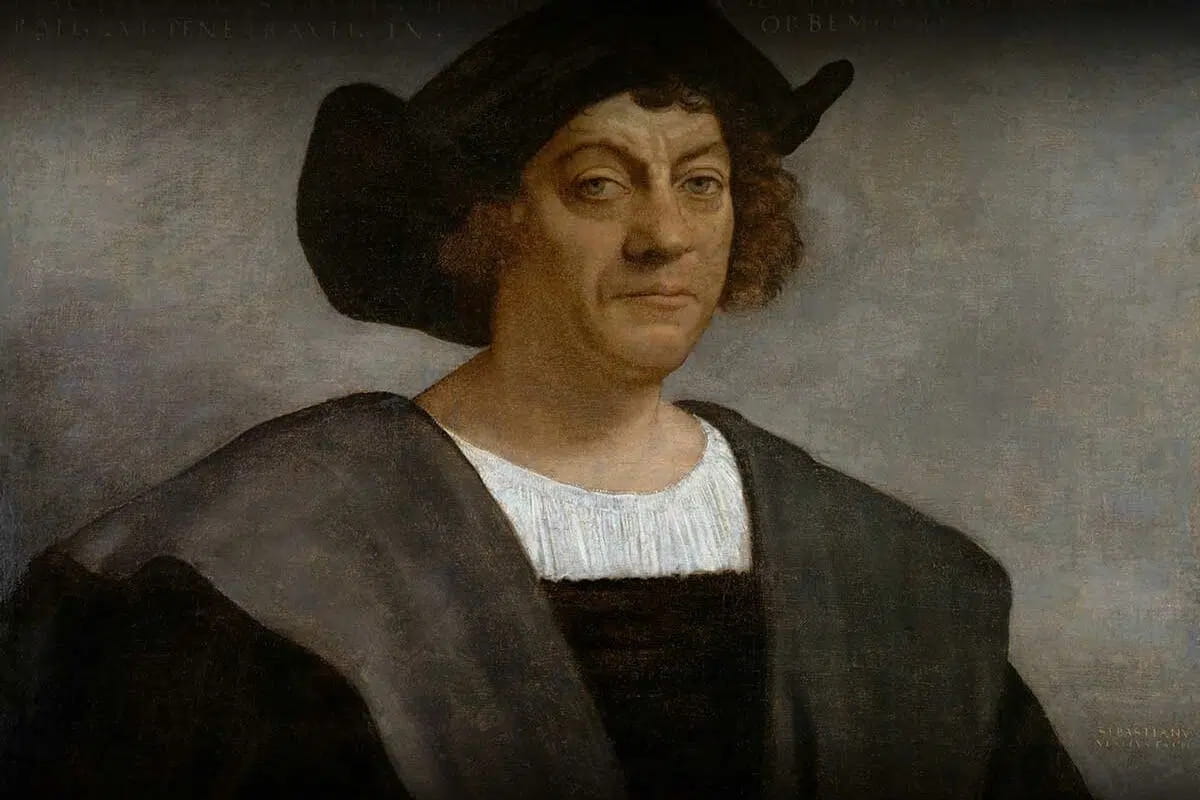
Christopher Columbus is one of the most controversial and debated figures in human history, whose voyages forever changed the world map and the course of civilization. This Genoese navigator who served the Spanish crown is known as the discoverer of America for Europeans, although in reality he believed until the end of his life that he had reached the shores of Asia. Behind the official version of history lies a multitude of incredible facts about Columbus’s life, voyages, and legacy that often contradict established myths. You may not have known about the numerous errors in his calculations, the dramatic circumstances of his expeditions, complex relationships with indigenous peoples, and the tragic end of his life. We invite you to discover fascinating facts about Christopher Columbus that reveal the true personality of this navigator and the real consequences of his discoveries for world history.
- Christopher Columbus was born approximately in 1451 in Genoa, an Italian maritime republic, although the exact date of his birth remains a subject of debate. His father Domenico Colombo was a wool weaver and owner of a small shop, indicating the family’s middle-class social status. In his youth, Columbus worked as his father’s assistant, but already in his teenage years began going to sea on Genoese merchant ships. This early maritime experience laid the foundation for his future ambitions to become a great navigator and explorer.
- Columbus never completed formal education and was largely self-taught, having learned to read and write already in adulthood. Despite the lack of systematic education, he studied Latin, cartography, astronomy, and navigation independently or from experienced sailors. His geographical knowledge was based on works of ancient authors, medieval maps, and tales of other navigators. Columbus spoke several languages, including Italian, Spanish, Portuguese, and Latin, which helped him communicate at various European courts.
- The main goal of Columbus’s first expedition was to find a western sea route to India, China, and the Spice Islands, bypassing trade routes controlled by Muslims. He based his calculations on a significantly underestimated assessment of Earth’s circumference, mistakenly believing that Asia was much closer to Europe than it actually is. Columbus used data from Pierre d’Ailly and Paolo Toscanelli, who were also wrong in their measurements. Had the Americas not been in the way, his expedition would inevitably have perished from hunger and thirst in the endless ocean.
- Before receiving support from Spanish monarchs, Columbus approached Portuguese King John II for financing, who rejected his project. Portuguese experts correctly determined that Columbus’s calculations regarding distance to Asia were erroneous and the journey impossible. After Portugal’s refusal, Columbus spent years trying to convince Spanish monarchs Ferdinand and Isabella to finance the expedition. Only after the completion of the Reconquista and capture of Granada in 1492 did Queen Isabella finally agree to support Columbus’s project.
- Columbus’s first expedition consisted of three ships known as Santa Maria, Pinta, and Niña, with a total crew of about 90 people. Santa Maria was the largest ship, but during the voyage ran aground off the coast of Haiti on Christmas 1492 and was abandoned. From its wreckage, Columbus ordered the construction of Fort Navidad, which became the first European settlement in the New World. When Columbus returned during the second expedition, he discovered that all members of the fort’s garrison had been killed by local inhabitants after conflicts.
- Columbus made four transatlantic voyages between 1492 and 1504, but never realized he had discovered a new continent. During his first voyage, he landed on an island he named San Salvador in the Bahamas on October 12, 1492. Over the following months, he explored Cuba and Haiti, which he named Hispaniola. Until the end of his life, Columbus insisted he had reached the eastern coast of Asia, despite evidence to the contrary.
- Columbus’s relations with indigenous peoples were complex and often brutal, leading to catastrophic consequences for the natives. Initially, he described the indigenous Taino inhabitants as peaceful and hospitable people in his journals. However, Columbus quickly introduced a system of forced labor and demanded that natives surrender gold as tribute under threat of punishment. Those who could not meet quotas were subject to cruel punishments, including hand amputation or death.
- Columbus’s second expedition in 1493 was much larger in scale, including 17 ships and about 1,200 people. Unlike the first exploratory voyage, this expedition aimed at colonization with settlers, priests, soldiers, and animals. Columbus also brought seeds of European crops, including wheat, barley, and grapes, which he attempted to cultivate in the new lands. This voyage marked the beginning of systematic European colonization of America with all its tragic consequences for indigenous populations.
- Columbus brought to Europe numerous previously unknown products and plants, including corn, potatoes, tomatoes, cocoa, and tobacco. These crops later revolutionized European agriculture and diet, leading to a demographic population explosion. At the same time, he brought to America horses, cattle, pigs, wheat, and sugarcane, changing the New World’s ecosystem. This exchange of plants, animals, diseases, and cultures between the Old and New Worlds is known as the Columbian Exchange.
- During the third expedition in 1498, Columbus reached the South American continent, becoming the first European to document the discovery of mainland America. He landed on the territory of modern-day Venezuela near the Orinoco River delta. Columbus also discovered Trinidad island, named by him in honor of the Holy Trinity. Despite these significant geographical discoveries, this voyage ended in disaster for him.
- Columbus was arrested by Spanish royal commissioner Francisco de Bobadilla in 1500 over numerous complaints about his brutal rule as governor. He was sent back to Spain in chains along with his two brothers due to accusations of tyranny and incompetent colony management. Although Ferdinand and Isabella freed him upon arrival and restored some privileges, Columbus never regained his position as governor. This episode left a deep emotional mark on the navigator and undermined his reputation at court.
- Columbus’s fourth and final voyage in 1502-1504 was the most difficult and dangerous of all his expeditions. He explored the Central American coast, including territories of modern-day Honduras, Nicaragua, Costa Rica, and Panama, searching for a passage to the Indian Ocean. During this voyage, his ships suffered from storms, attacks by indigenous peoples, and marine worms that damaged ship hulls. Columbus and his crew were stranded on Jamaica for over a year before being rescued.
- Columbus died on May 20, 1506, in Valladolid, Spain, at approximately 54-55 years of age, probably from arthritis and eye inflammation. At the time of death, he was relatively forgotten and impoverished despite his epochal discoveries. Columbus remained convinced until the end that he had discovered a route to Asia, not a new continent. His final years were filled with legal battles with the Spanish crown over promised titles, privileges, and share of wealth from new lands.
- Columbus’s remains had an amazing and confusing history after his death, moving between several cities over centuries. Initially he was buried in Valladolid, then moved to Seville, and later to Santo Domingo in Haiti according to his will to be buried in the New World. In 1795, the remains were moved to Havana in Cuba, and then again to Seville in 1898. Genetic tests conducted in the 21st century confirmed that at least part of the remains in Seville indeed belong to Columbus.
- America was named not after Columbus but after Italian explorer Amerigo Vespucci, who first recognized that the discovered lands were a new continent. German cartographer Martin Waldseemüller in 1507 created a map where he first used the name America to designate the New World. By this time Columbus had already died and never learned of this naming. Ironically, the man who actually discovered America for Europe did not receive the honor of having the continent named after him.
- Columbus’s legacy remains deeply controversial, with sharp disagreements in assessments between those who see him as a hero-explorer and those who consider him responsible for genocide. In many American countries, October 12, the day of his arrival in the New World, is celebrated as Columbus Day or Discovery of America Day. However, in recent decades, criticism of celebrating this date has grown due to tragic consequences of his arrival for indigenous populations. Some countries and communities have renamed this holiday Indigenous Peoples’ Day to honor natives instead of the colonizer.
- Columbus left detailed journals of his voyages, which are valuable historical sources about his expeditions and first contacts with indigenous Americans. Originals of most of his journals were lost, but copies and summaries made by historian Bartolomé de las Casas and Columbus’s son Ferdinand have survived. These documents provide a unique view into the navigator’s thinking, his observations about geography, flora, fauna, and people of the New World. The journals also reveal his religious fanaticism and belief in a divine mission to spread Christianity.
- Columbus’s impact on world history was enormous and multifaceted, regardless of moral evaluation of his actions. His voyages initiated the era of European expansion, transatlantic slave trade, and economic globalization. The discovery of America led to mass European migration, tragedy of indigenous populations through disease and violence, and creation of new cultures and nations. The consequences of his expeditions continue shaping the modern world, including demographics, culture, economy, and politics of two continents.
Incredible facts about Christopher Columbus demonstrate that the real history of this navigator is far more complex than simplified school textbooks that portray him as either a hero or a villain. From erroneous geographical calculations to tragic consequences for indigenous peoples, from triumphs of discoveries to personal failures and humiliations, his life was filled with paradoxes and contradictions. Interesting facts about Columbus remind us of the importance of critical comprehension of history and recognition of both achievements and crimes of historical figures. Now, having learned about fascinating details of Christopher Columbus’s life, you can form a more balanced and nuanced understanding of his role in shaping the modern world and realize the complexity of the legacy of European colonization of America.


