
Vincent van Gogh remains one of the most enigmatic figures in the history of art, whose works today are worth millions, although during his lifetime he sold only a few paintings. You may not know that this genius of the brush created more than two thousand works in just ten years of creative activity before taking his own life at the age of thirty-seven. These fascinating facts will reveal not only an artist with an unstable psyche, but also a deeply intellectual person, a philosopher who sought the meaning of life through art. Today we will immerse ourselves in the world of van Gogh to understand how suffering, love for nature, and inexhaustible diligence turned him into a symbol of the struggle of the creative soul. Prepare to discover astonishing details of a life that became legendary not only because of art, but also because of human tragedy.
- Vincent van Gogh was born on March 30, 1853, in the village of Groot-Zundert in the Netherlands and was named after his older brother, who had died a year before his birth, a fact that placed a psychological burden on him throughout his life. His father, Theodorus van Gogh, was a pastor of the Reformed Church, while his mother, Anna Cornelia Carbentus, came from a family of book publishers and possessed artistic talent. Vincent was the eldest of six children who reached adulthood, although there was also another sister who died in infancy. This family tragedy and the constant comparison with the “memory of the deceased brother” influenced the formation of his complex character.
- Until the age of twenty-seven, van Gogh did not paint professionally but worked as an art dealer at the Goupil Gallery in The Hague, London, and Paris, where he became acquainted with the works of contemporary artists. After an unsuccessful love for his cousin Kee Vos-Stricker and the failure of his attempts to become a pastor, he decided to devote himself entirely to art. His earliest works were dark, melancholic canvases depicting rural scenes, such as The Potato Eaters, which differed greatly from the bright paintings he created later. Only at the age of twenty-seven did he decide to become an artist, making him one of the latest-blooming geniuses in the history of art.
- The most famous self-portrait of van Gogh with a bandaged ear was painted after an incident in December 1888, when, during a mental crisis, he cut off part of his own left ear and gave it to a prostitute named Rachel in a brothel in Arles. This incident occurred after a violent quarrel with his friend Paul Gauguin, who had come to live with him in the Yellow House in Arles to create a joint artists’ studio. Afterward, van Gogh was admitted to a hospital, where he painted several self-portraits with his head bandaged to document his injury. Modern researchers suggest that the incident may have been provoked not only by mental illness, but also by excessive consumption of absinthe and malnutrition.
- Van Gogh painted more than eight hundred canvases and created over a thousand drawings during just ten years of active creativity from 1880 to 1890, averaging one painting every four days. His most productive period was his stay in Arles from February 1888 to May 1889, when he created around two hundred paintings, including the famous Sunflowers and The Night Café. Even while confined in the psychiatric hospital in Saint-Rémy, he continued to paint several works a week, often depicting views from the window of his room. Such extraordinary productivity was made possible by his exceptional capacity for work and a sense of urgency associated with his deteriorating health.
- The original colors of van Gogh’s paintings have changed over time due to chemical reactions in the pigments he used, especially cadmium yellow, which darkens under exposure to light. Modern studies using X-ray fluorescence have shown that some areas of his paintings were originally much brighter than they appear today. For example, the blue areas in The Night Café were initially much darker, intensifying the contrast with the yellow elements. This discovery has changed the understanding of van Gogh’s artistic technique and his intentions regarding color.
- Van Gogh had a very close relationship with his younger brother Theo, who was an art dealer and financially supported Vincent throughout his life by sending him money and painting supplies. The brothers maintained an intense correspondence in which Vincent described his creative searches, philosophical reflections, and emotional crises, leaving more than six hundred letters that serve as an invaluable source for understanding his personality. Theo died only six months after Vincent’s death, likely from syphilis and emotional exhaustion, and was buried next to his brother in the cemetery at Auvers-sur-Oise. It was thanks to Theo that van Gogh’s works were preserved and presented to the public after his death.
- Van Gogh spent the last months of his life in the town of Auvers-sur-Oise near Paris, where under the supervision of Doctor Paul Gachet he created about eighty paintings in just seventy days. Among them were such masterpieces as Portrait of Dr. Gachet and The Church at Auvers, as well as his final painting Wheatfield with Crows, often interpreted as a premonition of death. On July 27, 1890, van Gogh shot himself in the chest in a field near Auvers, but did not die immediately and returned to his inn, where he passed away two days later in the presence of his brother Theo. His last words were “The sadness will last forever,” reflecting the deep depression that haunted him until the end.
- Van Gogh never married, but experienced several tragic love affairs, the most famous being his relationship with his neighbor Sien Hoornik, a prostitute with a child whom he wanted to adopt. His parents and brother Theo strongly opposed this union, which led to their separation and plunged van Gogh into deep depression. Later he fell in love with his cousin Kee Vos-Stricker, who rejected him, after which he spent several days standing in the rain outside her house, hoping to change her decision. These failures in his personal life intensified his sense of loneliness and rejection by society.
- Van Gogh was a great admirer of Japanese ukiyo-e prints, which strongly influenced his artistic style, especially during his time in Paris, where he assembled a collection of more than six hundred prints. He copied some of these works, transforming them into oil paintings and adapting Japanese aesthetics to European art. His painting Flowering Gardens in Arles was directly inspired by the bold perspectives and flat color planes characteristic of Japanese prints. This influence of Japanese culture became a key factor in shaping van Gogh’s post-Impressionist style.
- During his stay in the psychiatric hospital in Saint-Rémy, van Gogh painted through the special bars on the windows of his room, which explains the characteristic vertical lines seen in some of his works from that period. Despite mental crises that sometimes lasted for weeks, he was allowed to work in the hospital studio, where he created some of his most famous paintings, including Irises and The Starry Night. Doctors permitted him to paint, considering it a therapeutic practice that helped him cope with his mental condition. During this period he produced around one hundred and fifty paintings, demonstrating his remarkable creative energy even under severe circumstances.
- Van Gogh created a series of twelve paintings titled Sunflowers, intended to decorate the home of his friend Paul Gauguin in Arles, although Gauguin did not stay there long. These works differ in the number of flowers in the vase and the degree of their bloom, symbolizing various stages of life from flourishing to decay. Modern research has shown that van Gogh used different shades of yellow derived from various chemical compounds, explaining the uneven fading of color in some of the series. Four of these paintings are held in museums in London, Munich, Amsterdam, and Philadelphia, while others have been lost or destroyed.
- Van Gogh received almost no recognition during his lifetime and sold only one painting, The Red Vineyard, for four hundred francs shortly before his death. The buyer was Anna Boch of Belgium, the sister of the artist Isaac Boch, who knew van Gogh. Most of his works were stored in his brother Theo’s apartment in Paris and were known only to a small circle of artists and critics. Only after van Gogh’s death did his creations begin to gain recognition thanks to the efforts of his sister-in-law Johanna van Gogh-Bonger, who organized the first exhibitions of his work. Today his paintings are among the most expensive in the world, with some sold for hundreds of millions of dollars.
- Van Gogh had complex relationships with other artists of his time, although he admired the works of masters such as Georges Seurat, Paul Cézanne, and Henri de Toulouse-Lautrec. He particularly respected Paul Gauguin, although their shared life in Arles ended disastrously due to differing views on art and the difficult personalities of both men. Van Gogh frequented the Tambourin Café in Montmartre, where he met young artists, but often felt isolated because of his restless temperament and poverty. Only after his death did other artists, such as Émile Bernard and Paul Signac, actively promote his legacy.
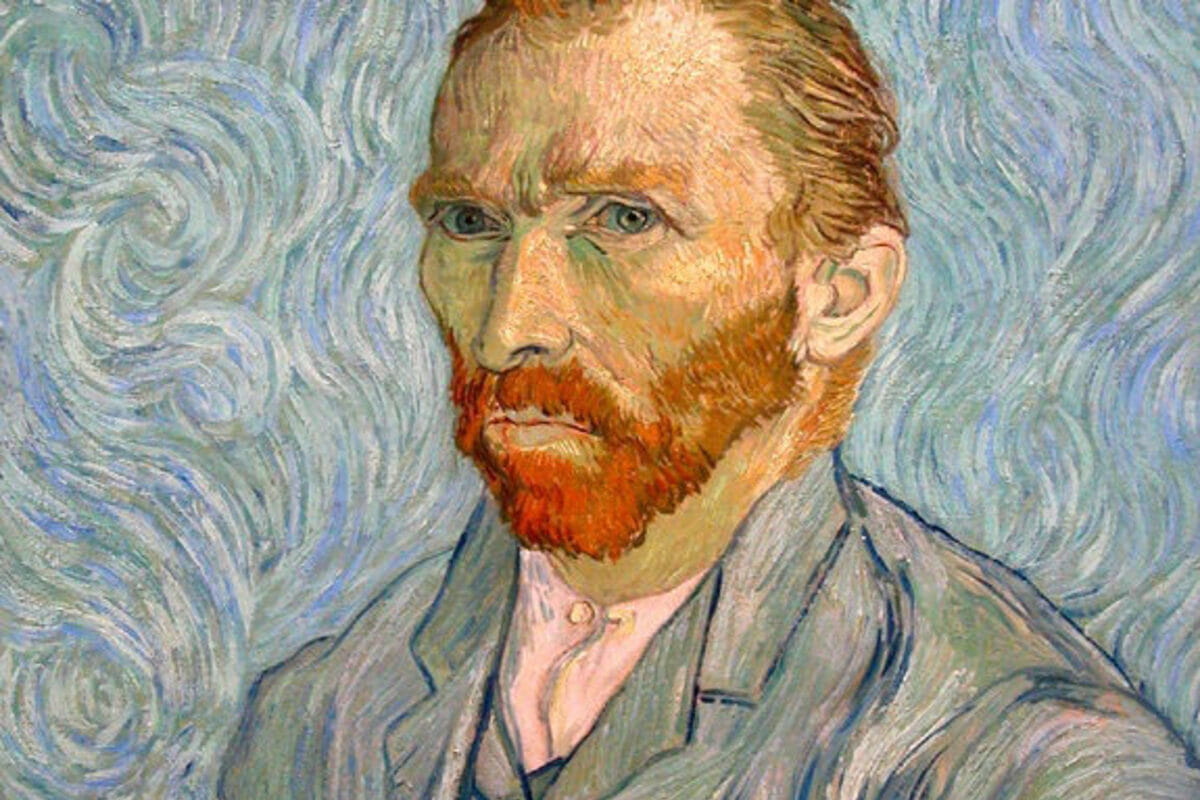
- Van Gogh created more than thirty self-portraits, making him one of the artists who depicted himself most frequently, a result of both financial constraints and a desire to explore his own identity through art. Many of these self-portraits were painted during his stays in psychiatric hospitals, where he had no access to models. In these works he often portrayed himself with a somber expression but an intense gaze, reflecting the inner conflict between suffering and creative energy. These paintings became a unique record of the artist’s emotional state at different stages of his life.
- Van Gogh suffered from health problems throughout his life, including possible epileptic seizures, lead poisoning from paints, and mental disorders that modern doctors diagnose as bipolar disorder or schizoaffective disorder. He experienced hallucinations, insomnia, and paranoia during mental crises, which led to hospitalization. He also had gastrointestinal problems, likely caused by excessive consumption of coffee, tobacco, and absinthe. His letters to his brother Theo contain detailed descriptions of his health, helping modern researchers reconstruct his medical history.
- The Van Gogh Museum in Amsterdam houses the largest collection of the artist’s works, including more than two hundred paintings, four hundred drawings, and over seven hundred letters. This collection was assembled through the efforts of Johanna van Gogh-Bonger, who inherited the works after Theo’s death. The museum opened to the public in 1973 and is visited each year by more than two million people from around the world. Among its most famous exhibits are Sunflowers, The Potato Eaters, and several of van Gogh’s self-portraits.
- In his youth, van Gogh was deeply religious and even attempted to become a pastor, which led him to work as a preacher among miners in Belgium, where he lived in poverty, sharing their way of life. His extreme devotion caused concern among church authorities, who considered his behavior too radical for a spiritual leader. After being denied ordination, he gradually distanced himself from organized religion but remained a spiritual person, seeking meaning in life through art. Many of his paintings contain hidden religious symbolism, especially in early works such as The Potato Eaters.
- Van Gogh used the impasto technique, applying paint in thick layers to create a textured surface that conveyed the emotional intensity of his works. His brushstrokes often left expressive marks on the canvas, creating a sense of movement and energy, particularly evident in paintings like The Starry Night. This technique was innovative for its time and influenced the development of Expressionism in the twentieth century. Modern conservators face challenges in preserving these thick layers of paint, which can detach from the canvas over time.
- Van Gogh painted many portraits of ordinary people—workers, peasants, and city dwellers—reflecting his interest in the lives of common individuals. His series of portraits of the postman Joseph Roulin became one of the most famous cycles of his work, depicting his friend in various moods and perspectives. He often paid his models with food or small sums of money, as he himself lived in extreme poverty. These portraits are distinguished by their psychological depth and the empathy with which the artist treated his subjects.
- Van Gogh’s final place of residence, the Ravoux Inn in Auvers-sur-Oise, has been opened to visitors as a museum dedicated to the last days of the artist’s life. In room number five, where he lived and died, the original interior and furniture of the era have been preserved. Nearby lies the field where he is believed to have shot himself, although some modern researchers propose theories of an accident or even murder. This site has become a place of pilgrimage for admirers of van Gogh’s work from all over the world.
These remarkable facts only partially reveal the complex personality of van Gogh, who combined genius with profound human vulnerability. Fascinating details of his life remind us that great art often arises from personal suffering and inner struggle. You may not realize how short his creative path was and how little recognition he received during his lifetime compared to the cult that surrounds his name today. The legacy of van Gogh remains powerful proof that true art can survive not only the death of its creator, but also the passage of time, becoming a universal language of human emotion.


