
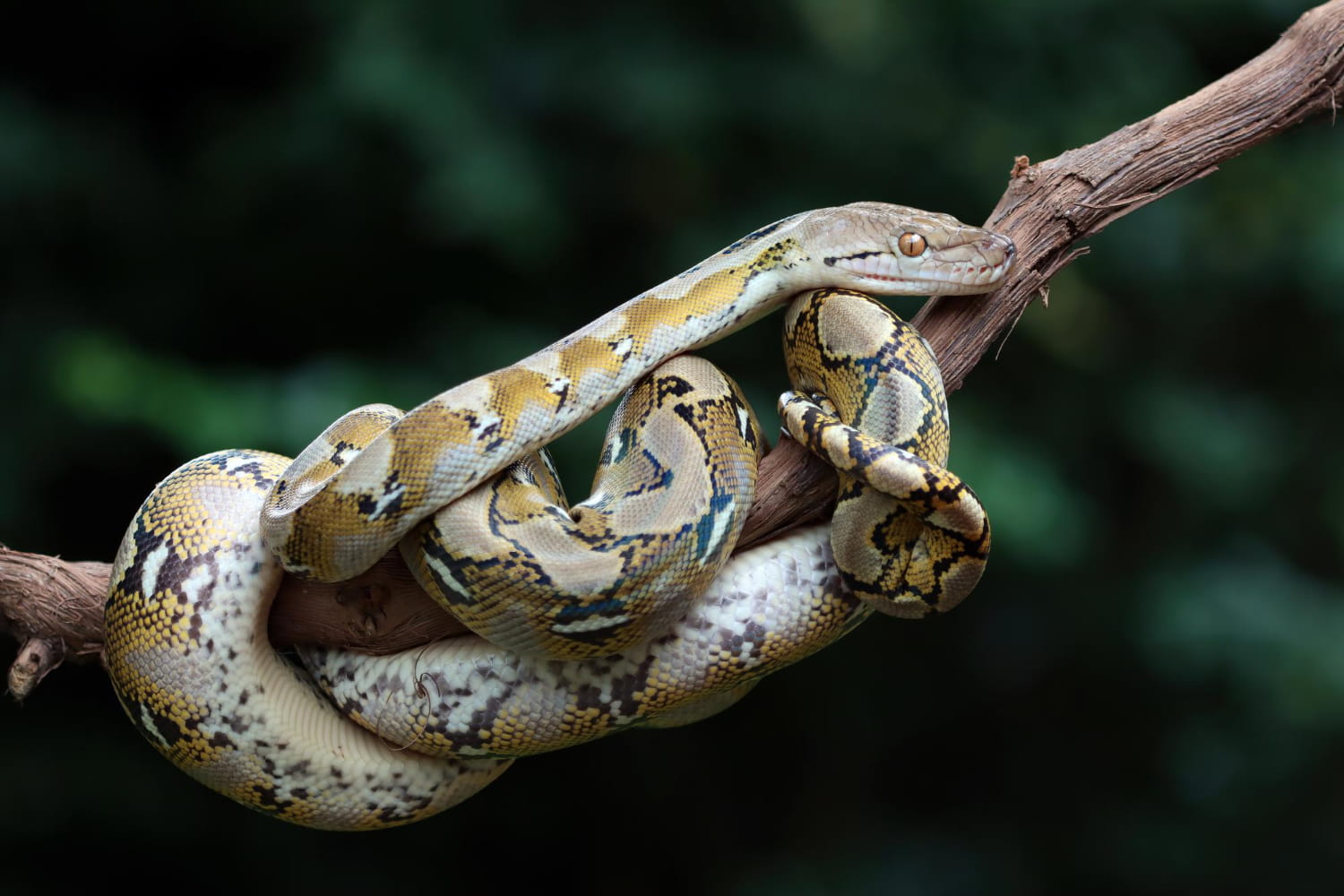
Pythons belong to the most impressive and mysterious representatives of the reptile world, inhabiting tropical and subtropical regions of Africa, Asia, and Australia. These non-venomous snakes are capable of amazing with their size, strength, and unique hunting methods that have evolved over millions of years. Despite the fact that pythons often evoke fear and misunderstanding in people, they play a critically important role in ecosystems as predators controlling populations of rodents and other animals. You may not have known about the incredible physiological adaptations of these snakes, their complex behavior during reproduction, unique sensory abilities, and challenges they face due to habitat loss. We invite you to discover fascinating facts about pythons that reveal the amazing nature of these ancient predators and demonstrate why they deserve respect and protection.
- The reticulated python is the longest snake in the world with confirmed records of individuals reaching over 7 meters in length. The longest officially measured reticulated python had a length of 7.67 meters and was found on the island of Sulawesi in Indonesia. Although there are unverified reports of individuals over 10 meters long, most scientists question them. Reticulated pythons inhabit Southeast Asia and are excellent swimmers, often found near water bodies.
- Pythons are not venomous snakes and kill their prey by constriction method, wrapping around the victim with body coils. Contrary to popular belief, pythons do not break their prey’s bones and do not suffocate it in the classical sense. Instead, they squeeze the victim each time it exhales, preventing inhalation and disrupting blood circulation, which leads to cardiac arrest. Death of prey usually occurs within minutes from heart and circulation stoppage, not from suffocation.
- Pythons have specialized heat-sensing pits on the upper and lower lips that allow them to detect warm-blooded prey in complete darkness. These organs can detect temperature changes of just 0.003 degrees Celsius, creating a thermal map of the environment. This gives pythons a huge advantage during nocturnal hunting, allowing them to accurately determine the location of warm-blooded animals even without visual contact. Heat sensitivity works at distances up to one meter, depending on prey size and temperature.
- Females of many python species demonstrate maternal behavior, coiling around their eggs for protection and incubation. During incubation, the female can raise her body temperature by several degrees through rhythmic muscle contractions resembling shivering. This thermogenesis process requires enormous energy expenditure, and the female can lose up to half her weight during the incubation period. Female pythons do not eat throughout the entire brooding period, which can last from two to three months depending on species.
- The green tree python has bright green coloration that provides ideal camouflage among tropical forest foliage. Interestingly, young green tree pythons are born bright yellow or red and change color to green during their first year of life. This color change may be an adaptation since young snakes spend more time on the ground among fallen leaves. Green tree pythons have extraordinarily long teeth compared to other pythons, which helps them hold prey caught in trees.
- Pythons can swallow prey significantly exceeding the diameter of their head thanks to extremely elastic jaw ligaments. The python’s lower jaw is not fused in the middle but connected by a stretchable ligament, allowing it to expand sideways. Additionally, the quadrate bone of the python’s skull can move, allowing the jaw to open at an angle exceeding 150 degrees. After swallowing large prey, a python may not eat for several weeks or even months while the food is digested.
- The Burmese python is the second largest python species after the reticulated, reaching lengths up to 5-6 meters. In Florida, USA, Burmese pythons became an invasive species after accidental or deliberate release of pet snakes into the wild. The Burmese python population in the Everglades numbers thousands of individuals and causes serious damage to the local ecosystem, eating native mammal and bird species. Population control programs, including hunting and snake removal, have limited success due to difficulty detecting pythons in dense vegetation.
- Pythons grow throughout their lives, although growth rate significantly slows after reaching sexual maturity. Young pythons can increase their length by 30-50 percent during the first year of life with sufficient feeding. Periodic skin shedding is a necessary part of growth since the outer skin layer does not grow with the snake. Before shedding, the python’s eyes become cloudy blue due to separation of old skin from new, and the snake temporarily becomes nearly blind.
- Some python species, especially the ball python or royal python, have an extremely mild temperament and rarely bite, making them popular pets. Ball pythons got their name from the habit of curling into a tight ball with the head inside when feeling threatened. These pythons reach relatively modest sizes of 1-1.5 meters and can live in captivity for over 30 years with proper care. There are over 6,000 different color morphs of ball pythons bred by breeders through genetic mutations.
- Pythons have two functional lungs, unlike most snakes which have only one developed lung. The right lung is significantly larger and performs the main breathing function, while the left lung is smaller but still functional. This is a primitive characteristic that pythons retained from ancient snake ancestors. The presence of two lungs may help pythons during prey constriction when their body is compressed and breathing is difficult.
- The amethystine python of Australia is the largest snake on the continent, reaching lengths up to 5-7 meters. This species plays an important ecological role, hunting kangaroos, wallabies, birds, and other animals. Amethystine pythons are often found in trees despite their large size and are excellent climbers. The color of their scales can shimmer with iridescent reflections at certain light angles, which gave them the name amethystine.
- Pythons do not have ears and do not hear sounds in air as mammals do, but they are sensitive to vibrations through the ground. Their internal ear structure is connected directly to the jaw bone, allowing them to sense vibrations transmitted through substrate. This means a python can detect approaching prey or predator through ground vibrations. Additionally, pythons have excellent vision, especially for detecting movement, which helps them during hunting.
- Python skin is covered with overlapping scales that provide protection and help with movement. Ventral scales, known as scutes, are larger and wider, used to grip surface irregularities during movement. Each scale is attached to the skin only at one edge, allowing flexibility and stretching during swallowing of large prey. Scale patterns and colors are unique to each species and even individual, functioning as natural camouflage.
- Python blood has unique properties allowing it to transport increased amounts of oxygen during and after eating large prey. Digesting a large food object requires enormous metabolic expenditure, and the python’s heart can increase by 40 percent within 48 hours after feeding. Metabolic rate can rise 40-fold above baseline level during peak digestion. This extreme metabolic flexibility is one of the most impressive physiological adaptations in the animal world.
- The African rock python is the largest African species, reaching lengths over 6 meters in some cases. This species has a reputation for being aggressive and unpredictable, especially when defending territory or eggs. African rock pythons hunt diverse prey including antelopes, monkeys, crocodiles, and even large predatory birds. In some African cultures, pythons are considered sacred animals and are associated with religious beliefs and rituals.
- Python teeth are curved backward and designed for grasping and holding prey, not for chewing. Pythons have from 80 to over 100 teeth depending on species, arranged in four rows on the upper jaw and two rows on the lower. When a tooth breaks or is lost, which happens regularly, a new tooth grows in its place within several weeks. A python bite can be very painful and cause significant bleeding but is not venomous.
- Pythons can remain without food for extraordinarily long periods, sometimes over a year, relying on stored fats. During starvation, python metabolism slows to minimum, conserving energy. The ability to survive without food for extended periods is an important adaptation for environments where prey may be unpredictable or seasonal. However, prolonged starvation can lead to significant weight loss and decreased immune function.
- The pygmy python is one of the smallest python species, usually not exceeding 1 meter in length. This rare species is found only in a limited region of Western Australia and leads a predominantly subterranean lifestyle. Due to their small size and secretive lifestyle, pygmy pythons remain poorly studied. They feed mainly on geckos and other small reptiles, hunting at night.
- Populations of many python species are declining due to habitat loss, hunting for skin, and illegal pet trade. Python skin is highly valued in the fashion industry for production of bags, shoes, and accessories, leading to illegal poaching. Some python species, such as Burmese and Indian, are listed in the Red Book as threatened species. International agreements such as CITES regulate python trade, but illegal trafficking remains a significant problem.
Incredible facts about pythons demonstrate that these snakes are far more complex and amazing creatures than many imagine. From their unique physiological adaptations to complex behavior and critical ecological role, pythons deserve respect and conservation. Interesting facts about these ancient predators remind us of the importance of protecting biodiversity and understanding complex interconnections in ecosystems. Now, having learned about the fascinating features of pythons, you can more deeply appreciate their role in nature and understand the necessity of protecting them from growing threats that these vulnerable species face in the modern world.


