
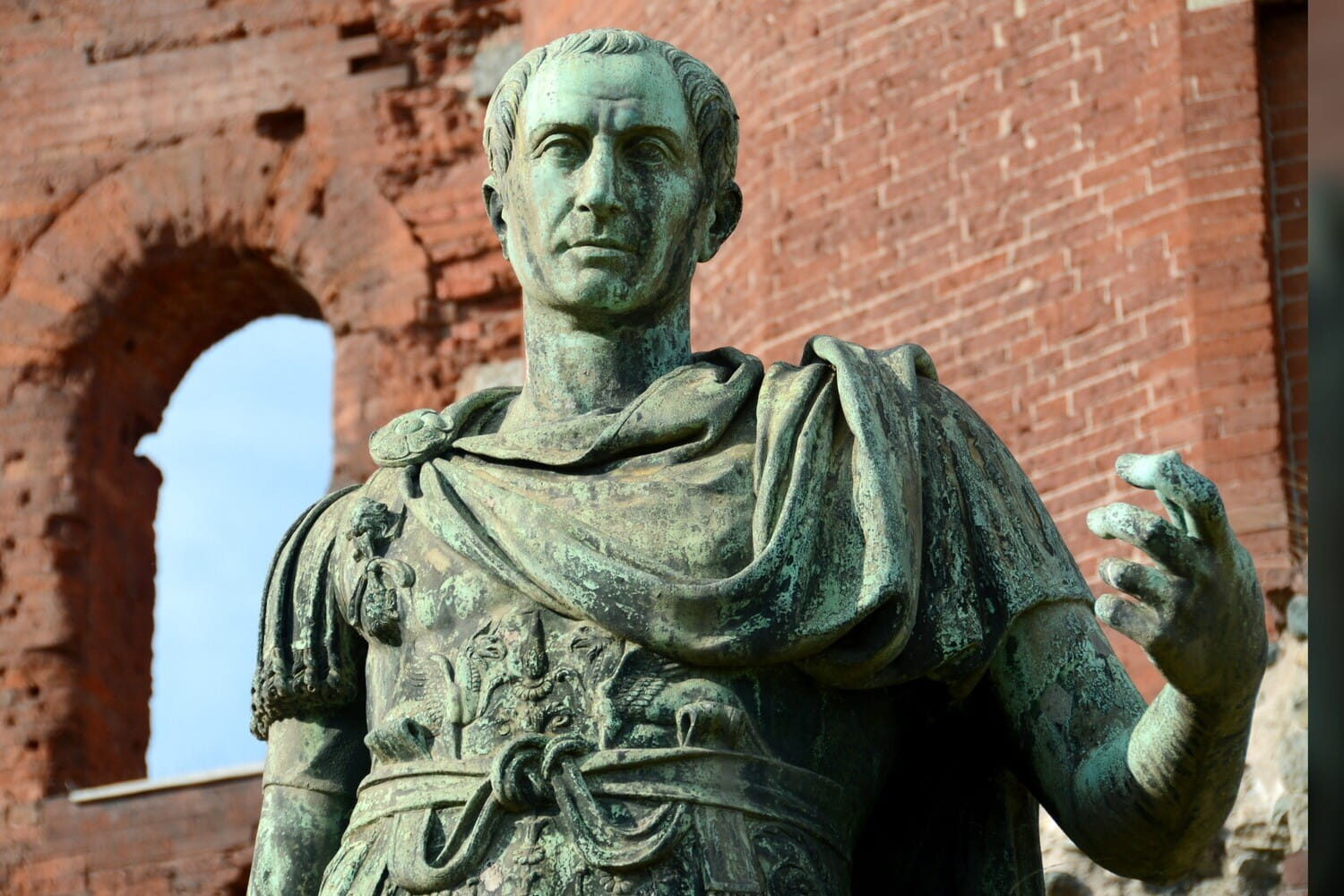
Gaius Julius Caesar remains one of the most influential figures in human history, whose name has become synonymous with power, military genius, and political mastery. Interesting facts about this outstanding Roman reveal not only his triumphs on battlefields and in the senate, but also unexpected details of his personal life that make his figure even more captivating. From the shores of the Rubicon to the streets of Rome, from Gallic forests to the deserts of Egypt, Caesar left an indelible mark on world history. You may not have known many details about the life of this legendary person that demonstrate his multifaceted nature as a commander, writer, reformer, and lover. Fascinating facts about Julius Caesar show how one person can change the course of history of an entire civilization.
- Julius Caesar was born on July 12 or 13, 100 BCE in a patrician family that traced its lineage to the legendary Trojan hero Aeneas and the goddess Venus. His full name was Gaius Julius Caesar, and he belonged to the patrician Julian clan, which was considered one of the oldest in Rome. Despite his noble origin, Caesar’s family was not excessively wealthy, which forced him from a young age to seek ways to elevate his status. It was precisely this combination of aristocratic lineage and relative poverty that shaped his ambitious character.
- In 75 BCE, Caesar was kidnapped by Cilician pirates who demanded a ransom of 20 talents of silver. When Caesar learned of the ransom amount, he laughed and declared that he was worth at least 50 talents, forcing the pirates to raise the ransom. During 38 days of captivity, he treated the pirates as subordinates, forcing them to listen to his poems and speeches, and when they did not applaud loudly enough, he jokingly threatened to crucify them. After his release, Caesar assembled a fleet, captured the pirates, and indeed ordered them all crucified, though out of mercy he first cut their throats.
- Caesar suffered from epilepsy, which in ancient times was considered a “sacred disease” and attributed to divine intervention. Historical sources record at least four epileptic seizures during his life, including one during the Battle of Thapsus in 46 BCE. Despite this ailment, Caesar managed to achieve incredible military and political successes, which testifies to his extraordinary willpower. Some researchers suggest that precisely the awareness of his own mortality due to illness made him even more determined in achieving his goals.
- Caesar’s Gallic campaign lasted from 58 to 50 BCE and led to the conquest of a vast territory that approximately corresponds to modern France, Belgium, parts of Switzerland, the Netherlands, and Germany. According to various estimates, about one million Gauls died during these wars, and another million were enslaved. Caesar personally wrote detailed “Commentaries on the Gallic War,” which became a classic of Latin literature and an important historical source. These conquests made Caesar extremely wealthy and popular among the Roman people, providing him with a political base for his future struggle for power.
- On January 10, 49 BCE, Caesar crossed the Rubicon River with his army, uttering the legendary phrase “Alea iacta est” (“The die is cast”). This crossing marked the beginning of civil war, since Roman law forbade commanders from entering Italy with legions. The Rubicon was a small river that served as the boundary between the province of Cisalpine Gaul and Italy proper. This act forever entered history as a symbol of crossing the point of no return, and the expression “crossing the Rubicon” is still used to denote a decisive step.
- Caesar had a passionate romance with Cleopatra VII, Queen of Egypt, who bore him a son named Caesarion around 47 BCE. When Caesar arrived in Egypt in 48 BCE pursuing Pompey, Cleopatra according to legend was delivered to him wrapped in a carpet or laundry sack. Their romance was not only a love affair but also a political alliance that strengthened the positions of both rulers. Caesar even brought Cleopatra to Rome, where she lived in his estate, which caused a scandal among the conservative Roman elite.
- In 46 BCE, Caesar carried out a calendar reform, introducing the Julian calendar, which was used in Europe until the 16th century. The old Roman calendar was lunar and had only 355 days, which led to constant confusion and the necessity of adding intercalary months. The Julian calendar was based on the solar cycle and had 365 days with an additional day every four years. Caesar also renamed the month Quintilis to Julius (July) in his own honor, and this name has survived to the present day.
- Caesar was not only a commander but also an outstanding orator and writer whose works were studied in Roman schools during his lifetime. Besides “Commentaries on the Gallic War,” he wrote “Commentaries on the Civil War” and other works, most of which have not survived. Cicero, the greatest Roman orator, highly valued Caesar’s literary talent, calling his style pure and elegant. Caesar also wrote a treatise on grammar titled “De Analogia,” dedicated to questions of correctness in the Latin language.
- Caesar’s baldness was a source of great insecurity for him, and he employed various measures to conceal it. He combed his hair forward from the back of his head, which became so characteristic of him that it entered history as the “Caesar haircut.” When the senate granted him the right to permanently wear a laurel wreath, Caesar was particularly pleased, as this gave him the perfect pretext to hide his baldness. His contemporaries sometimes mocked this weakness of his, which irritated the proud dictator.
- Caesar married three times during his life, and each marriage had significant political undertones. His first wife was Cornelia, daughter of Cinna, one of the leaders of the populares, with whom he had a daughter Julia. His second wife was Pompeia Sulla, granddaughter of the dictator Sulla, but Caesar divorced her due to a scandal with Publius Clodius with the words “Caesar’s wife must be above suspicion.” His third and final wife was Calpurnia, who remained with him until his death and, according to legend, had a prophetic dream about his assassination on the eve of the Ides of March.
- On March 15, 44 BCE, on the day known as the Ides of March, Caesar was murdered by conspirators at a senate meeting near Pompey’s Theater. About 60 senators participated in the conspiracy, including Marcus Junius Brutus and Gaius Cassius Longinus. Caesar received 23 stab wounds, though according to medical examination, only one of them was fatal. According to legend, Caesar’s last words to Brutus were “Et tu, Brute?” (“And you, Brutus?” or “Kai su, teknon?” in Greek), though the historical authenticity of this phrase is doubtful.
- Caesar was an outstanding military engineer and often personally directed the construction of bridges, fortifications, and siege structures. During the Gallic campaign, he ordered a bridge built across the Rhine in just ten days, which was an engineering marvel of that time. During the siege of Alesia in 52 BCE, the Romans built two lines of fortifications with a total length of about 40 kilometers. These fortification works demonstrated not only Caesar’s military genius but also his ability to organize and motivate tens of thousands of soldiers to carry out grandiose engineering projects.
- Caesar introduced numerous reforms in Rome, including redistribution of land for veterans, expansion of Roman citizenship, and reorganization of local government. He increased the number of senators from 600 to 900, including representatives of provinces and his supporters in the senate. Caesar also began large-scale construction projects, including a new forum, the Basilica Julia, and renovation of numerous temples. His social reforms included limiting luxury, regulating debts, and even an attempt to restrict the use of closed litters in Rome.
- Physically, Caesar was described as a tall, slender man with dark eyes and fair complexion. He was known for his physical endurance and often walked on foot at the head of his troops, covering enormous distances. Caesar could dictate letters to several scribes simultaneously, demonstrating extraordinary mental flexibility. He was also known for his clemency toward defeated enemies, which contrasted with the cruelty of many other Roman commanders and helped him win political supporters.
- The First Triumvirate, an informal political alliance between Caesar, Pompey, and Crassus, formed around 60 BCE, forever changed Roman politics. This alliance allowed the three most influential men in Rome to bypass traditional republican institutions and control the state. The alliance was sealed by a marriage between Pompey and Caesar’s daughter Julia, which demonstrated the importance of family connections in Roman politics. After the death of Crassus in 53 BCE and Julia in 54 BCE, the triumvirate collapsed, which led to civil war between Caesar and Pompey.
Incredible facts about Julius Caesar demonstrate how one person can embody a commander, politician, writer, reformer, and even lover, while remaining a deeply human personality with his own weaknesses and insecurities. His life became a model for countless rulers of subsequent epochs, and his name transformed into a title of power in many languages of the world. Fascinating details of Caesar’s biography remind us that even the greatest figures in history were living people with their dreams, fears, and ambitions. The legacy of Julius Caesar continues to influence the modern world through political institutions, the calendar, and cultural memory of the great Roman who changed the course of history.


