
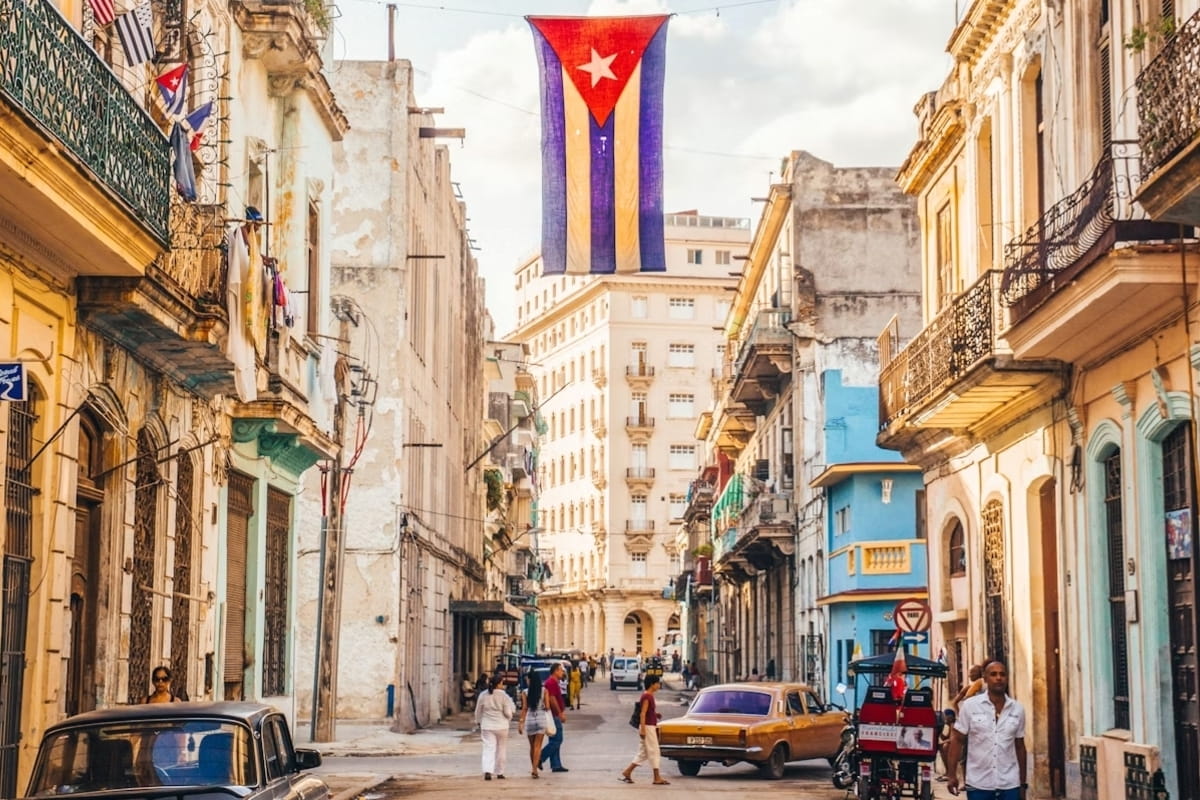
Cuba remains one of the most mysterious and distinctive countries of the Caribbean basin, where history, culture, and nature have intertwined into an unrepeatable kaleidoscope of impressions. Interesting facts about this island paradise reveal unexpected details about a land that gave the world fiery salsa, legendary cigars, and revolutionary spirit. From the colonial streets of Havana to the snow-white beaches of Varadero, from tobacco plantations to mountain ranges, Cuba amazes with its diversity and contrasts. You may not have known many fascinating details about this country that for decades lived by its own rules, preserving a unique identity. Incredible facts about Cuba demonstrate how an island nation can influence world culture, politics, and the imagination of millions of people around the globe.
- Cuba is the largest island in the Caribbean basin with an area of approximately 109,884 square kilometers, which makes it slightly smaller than England. The island has a characteristic elongated shape that is often compared to an alligator or crocodile, stretching from west to east for a distance of over 1,200 kilometers. Cuba is surrounded by more than 4,000 small islands and reefs that together with the main island form the Cuban archipelago. The country’s coastline extends for 5,746 kilometers and includes some of the world’s most beautiful beaches with white sand and crystal-clear water.
- Havana was founded by Spanish conquistadors in 1519 and became one of the most important ports of the New World for the Spanish colonial empire. The city served as a collection point for Spanish galleons that loaded gold, silver, and other treasures from America before returning to Europe. Today Old Havana is a UNESCO World Heritage Site and preserves hundreds of colonial buildings, fortresses, and squares in baroque and neoclassical styles. The streets of the old city resemble an open-air museum where time seems to have stopped in the mid-20th century with their American automobiles from the 1950s.
- Cuban cigars are considered the best in the world thanks to a unique combination of climate, soil, and centuries-old traditions of tobacco cultivation. The Vinales region in western Cuba, with its red soil and special microclimate, produces the highest quality tobacco for premium brands like Cohiba, Montecristo, and Romeo y Julieta. The process of making a Cuban cigar includes more than 200 stages of manual labor, from planting seeds to the final wrapping of leaves. Master torcedores learn their craft for years, and their work is valued as true art passed down from generation to generation.
- The Cuban Revolution of 1959 under the leadership of Fidel Castro and Ernesto Che Guevara forever changed not only the fate of the island but also the geopolitical balance in the Western Hemisphere. The revolutionaries overthrew dictator Fulgencio Batista and established a socialist regime that lasted under Castro’s leadership for over half a century. Cuba became the first socialist country in the Americas and one of the closest allies of the Soviet Union during the Cold War. The Cuban Missile Crisis of 1962, when Soviet nuclear missiles were placed in Cuba, brought the world to the brink of nuclear war and became one of the most dangerous moments in human history.
- The Cuban healthcare system is recognized as one of the best among developing countries, with free medical care for all citizens. Cuba has one of the highest rates of doctors per capita in the world, with approximately one doctor per 150 residents. The country sends thousands of medical workers abroad to provide assistance in disaster zones and poor countries, which has become an important part of Cuban foreign policy. Life expectancy in Cuba is about 79 years, which is comparable to many developed countries despite economic difficulties.
- Music and dance are an integral part of Cuban identity, and the country has given the world numerous musical genres and styles. Salsa, mambo, rumba, cha-cha-cha, and bolero originated or developed in Cuba, mixing African rhythms with Spanish melodies and European instruments. Buena Vista Social Club, the album and documentary film, introduced traditional Cuban music to a global audience in the 1990s and revived interest in classic Cuban melodies. Music education in Cuba is free and high-quality, producing talented musicians who perform on the world’s most prestigious stages.
- The US economic embargo against Cuba, imposed in 1960, is the longest trade embargo in modern history and has significantly affected the island’s economy. The blockade restricts trade between Cuba and the US, and also creates obstacles for trade with third countries through extraterritorial provisions of American legislation. According to estimates by the Cuban government, the embargo has caused the country’s economy losses totaling more than 130 billion dollars over the decades. Despite numerous UN General Assembly resolutions calling for the embargo’s lifting, it remains in force, although some restrictions were eased during Barack Obama’s presidency.
- The Vinales Valley, located in Pinar del Rio province, is famous for its unique limestone cliffs called mogotes that rise directly from the flat valley. These geological formations, remaining after erosion of an ancient plateau, create a surrealistic landscape that has existed for millions of years. The valley is a UNESCO World Heritage Site and preserves traditional agricultural methods, especially tobacco cultivation using oxen and manual labor. Numerous caves in the mogotes contain prehistoric drawings and stalactite formations, attracting speleologists and tourists from around the world.
- Cuban rum is one of the country’s most famous export products, and brands like Havana Club and Santiago de Cuba are known worldwide. The tradition of rum production in Cuba dates back to the 16th century when Spanish colonists began fermenting and distilling molasses from sugarcane. Cuban master distiller Fausto Rodriguez developed the modern method of producing light rum in the 19th century, which became the foundation for the Cuban style. Rum is the main ingredient in legendary Cuban cocktails like mojito, daiquiri, and cuba libre, which have become symbols of island culture.
- The Cuban education system provides free education at all levels, from elementary school to university, and the country has one of the highest literacy rates in the world at 99.8 percent. The revolutionary government made the elimination of illiteracy one of its priorities, and as early as 1961 a large-scale literacy campaign was conducted. Cuba produces more university graduates per capita than most Latin American countries, especially in the fields of medicine, engineering, and natural sciences. However, economic difficulties mean that many highly educated Cubans work in the tourism industry or seek opportunities abroad.
- The National Ballet of Cuba, founded by legendary ballerina Alicia Alonso in 1948, is considered one of the world’s most prestigious ballet companies. Alonso, who continued dancing until age 75 despite near-total blindness, created a unique Cuban ballet school combining classical technique with Latin American passion. The ballet school in Cuba accepts talented children from across the country and provides them with free world-class professional education. Cuban dancers perform in leading theaters worldwide and regularly win international competitions, maintaining the country’s reputation as a ballet superpower.
- Cuba had a unique dual currency system that existed from 1994 to 2021, when the population used Cuban pesos while tourists and certain economic sectors used convertible pesos. This system created a complex economic reality where prices for the same goods could differ by tens of times depending on the currency. In 2021 the government announced currency unification, abolishing convertible pesos and leaving only Cuban pesos, which became one of the largest economic reforms in recent decades. The unification process was accompanied by inflation and economic difficulties that millions of Cubans experienced.
- Cuba’s ecosystem is extraordinarily diverse and includes more than 6,000 plant species, half of which are endemic and found nowhere else in the world. The island is home to the world’s smallest bird, the bee hummingbird, which weighs less than two grams and is only 5-6 centimeters long. The Cuban crocodile, one of the rarest crocodile species, has survived only in Cuba in the swamps of the Zapata Peninsula. The country has created a system of national parks and biosphere reserves protecting unique ecosystems, including mangrove forests, coral reefs, and tropical rainforests.
- Baseball is the most popular sport in Cuba and is considered part of national identity, surpassing even soccer in popularity. The game was brought to the island in the 1860s by Cuban students studying in the US and quickly became a national passion. The Cuban national baseball team is one of the strongest in the world, having won numerous gold medals at Olympic Games and world championships. Many Cuban players have fled to the US to play in Major League Baseball, where they became stars and earn millions of dollars, which contrasts with their life in Cuba.
- Revolution Square in Havana is one of the largest squares in the world, capable of holding over a million people during political rallies and mass gatherings. The square features the iconic Jose Marti Memorial, Cuba’s national hero, in the form of a 109-meter tower shaped like a five-pointed star. Huge metal portraits of Che Guevara and Camilo Cienfuegos on the facades of government buildings have become some of Cuba’s most recognizable symbols. The square has been used for important state events, including Fidel Castro’s hours-long speeches and visits by foreign leaders such as the Pope.
Fascinating facts about Cuba demonstrate how a small island nation can have a disproportionate influence on world culture, politics, and the imagination of people on all continents. From revolutionary history to musical rhythms, from medical achievements to natural wonders, Cuba remains a land of contrasts and paradoxes where past and present coexist in unusual harmony. Incredible details about this Caribbean wonder remind us that even in the age of globalization it is possible to preserve a unique cultural identity and one’s own path of development. Cuba’s legacy continues to inspire, provoke discussions, and attract millions of visitors who seek to discover the magic of this special island.


