
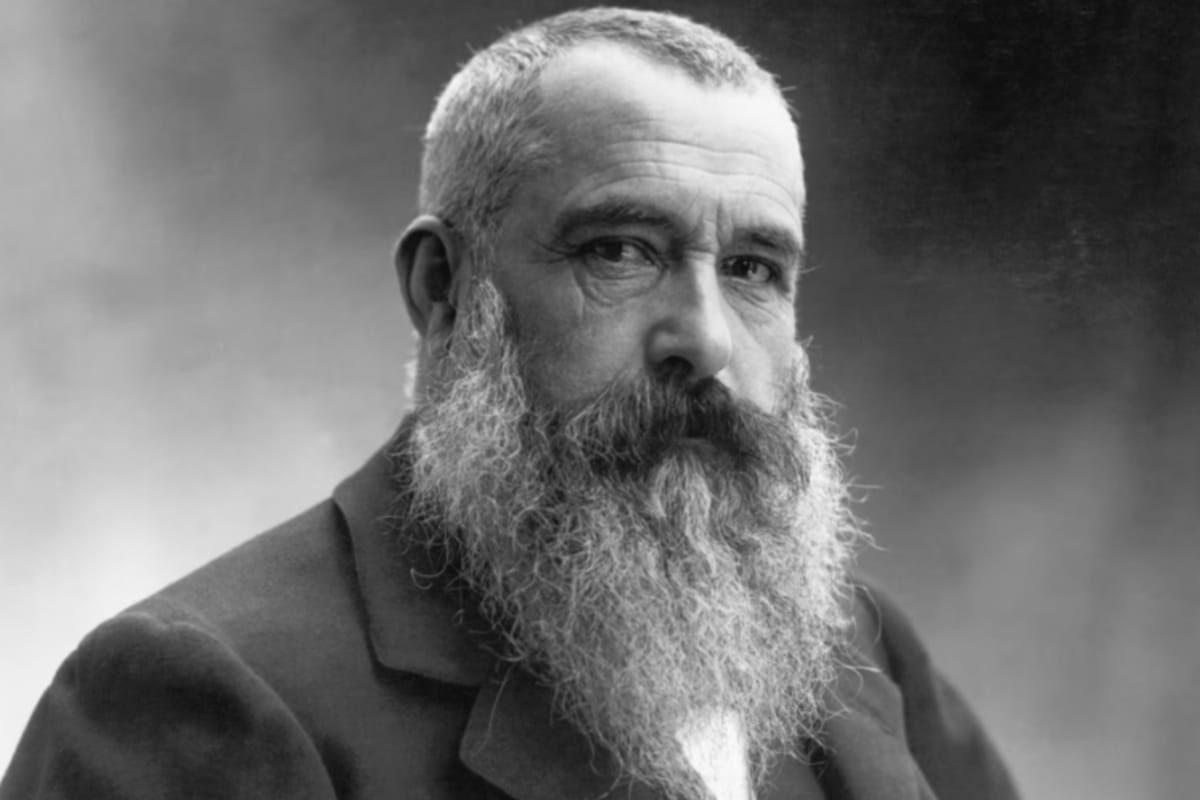
Claude Monet remains one of the most influential figures in the history of world art, and his name has become synonymous with Impressionism and a revolution in the perception of light and color. You may not know that this artist, whose works today sell for tens of millions of dollars, lived in poverty for many years and faced harsh criticism from official art institutions. These fascinating facts reveal not only a brilliant master of the brush, but also a man with a unique vision who transformed the very essence of painting. We will explore Monet’s life and work to uncover how he turned fleeting impressions of nature into timeless masterpieces. Prepare to learn about the artist’s remarkable journey from caricaturist to creator of one of the most famous gardens in France.
- Claude Monet was born on November 14, 1840, in Paris, but spent his childhood in the town of Le Havre on the Norman coast, where his father ran a grocery shop. From an early age he showed a talent for drawing, creating caricatures of well-known townspeople and selling them for a few francs. It was in Le Havre that he met the painter Eugène Boudin, who became his first mentor and encouraged him to paint outdoors rather than in a studio. This meeting fundamentally changed Monet’s life and laid the groundwork for the future of Impressionism.
- The artist’s full name was Oscar-Claude Monet, yet he always signed his works simply as Claude Monet, rejecting the name Oscar because of its association with the acting profession, which he did not respect. His father hoped his son would become a businessman and considered art a waste of time. For many years Monet depended financially on his mother, who supported his artistic ambitions despite her husband’s opposition. Only after her death in 1857 was Monet forced to rely entirely on himself in his struggle for recognition.
- The term Impressionism originated from Monet’s painting Impression, Sunrise, created in 1872 and shown at the first joint exhibition of the group in 1874. Critic Louis Leroy mocked the work in a newspaper review, coining the term impressionists as an insult for artists who painted impressions rather than detailed representations. Over time, the artists themselves adopted the term, and it became the name of an entire movement that changed the course of art history. The painting is now exhibited at the Musée Marmottan Monet in Paris.
- Monet was a pioneer of painting series in which he depicted the same subject at different times of day and under varying weather conditions to capture changes in light. His most famous series include Haystacks, Rouen Cathedral, the Houses of Parliament in London, and the Japanese Bridge in Giverny, each consisting of dozens of canvases. For the Rouen Cathedral series, Monet rented a room opposite the building and painted it over two years at different times and in different weather. This method allowed him to explore the fleeting nature of perception and show how light transforms even the most massive structures.
- In 1890, Monet purchased a house in the village of Giverny, about seventy kilometers from Paris, where he created a unique water garden specifically for his future paintings. He reshaped the land, imported exotic plants from around the world, and even obtained permission to divert water from the Epte River to create a pond filled with water lilies. In this garden he cultivated rare varieties of lilies from Egypt, Brazil, and other countries, which later became the central subjects of his late masterpieces. Today the garden is one of France’s most popular tourist destinations.
- Monet was married twice, and his first wife, Camille Doncieux, appeared in many of his early paintings, including the famous work The Walk. Camille died in 1879 from uterine cancer at the age of thirty-two, leaving Monet with two young sons. After her death, Monet created one of his most emotional works, portraying Camille on her deathbed, her face dissolving into a haze of blue-gray tones. His second wife was Alice Hoschedé, the widow of his friend and patron Ernest Hoschedé, with whom he lived until the end of his life.
- In old age, Monet suffered from cataracts, which severely impaired his vision and altered his perception of color, causing his paintings to become dominated by red and orange hues. Doctors advised surgery, but he hesitated for a long time, fearing he would lose the ability to paint. After undergoing surgery in 1923 at the age of eighty-three, Monet was able to see into the ultraviolet spectrum, which changed his approach to color. His final large canvases from the Water Lilies series, painted after the operation, are more abstract in nature and are often seen as precursors to abstract expressionism.
- Monet was a devoted admirer of Japanese culture and owned an impressive collection of ukiyo-e woodblock prints, which he collected throughout his life. He even built a Japanese bridge in his garden at Giverny, which became the subject of one of his most famous series of paintings. Japanese prints strongly influenced the composition of his works, particularly in their bold perspectives and use of empty space. Although Monet never visited Japan, he formed his own vision of the country through these prints, which he expressed in his garden and paintings.
- During the Franco-Prussian War of 1870–1871, Monet fled to London with his family, where he met the Impressionist painter Camille Pissarro and art dealer Paul Durand-Ruel, who became his most important patron. In London, Monet first encountered the works of Joseph Mallord William Turner, whose treatment of light and fog had a profound impact on his style. After returning to France, he settled in Argenteuil, where he created a series of paintings along the banks of the Seine. This period of exile proved to be a time of crucial artistic discovery.
- Monet was not only a painter but also a talented gardener who personally planned and maintained his garden in Giverny until the final days of his life. He corresponded with botanists around the world to learn the best methods for cultivating exotic plants and even designed his own irrigation system for the water garden. The garden was divided into two parts, a flower garden near the house and a water garden with lilies across the road, created specifically for painting. Monet once said that he became a gardener for the sake of painting and a painter for the sake of gardening.
- Monet created more than two hundred paintings featuring water lilies, which became his most famous series and occupied the last thirty years of his career. He built a large studio in Giverny with a north-facing window to provide sufficient light for working on massive canvases up to six meters long. In his final years, he worked on a cycle of monumental panels depicting water lilies, which he intended to donate to France as a symbol of reconciliation after the First World War. These works are now displayed in the Musée de l’Orangerie in Paris.
- Despite the fact that Monet’s paintings are among the most expensive in the world today, he often struggled financially during his lifetime and was forced to sell his works for very small sums. In the 1870s, his family frequently faced hunger, and his wife Camille suffered from illness due to poor nutrition and lack of medical care. Only in the 1890s, after the success of his exhibitions and the support of Durand-Ruel, did Monet’s financial situation improve enough for him to purchase the house in Giverny. It was only after his death in 1926 that the prices of his works began to rise dramatically.
- Monet was a close friend of many other Impressionists, especially Pierre-Auguste Renoir, with whom he often painted outdoors in his youth. Together with Renoir, Sisley, and Pissarro, he organized the first independent exhibition in 1874, which marked the birth of Impressionism as an artistic movement. Monet and Renoir frequently painted the same landscape while sitting side by side, yet their interpretations differed greatly, highlighting each artist’s individuality. Their friendship lasted for more than fifty years.
- In 1868, after the birth of his first son Jean and amid severe financial hardship, Monet fell into deep depression and even attempted to take his own life by throwing himself into the River Seine. He was rescued and supported financially by his friend and patron Ernest Hoschedé, which allowed him to continue his artistic work. This period became a turning point in Monet’s life, after which he developed greater resilience in the face of adversity. Ironically, some of his finest early works were created shortly after this crisis.
- Monet was among the first artists to actively use newly invented paint tubes, which allowed him to work outdoors without having to prepare paints on site. This technical innovation was crucial to the development of Impressionism, as it enabled artists to quickly capture fleeting changes of light and color in nature. Monet often painted in challenging weather conditions, sometimes even sitting in a boat on the water with his palette in hand to find the perfect angle for reflections. His commitment to plein air painting transformed the very concept of art, moving it out of dark studios and into open air.
- In the final years of his life, Monet devoted himself to creating large panels of water lilies, which he intended to give to France as a symbol of peace after the First World War. He continued working on these canvases even as his eyesight deteriorated, converting part of his home into a special studio with large windows. Monet died on December 5, 1926, at the age of eighty-six and was buried in Giverny at the local cemetery near his first wife Camille. According to his will, his house, garden, and several paintings were transferred to the state, while the monumental water lily panels were installed in the Orangerie in Paris, where they remain today.
- Monet had four sons, two biological sons, Jean and Michel, from his marriage to Camille, and two stepsons from his second marriage to Alice Hoschedé. His son Jean also became a painter, though he never achieved the fame of his father, while Michel later became the head of the Claude Monet Foundation and helped preserve his father’s legacy. Despite his intense creative work, Monet was a caring father and often portrayed his children in his paintings, especially in his early period. His painting Jean Monet on a Hobby Horse is considered one of the most famous depictions of children in art history.
- Monet’s house and gardens in Giverny were restored and opened to the public in 1980 thanks to the efforts of the Claude Monet Foundation under the leadership of his son Michel. The gardens were recreated based on Monet’s own sketches and period photographs to reflect as accurately as possible what the artist saw while creating his masterpieces. Today the site is one of the most visited museum complexes in France, welcoming over a million visitors each year. Visitors can explore both the water garden with lilies and the artist’s home with its personal belongings and collection of Japanese prints.
These facts only partially reveal the multifaceted personality of Claude Monet, who was not only a genius painter but also a passionate gardener, a loyal friend, and a perceptive observer of nature and light. His life demonstrates how creative dedication can transform ordinary subjects into endless sources of inspiration. The story of Impressionism shows how a term born as an insult became the name of one of the most influential movements in the history of art. Monet’s legacy reminds us that true art has the power to turn fleeting impressions into enduring masterpieces that continue to speak to us across generations.


