
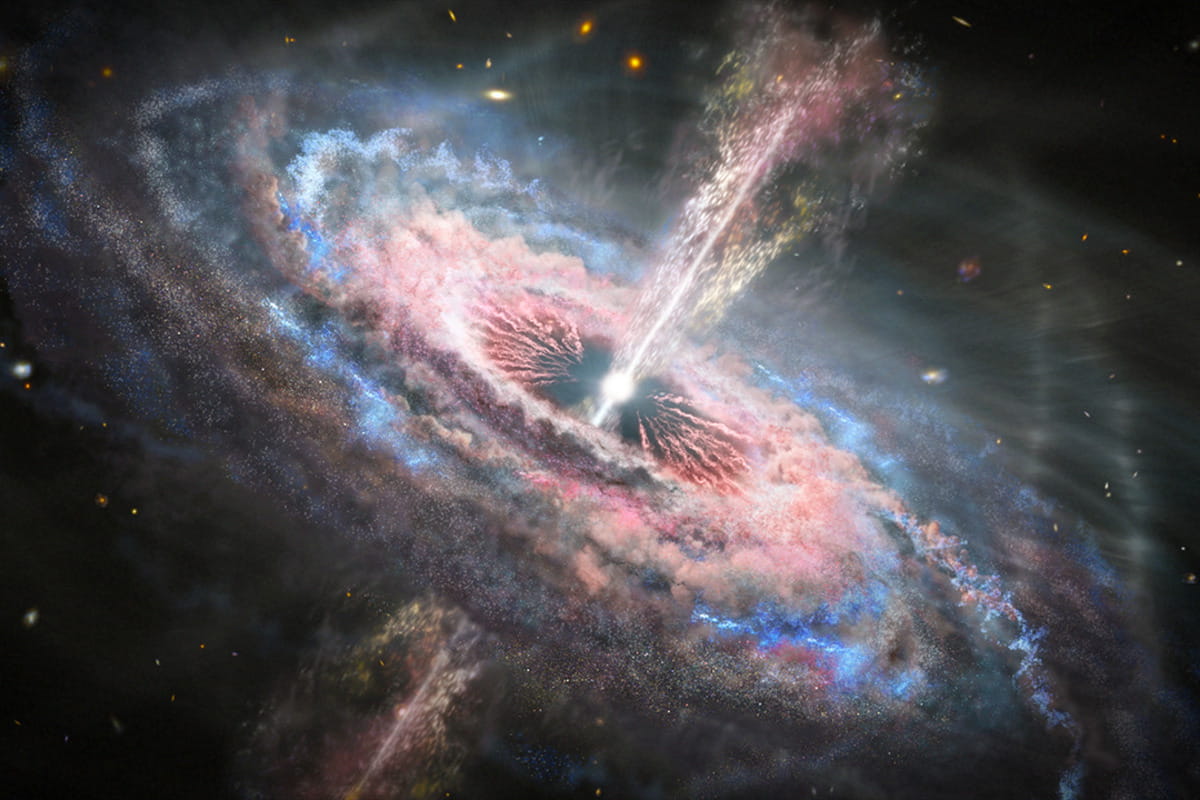
Quasars rank among the most mysterious and powerful objects in the universe, captivating astronomers with their staggering energy output and mind-boggling distances from Earth. You may not have known that these tiny starlike points of light visible in telescopes are actually the blazing cores of incredibly distant galaxies, outshining entire stellar systems containing hundreds of billions of stars. Fascinating facts about quasars reveal a cosmic realm dominated by supermassive black holes devouring matter and creating the brightest persistent beacons across the vast expanse of space. These incredible facts about cosmic giants help us understand how they shaped the early universe and how modern astronomy harnesses them as unique tools for exploring cosmic history.
- Quasars stand as the brightest persistent objects in the entire universe capable of outshining entire galaxies that contain hundreds of billions of stars combined. This extraordinary luminosity stems from supermassive black holes residing at galactic centers actively consuming surrounding matter at prodigious rates. As material spirals toward the black hole it forms an intensely heated accretion disk that converts gravitational energy into radiation with remarkable efficiency far surpassing nuclear fusion processes.
- The term quasar originated as shorthand for quasi-stellar radio source because these objects initially appeared starlike in photographs yet emitted peculiar radio signals that defied conventional explanation. Astronomer Martin Schmidt identified the first quasar 3C 273 in 1963 when he recognized its enormous redshift indicating extreme cosmic distance rather than nearby stellar nature. This breakthrough revelation transformed our understanding of the universe revealing that some pointlike objects actually resided billions of light years away.
- Quasars inhabit such tremendous distances that their light requires billions of years to reach Earth allowing us to observe them as they existed during the universe’s youth. Most quasars flourished when the cosmos was merely one to five billion years old making them invaluable cosmic fossils that illuminate early galactic evolution. Modern observatories detect quasars with redshifts exceeding seven corresponding to distances beyond thirteen billion light years approaching the dawn of cosmic time.
- Quasar energy originates from supermassive black holes with masses ranging from millions to tens of billions times that of our Sun anchored at galactic centers. When gas dust and stars venture too close they become trapped in the black hole’s gravitational grip forming a swirling accretion disk heated to millions of degrees by friction and compression. This process converts up to ten percent of infalling mass into pure energy through Einstein’s mass energy equivalence far more efficient than stellar nuclear fusion.
- Many quasars launch powerful relativistic jets streams of charged particles accelerated to velocities approaching light speed through complex magnetic interactions. These jets form when the black hole’s rotation twists magnetic fields threading the accretion disk channeling energy along the rotational axis. Some jets extend millions of light years into intergalactic space creating spectacular radio structures visible across cosmic distances.
- The nearest quasar to Earth 3C 273 resides approximately two billion light years away in the constellation Virgo yet remains visible through modest amateur telescopes. Despite its immense distance this object shines with an apparent magnitude around thirteen making it accessible to dedicated backyard observers with appropriate equipment. Remarkably this single quasar radiates thousands of times more energy than our entire Milky Way galaxy while occupying a region no larger than our solar system.
- Quasars serve as brilliant cosmic lighthouses enabling astronomers to probe the intergalactic medium through which their light travels across billions of years. As quasar radiation passes through diffuse gas clouds it imprints absorption lines in the spectrum revealing chemical composition density and motion of intervening material. This technique has mapped the cosmic web the universe’s large scale structure of galaxy clusters filaments and voids.
- Some quasars exhibit dramatic brightness variations occurring within hours or even minutes demonstrating the compact nature of their energy source. Such rapid fluctuations constrain the emitting region’s size since light cannot coordinate changes across distances greater than light travel time permits. These observations confirm that quasar power originates within a volume comparable to our solar system despite outshining entire galaxies.
- Quasars were considerably more abundant in the early universe when galaxies contained abundant gas reservoirs to fuel black hole growth through accretion. Over cosmic time these fuel supplies diminished while galaxy mergers that triggered quasar activity became less frequent in the expanding universe. Consequently most modern galaxies including our Milky Way harbor dormant supermassive black holes that could reignite given fresh material inflow.
- Quasars emit energy across the entire electromagnetic spectrum from long wavelength radio waves to short wavelength gamma rays revealing different physical processes at work. Radio emissions typically trace synchrotron radiation from relativistic jets while X-rays originate in the hottest inner disk regions and corona surrounding the black hole. Multiwavelength observations provide comprehensive views of these complex astrophysical engines.
- Certain quasars host supermassive black holes exceeding ten billion solar masses challenging theories about rapid formation mechanisms in the early universe. Astrophysicists propose these behemoths may have formed through direct collapse of primordial gas clouds bypassing normal star formation stages entirely. Alternative models suggest rapid growth via frequent mergers in dense early galactic nuclei where black holes could accumulate mass efficiently.
- Quasars influence their host galaxy evolution through energetic feedback processes where radiation and jets heat or expel gas reservoirs essential for star formation. This self regulation can effectively shut down stellar birth transforming galaxies from blue star forming spirals into red passive ellipticals. Such feedback mechanisms explain observed correlations between black hole mass and galactic bulge properties.
- Quasar observations provided crucial evidence for dark matter through gravitational lensing phenomena where foreground mass bends light from distant sources. When quasar light passes near massive galaxy clusters it creates multiple images distorted arcs or complete Einstein rings depending on alignment geometry. Analyzing these lensing patterns allows precise mapping of invisible dark matter distributions.
- Quasars function as natural laboratories for testing general relativity under extreme gravitational conditions near event horizons. Observations of orbiting stars and gas clouds around supermassive black holes confirm Einstein’s predictions about spacetime curvature and relativistic effects. Additionally quasar spectra enable investigations into potential variations of fundamental constants across cosmic time.
- Periodic brightness oscillations in some quasars suggest the presence of binary supermassive black hole systems orbiting common centers of mass. These pairs form when galaxies merge bringing their central black holes into close proximity where gravitational wave emission gradually shrinks their orbits. Detecting such systems helps predict gravitational wave backgrounds detectable by future space based observatories.
- Quasars contributed indirectly to the discovery of cosmic acceleration though this breakthrough came primarily from Type Ia supernova studies. Nevertheless quasars serve as standardizable candles at extreme distances helping calibrate the cosmic distance ladder beyond supernova ranges. Recent research employs quasars to independently verify dark energy parameters governing the universe’s accelerating expansion.
- Measurements of accretion disk rotation in certain quasars indicate their central black holes spin near maximum theoretical rates permitted by general relativity. This rapid rotation enhances energy extraction efficiency through the Penrose process and influences jet formation geometry and power. Spin measurements provide crucial insights into black hole growth histories dominated by coherent accretion versus random mergers.
- Quasars represent transient phenomena existing only during active feeding phases when sufficient matter flows toward the central black hole. Once available fuel depletes these brilliant beacons fade leaving dormant black holes that may reactivate during future galaxy collisions or gas inflow events. This cyclical nature explains why most nearby galaxies host quiescent nuclei despite containing massive black holes.
- X-ray observations of quasars revealed extremely hot coronal gas surrounding accretion disks with temperatures reaching billions of degrees Kelvin. This corona generates hard X-rays through inverse Compton scattering where disk photons gain energy from collisions with relativistic electrons. Studying coronal properties provides vital clues about energy transport mechanisms in extreme gravitational environments.
- Quasars illuminate cosmic chemical evolution as their spectra contain absorption signatures from heavy elements present in early galactic environments. Spectral analysis shows metals existed in quasar environments within a billion years after the Big Bang products of the universe’s first stellar generations. This rapid enrichment demonstrates efficient dispersal of nucleosynthetic products through supernova explosions and galactic winds.
Quasars remain indispensable cosmic probes illuminating fundamental processes from structure formation to gravity’s nature under extreme conditions. Incredible facts about these luminous beacons confirm that even the universe’s most remote realms hold keys to understanding physical laws governing our existence. Interesting facts about quasars remind us of cosmic grandeur and humanity’s capacity to decipher light that has journeyed across spacetime since the universe’s infancy. Fascinating discoveries involving these brilliant objects will continue shaping our comprehension of cosmic evolution and our place within the magnificent unfolding story of the cosmos.


