
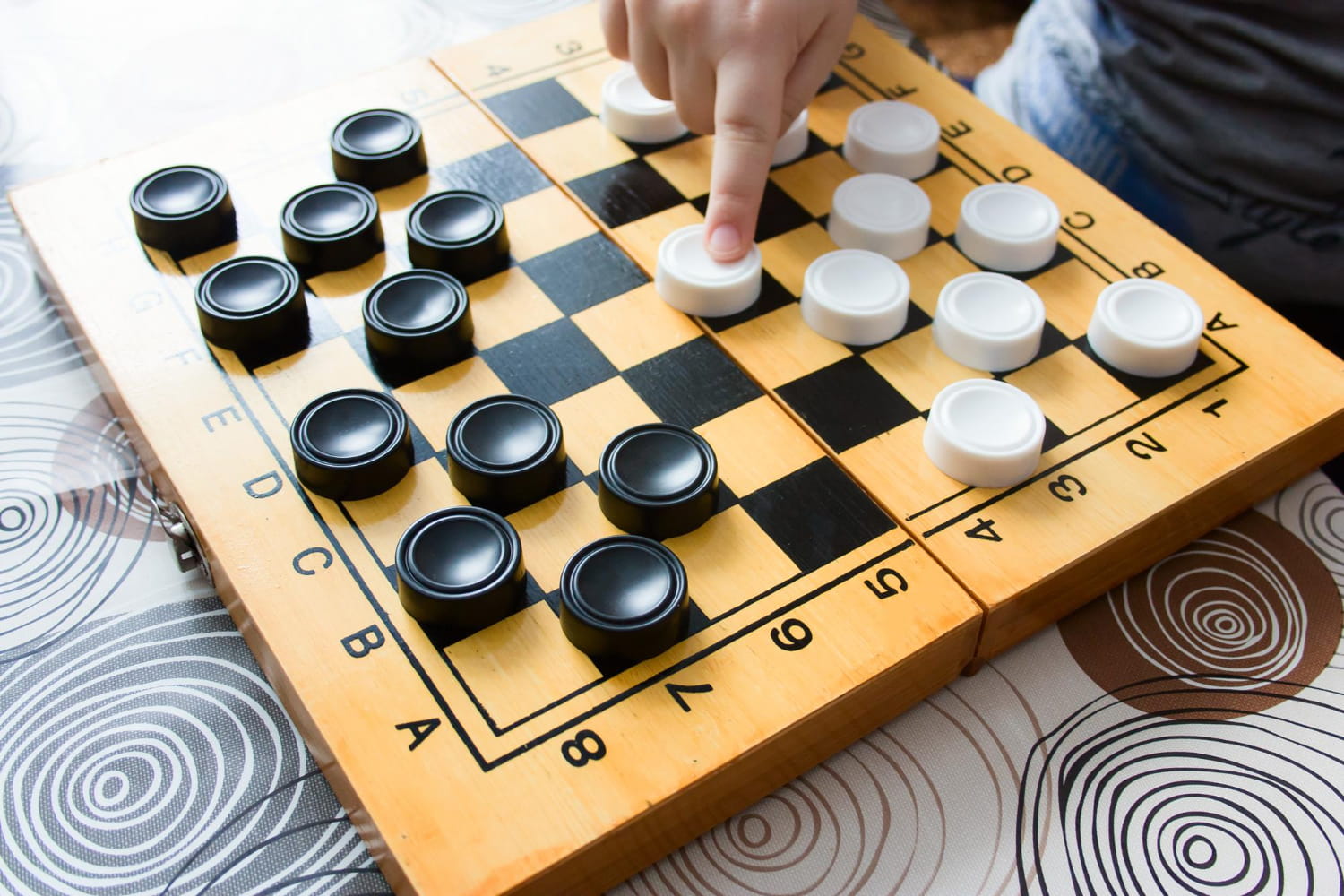
Checkers stands among the world’s oldest board games, captivating people of all ages and social backgrounds for thousands of years. At first glance the game appears simple, yet behind its concise rules lies profound strategic complexity capable of surprising even seasoned players. You may not have known that checkers possesses a rich history intertwined with culture, mathematics, and even modern technology. These fascinating details will help you view the familiar black and white squares and pieces with fresh eyes, revealing the countless secrets hidden beneath apparent simplicity.
- Checkers originated more than five thousand years ago in Mesopotamia, as confirmed by archaeological discoveries of ancient game boards. Early versions of the game were considerably simpler than modern rules, yet they already served as entertainment for people across different social strata. Over time the game spread to Ancient Egypt, where archaeologists found checker-like boards in pharaohs’ tombs alongside everyday objects. This ancient heritage makes checkers one of the oldest games to survive into our era with its fundamental concept largely unchanged.
- In Ancient Rome checkers enjoyed such immense popularity that Emperor Caligula ordered the destruction of all game boards following a series of personal defeats. Romans played a variant called latrunculi which featured its own distinctive rules and strategic approaches. Archaeologists have uncovered numerous examples of Roman game boards carved directly into stone streets and public forums. This prohibition only underscores how passionately Romans embraced this intellectual pastime.
- The first official book containing checkers rules was published in France in 1757, marking a crucial step toward standardizing the game internationally. Before this publication rules existed solely through oral tradition and varied significantly between regions, complicating international competition. French masters played a pivotal role in shaping modern international draughts rules now used across most countries worldwide. This publication initiated the systematic organization of checker theory and strategy.
- A checkerboard always contains sixty-four squares but only thirty-two are actively used during play because pieces move exclusively on the dark squares. This characteristic makes each square strategically unique depending on its position across the board. Corner squares are considered most secure while central squares offer greater maneuvering possibilities. This geometric arrangement creates a complex system of piece interaction demanding deep positional understanding from players.
- Checkers features more than five hundred billion possible positions, making the game extraordinarily difficult for even modern computers to analyze completely. This number exceeds the quantity of stars in our Milky Way galaxy, demonstrating the game’s incredible strategic depth. Only in 2007 did researchers fully solve checkers, proving that with perfect play from both sides every game must end in a draw. This breakthrough represented a genuine milestone in game theory and artificial intelligence research.
- The first world championship in checkers took place in 1840 in England with Scotsman Andrew Anderson claiming victory. This event launched the formation of an international checker community and regular professional competitions. Since then world championships have occurred consistently with the title representing the highest achievement in a player’s career. Modern championships gather the strongest competitors from dozens of nations, showcasing the game’s global appeal.
- Russia and the Netherlands stand as world leaders in both the number of professional players and national-level development of the game. In these countries checkers functions not merely as recreation but as a full-fledged sport with government support and sophisticated training systems. Many world champions originate from these nations confirming their dominance on the international stage. School curricula in these countries often include checkers as a subject for developing logical thinking abilities.
- Checkers features the concept of a king which forms when an ordinary piece reaches the opponent’s back row. A king gains the ability to move any distance along diagonals making it significantly more powerful than a regular piece. This transformation frequently becomes the turning point in a match altering the balance of power between competitors. Strategically advancing pieces to king status while preventing the opponent from doing the same represents a fundamental element of masterful play.
- Checkers became the first board game completely solved by computer in 2007 through the work of Canadian scientist Jonathan Schaeffer. His program Chinook analyzed nearly forty trillion positions over eighteen years of development. This scientific achievement proved that perfect play by both sides inevitably results in a draw. Such a breakthrough opened new horizons for artificial intelligence research into complex games.
- Several African nations maintain unique checker variants differing in piece count, board size, and special capturing rules. For instance in Ghanaian versions pieces may jump over friendly checkers adding extra dynamism to gameplay. These regional adaptations survived through oral tradition and remain popular in rural communities today. They demonstrate how a single game concept can adapt to diverse cultural contexts while preserving its essential character.
- The longest officially recorded checker match lasted over twenty-four hours of continuous play between two masters in the Netherlands during the 1980s. Both players avoided mistakes that would have concluded the game prematurely displaying remarkable endurance and concentration. Such extended matches are virtually impossible today due to time controls implemented in official tournaments. This record remains testament to the extraordinary depth of human strategic thinking.
- Educators actively employ checkers to develop logical reasoning, attention span, and the ability to plan several moves ahead in young children. Research indicates regular checker play improves students academic performance particularly in mathematics and other quantitative subjects. Many psychologists recommend checkers as preventive exercise against cognitive decline in older age. This simple game serves as a powerful tool for maintaining brain activity throughout life.
- Medieval European churches frequently banned checkers due to the game’s association with gambling and the wagers players made during matches. Despite ecclesiastical prohibitions the game continued spreading across all social classes including clergy members. Historical documents confirm some monks secretly played checkers within their monastery cells. This history reveals the game’s powerful attraction even during eras of strict moral regulation.
- Modern checker tournaments commonly use the Berger system guaranteeing each participant plays every other competitor alternately with light and dark pieces. This arrangement ensures maximum fairness since piece color can influence strategic options during play. Tournament boards are crafted from special woods providing ideal surface smoothness for rapid piece movement. Professional pieces often feature slight indentations for secure handling during quick moves.
- Japan maintains its own strategic board game called shogi which blends elements of chess and traditional checkers with unique promotion rules. This game holds deep cultural roots in Japan and ranks among the country’s most intellectually demanding competitive activities. Although shogi differs significantly from Western checkers it demonstrates the universal appeal of strategic gameplay on a gridded board. Japanese shogi masters command considerable public respect.
- Ukrainian player Sergey Belov became the youngest world champion in checkers history claiming the title at merely eighteen years of age. His achievement created a sensation in the checker community heralding a new era of youthful talent in the sport. Belov demonstrated exceptional ability memorizing complex opening variations and tactical combinations. His success inspired countless young people worldwide to pursue checkers professionally.
- Checkers encompasses more than three hundred officially registered openings each with its own name and characteristic strategic concepts. Among the most famous are the Classical, Petrov, and Exchange openings studied even by beginners. Experienced players can recall dozens of opening variations along with their numerous sub-variations. Opening knowledge provides crucial advantage during initial game stages helping players avoid common tactical pitfalls.
- Checkers gained inclusion in the first World Mind Sports Games highlighting its status as a legitimate competitive discipline. This milestone represented important progress toward recognition by international sports organizations alongside chess and Go. Participation in such events enables players to earn official titles and accumulate rating points. This development encourages wider youth participation and attracts emerging talent to the game.
- Some Asian countries play traditional checkers on boards featuring one hundred squares instead of the standard sixty-four substantially increasing complexity. This variant known as international draughts serves as an official discipline in world championships. The larger board permits more intricate strategic combinations and extends average game duration. Many players consider this version more dynamic and engaging than traditional sixty-four square checkers.
- The first computer program designed to play checkers emerged in the 1950s making it among the earliest games adapted for electronic computation. Though primitive by contemporary standards this program paved the way for artificial intelligence development in gaming applications. Modern checker programs effortlessly defeat world champions analyzing millions of positions each second. This technological evolution established foundations for algorithms now applied across numerous scientific fields.
Checkers remains a remarkably vibrant intellectual sport seamlessly blending ancient tradition with contemporary innovation. These extraordinary facts remind us that even seemingly simple pursuits can conceal boundless depths worthy of exploration. The captivating details surrounding checkers affirm that strategic games have always formed an essential thread in humanity’s cultural fabric fostering mental development and meaningful connection across generations.


