
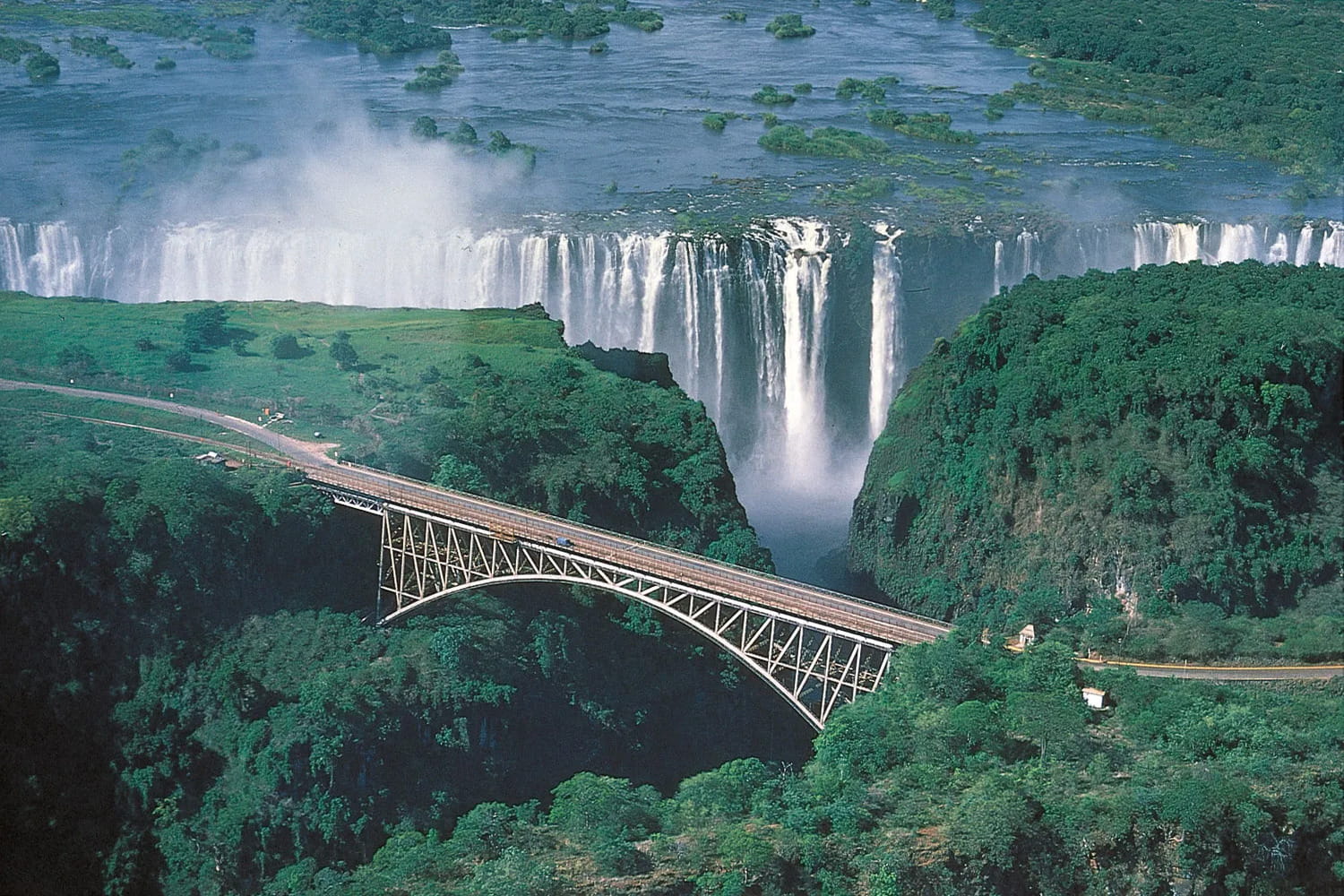
Victoria Falls is one of the most impressive natural wonders of the planet, located on the border between Zambia and Zimbabwe in the heart of Africa. This grandiose creation of nature impresses with its scale, beauty, and power, attracting millions of tourists from around the world who strive to see this unparalleled spectacle with their own eyes. Behind the majesty of the water curtain and the roar of falling water lies a multitude of incredible facts revealing the uniqueness of this natural phenomenon. You may not have known about the amazing features of the waterfall, its impact on the ecosystem, the history of its discovery, and cultural significance for local peoples. We invite you to discover fascinating facts about Victoria Falls that demonstrate why this wonder of nature deserves the status of one of the world’s most outstanding waterfalls.
- Victoria Falls was named by Scottish explorer David Livingstone in honor of Queen Victoria in 1855. Livingstone became the first European to see the waterfall, although local inhabitants had known about its existence for thousands of years. The indigenous Kololo and Lozi peoples called the waterfall Mosi-oa-Tunya, which translates as The Smoke That Thunders or Thundering Smoke. This name reflects the enormous roar and clouds of water mist rising above the waterfall and visible from a distance of over 20 kilometers.
- Victoria Falls is considered the largest in the world by area of continuous water curtain, although it is not the tallest or widest separately. Its width is approximately 1,708 meters, and its height reaches 108 meters at the highest point. The combination of width and height creates a water wall with an area of over 1.7 million square meters during peak flow. This makes Victoria the largest continuous water curtain on the planet, surpassing both Niagara Falls and Iguazu by this measure.
- The volume of water falling through Victoria Falls varies dramatically depending on the rainy season and drought. During the rainy season from February to May, up to 500 million liters of water per minute can pass through the waterfall. In the dry season from September to December, the flow can decrease to 10 million liters per minute, allowing one to see rocks and gorges usually hidden under water. During extreme drought, some sections of the waterfall can completely dry up, revealing impressive geological formations.
- Victoria Falls creates a constant cloud of water mist rising to a height of up to 400 meters above the waterfall. This mist is visible from a distance of up to 30 kilometers, creating an impressive spectacle of a pillar of white smoke above the savanna. The constant moisture from the mist has created a unique rainforest ecosystem directly at the waterfall, sharply contrasting with the surrounding savanna. In this humid environment, rare plant species thrive that are not found anywhere else in the region.
- The basalt rocks through which the water falls were formed as a result of volcanic activity approximately 200 million years ago. The waterfall itself began forming about 2 million years ago when the Zambezi River found a weak spot in the basalt rocks. Over millennia, water gradually eroded softer rocks, creating a series of eight gorges, each representing the previous position of the waterfall. Geologists believe the waterfall continues to slowly retreat upstream at a rate of approximately one meter per 10,000 years.
- Lunar rainbows regularly form above Victoria Falls, which can be observed during a full moon. This rare natural phenomenon occurs when moonlight refracts in drops of water mist the same way sunlight creates ordinary rainbows. Lunar rainbows typically appear whitish to the human eye due to limited color sensitivity in darkness, but in long-exposure photographs their true colors are revealed. The best time to observe this phenomenon falls during a full moon when water levels are high.
- Mosi-oa-Tunya National Park in Zambia and Victoria Falls National Park in Zimbabwe together form a UNESCO World Heritage Site since 1989. These parks protect not only the waterfall itself but also surrounding ecosystems with diverse flora and fauna. The park territories are home to elephants, buffalo, giraffes, zebras, and numerous antelope species. The river and surroundings are home to hippopotamuses and Nile crocodiles, as well as over 400 bird species, making this region a paradise for ornithologists.
- Devil’s Pool is a natural pool on the very edge of the waterfall where daring swimmers can bathe during the dry season. This pool is formed by a natural rock barrier that prevents swimmers from being pushed over the waterfall edge by the water current. Swimming in Devil’s Pool is possible only from September to December when the water level is low enough that the current is not too strong. Despite relative safety, this remains an extreme activity as swimmers are literally on the edge of a 108-meter-deep precipice.
- The first bridge across Victoria Gorge was built in 1905 and is still used for railway and automobile traffic. The bridge is located approximately 250 meters below the waterfall and connects Zambia and Zimbabwe. The bridge construction was designed so that trains crossing it would be enveloped in mist from the waterfall. Today the bridge is also used for bungee jumping from a height of 111 meters above the Zambezi River, which is considered one of the highest commercial jumps in the world.
- Research shows that Victoria Falls has important significance for the local climate and weather conditions in the region. Constant evaporation of enormous amounts of water affects air humidity and precipitation within a radius of several dozen kilometers. The microclimate around the waterfall maintains unique ecosystems, including an evergreen rainforest existing thanks to constant irrigation by mist. Some scientists believe that climate change and droughts may affect water flow and ecosystems around the waterfall in the future.
- Below Victoria Falls lies a series of narrow gorges through which water flows with tremendous force after falling. Batoka Gorge, which begins immediately after the waterfall, stretches for 120 kilometers and forms some of the most extreme rapids for rafting in the world. The rapids are classified from category V to VI difficulty, making them accessible only to experienced rafters. Some rapids have names like Bone Crusher, Washing Machine, and Terminator, which reflects their dangerous nature.
- Archaeological findings in the Victoria Falls area testify to human presence in this region for at least 3 million years. Ancient stone tools and rock paintings demonstrate that the waterfall had cultural and spiritual significance for the ancestors of modern African peoples. Local tribes considered the waterfall a sacred place and conducted religious ceremonies and rituals there. Legends tell of spirits living in the mist and of sacrifices made to appease these spirits before important events.
- Tourism to Victoria Falls began developing in the late 19th century after railway construction. The first hotels and tourist infrastructure appeared in the early 20th century when British colonial administrators began promoting the waterfall as a tourist attraction. Today the waterfall is visited by over a million tourists annually, making it one of the most popular tourist destinations in Africa. Tourism is the main source of income for local communities on both sides of the border.
- Victoria Falls can be viewed from several viewing points, each offering a unique perspective. On the Zimbabwe side there are 16 official viewing platforms allowing one to see most of the waterfall from a distance. The Zambian side offers closer contact with water and more dramatic views, especially on Livingstone Island. A helicopter flight over the waterfall remains the most popular way to see the entire majesty of the water curtain from the air.
- Flora around Victoria Falls includes over 500 plant species, many of which are rare and endemic. The rainforest maintained by constant mist contains huge fig trees, date palms, and ferns. Some plants grow directly on wet rocks near the waterfall, having adapted to constant irrigation. Botanists continue discovering new plant species in this unique ecosystem, which emphasizes the biological richness of the region.
- Victoria Falls generates constant roar that can be heard from a distance of up to 40 kilometers under favorable weather conditions. The noise level directly at the waterfall can exceed 110 decibels, equivalent to the sound of a rock concert. Local residents claim they can determine the water level in the river by the loudness of the waterfall’s roar. Some animals use the waterfall sound for orientation in the surrounding area.
- The hydroelectric potential of Victoria Falls is used in a limited way due to its World Heritage Site status. Although hydroelectric power plant construction projects have been repeatedly considered, environmental concerns and international pressure have prevented large-scale development. A small hydroelectric station was built downstream in Batoka Gorge, but it has minimal impact on the waterfall itself. Debates about the balance between energy needs and nature conservation continue.
- Victoria Falls experiences threats from climate change, excessive tourism, and infrastructure development in the region. Prolonged droughts in recent years have led to record low water levels, causing concern about the waterfall’s future. Conservation efforts include limiting development on the Zambezi River banks and implementing sustainable tourism practices. International organizations work with local governments to ensure protection of this natural wonder for future generations.
Incredible facts about Victoria Falls demonstrate that this natural wonder is not just an impressive spectacle but a complex ecosystem with deep cultural history and important significance for the region. From geological processes lasting millions of years to modern conservation challenges, the waterfall continues to amaze, inspire, and remind us of the power and beauty of the natural world. Interesting facts about Mosi-oa-Tunya emphasize the importance of protecting such unique places for future generations so they too can experience the majesty of this African treasure. Now, having learned about the fascinating features of Victoria Falls, you can more deeply appreciate its uniqueness and understand why this place truly deserves the title of one of the greatest natural wonders of the world.


