
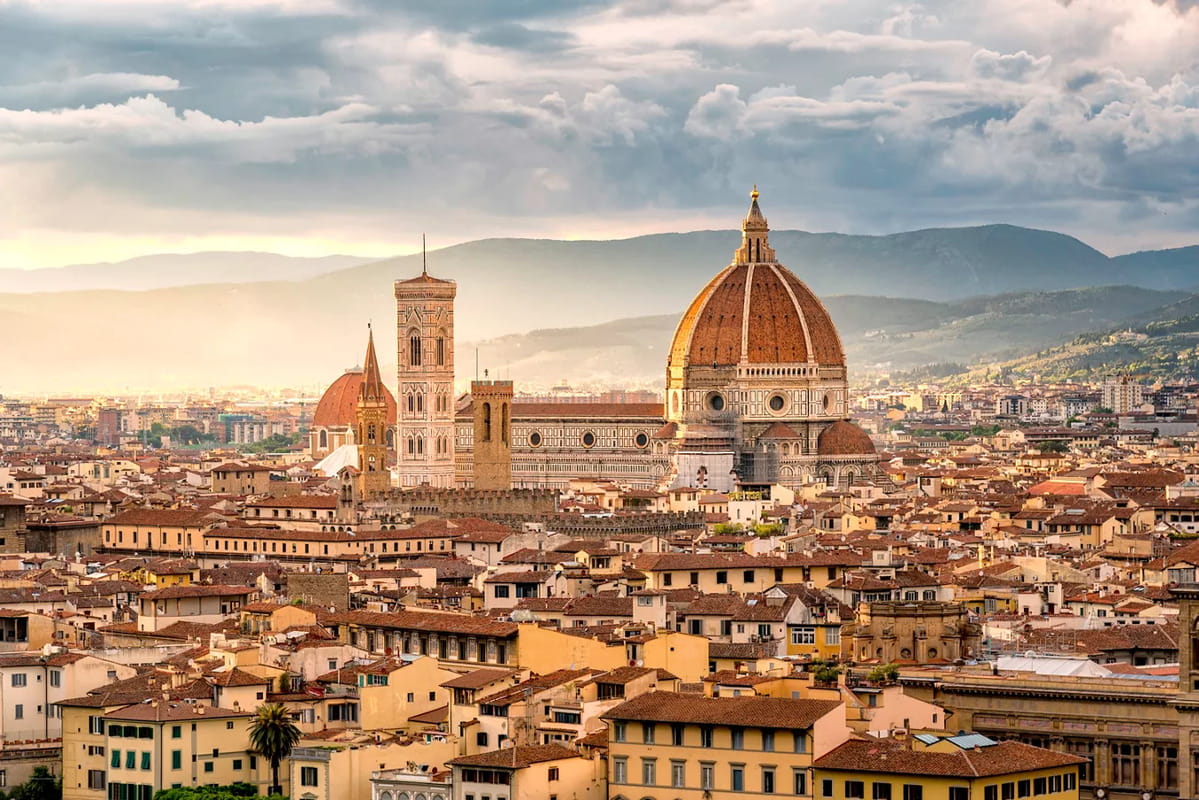
Florence is a city where every street tells the story of the Renaissance, and every corner preserves masterpieces created by the geniuses of human civilization. You may not know that this relatively small Italian city with a population of fewer than half a million people has produced more works of art than many European capitals combined. Fascinating facts about Florence reveal the cradle of the Renaissance, where the Medici ruled not by the sword but through money and art, transforming the city into a true paradise for artists and thinkers. Interesting facts about this Italian jewel help explain why ideas that changed the world forever were born именно here.
- Florence was the first city in the world where a modern banking system emerged, thanks to the Medici family, who as early as the fifteenth century created a network of banking branches across Europe. The Medici invented the system of double-entry bookkeeping, which made it possible to accurately track financial transactions and became the foundation of modern accounting. It was precisely due to the financial power of the Medici that the city turned into a center of art where masters received commissions without limitations.
- Michelangelo’s sculpture David was originally installed in Piazza della Signoria rather than in a museum and was regarded as a symbol of Florence’s republican freedom in opposition to tyranny. The original was carved from a single block of marble that other artists considered unsuitable because of cracks and defects. Today, the original is preserved in the Accademia Gallery, while an exact copy stands in the square and attracts millions of tourists every year.
- Florence Cathedral, Santa Maria del Fiore, possesses the largest brick dome in the world, designed by Filippo Brunelleschi, who invented a unique construction technology that made it possible to build without scaffolding. Brunelleschi kept his method secret and even used specially designed bricks of his own creation to prevent imitation. The construction of the dome lasted sixteen years and became a symbol of the engineering genius of the Renaissance.
- Florence is home to the oldest pharmacy in the world, Farmacia di Santa Maria Novella, which has been operating continuously since 1221 and originally belonged to a Dominican monastery. The monks produced perfumes, medicines, and cosmetic products from medicinal plants grown in the monastery garden. Today, this pharmacy sells the same recipes that were used in the Middle Ages, including the famous Water of the Queen of Hungary.
- Palazzo Vecchio was designed as a fortress with thick walls and a tower ninety-five meters high, intended to protect against internal unrest rather than external enemies. Beneath the palace are secret passages that rulers used to escape during uprisings, some of which were discovered only in the twentieth century. The most famous secret passage leads from the study of Cosimo I de’ Medici to Palazzo Pitti through the Vasari Corridor, which is one kilometer long.
- The Uffizi Gallery is one of the oldest museums in the world, founded in 1581 as a private collection of the Medici family for storing their artistic treasures. The building was originally intended to house government offices, which is why the name uffizi means offices in Italian. Only in 1765 was the collection opened to the public, after the last representative of the Medici family bequeathed it to the city on the condition that it would never leave Florence.
- The Ponte Vecchio is the only bridge in Florence that survived the Second World War, because the Germans received an order from Hitler himself not to destroy it due to its historical value. The bridge is home to jewelry workshops that have operated there since the sixteenth century, after Duke Ferdinando I de’ Medici relocated them from Piazza della Signoria. Originally, the bridge housed butcher and fishmongers’ shops, but they were expelled because of the unpleasant smell.
- Florence was the capital of Italy for six years, from 1865 to 1871, before the government moved to Rome after its capture. During this short period, the city underwent large-scale urban reconstruction, including the demolition of medieval walls and the creation of new boulevards. It was at this time that Piazza della Repubblica was built on the site of the old Jewish ghetto that had existed since the fourteenth century.
- Florence is home to one of the oldest pharmacies in the world producing perfumery, Farmacia degli Innocenti, founded in 1250 at an orphanage. The nuns of this institution created perfumes from local flowers and herbs to finance their charitable activities. Today, this pharmacy continues to produce perfumes according to medieval recipes, including the famous Florentine Lily fragrance.
- The sculpture Perseus with the Head of Medusa by Benvenuto Cellini was created under unusual conditions, as the master used all available bells in the city, including church bells, to cast the bronze. During the casting process, an accident occurred and the molten bronze nearly lost the required temperature, at which point Cellini ordered all the wooden furniture in the workshop to be thrown into the furnace. The result was a masterpiece that today adorns the Loggia dei Lanzi in Piazza della Signoria.
- Florence is considered the birthplace of opera, because it was here in 1598 that the first opera in history, Dafne by Jacopo Peri, was staged. The performance took place at the Palazzo Corsini with the support of the Florentine Camerata, a group of intellectuals who sought to revive ancient Greek theater. Although the score of Dafne has been lost, this production is regarded as the birth of the operatic genre.
- Florence has a unique tradition of handmade paper production that has been preserved for more than six hundred years and passed down from generation to generation. Craftsmen use ancient techniques, including filtering the paper pulp through bamboo screens and drying it on marble slabs. The most famous paper mill, Magnani, located near Pian di Ripoli, produces paper for the Vatican and European royal families.
- Palazzo Pitti, built for the banker Luca Pitti, was so enormous that it was never completed during the patron’s lifetime due to financial difficulties. Later, the palace was purchased by the Medici family and expanded to its present size, becoming the largest residence in Florence. Today, the palace houses several museums, including the Palatine Gallery, where masterpieces by Raphael, Titian, and Rubens are preserved.
- Florence is the only city in the world that has a museum dedicated exclusively to a single artist, the Leonardo da Vinci Museum, where copies of his inventions created from original sketches are displayed. The museum features working models of a tank, a helicopter, and a submarine that Leonardo conceived as early as the fifteenth century. These inventions demonstrate the genius of a master who was centuries ahead of his time.
- Florence is home to the oldest botanical garden in the world, the Orto Botanico, founded in 1545 by order of Cosimo I de’ Medici for the study of medicinal plants. The garden was originally circular in shape, symbolizing the Universe, and was divided into four sectors corresponding to the four elements. Today, more than six thousand plant species grow there, including rare specimens brought from all over the world during the time of the Medici.
- The Florentine style of preparing the bistecca alla fiorentina steak involves grilling it over wood fire to the al sangue state, meaning rare on the inside, which is considered the traditional method. This steak is always made from the local Chianina breed of cattle, renowned for its tenderness and flavor. A true Florentine steak must weigh at least one kilogram and be served for two people with only salt and olive oil, without any sauces.
- Florence has a unique tradition of leather craftsmanship that has existed since the Middle Ages, when the city was a center of the tanning trade. Artisans use only natural materials and manual labor, without the use of modern chemical agents. The most famous workshops are located on Via del Corso, some of which have been operating continuously for more than two hundred years.
- Florence is considered the birthplace of the Italian language, because the works of Dante Alighieri written in the Florentine dialect became the foundation of the modern literary Italian language. Before Dante, Italian existed only in the form of regional dialects, and his Divine Comedy united them into a single literary language. Today, Florence is home to the Accademia della Crusca, which is responsible for preserving the purity of the Italian language.
- Florence is home to the oldest scientific museum in the world, the Museo Galileo, which houses original instruments of the great astronomer, including his telescopes. Among the exhibits is Galileo’s finger, which was removed during the reburial of his remains in 1737 and placed in a special casket. This museum became the first in the world dedicated to the history of science as early as 1930.
- Florence possesses a unique system of underground tunnels and catacombs built by the Romans and used for centuries for various purposes, including storage and secret passages. Some of these tunnels were discovered only recently during construction work and contain artifacts dating back to the Etruscan period. The most famous underground passage, the Vasari Corridor, connects Palazzo Vecchio with Palazzo Pitti and runs above the Ponte Vecchio.
Florence remains a living museum where past and present coexist in remarkable harmony, creating a unique atmosphere of inspiration. Remarkable facts about this Italian city demonstrate that true wealth lies not in material treasures, but in spiritual heritage passed down from generation to generation. Interesting facts about Florence remind us that art and culture are indestructible values capable of surviving any historical trials. Fascinating discoveries about this city will continue to inspire travelers to seek beauty and depth in every corner of this cradle of human genius.


