
Basilisks have captivated human imagination for centuries as some of the most enigmatic creatures in both mythology and natural history. You might not have known that this single name bridges two completely different realities—the legendary serpent of medieval folklore and the remarkable real-life lizard inhabiting American rainforests. Fascinating facts about basilisks reveal not only ancient tales of serpents with deadly gazes but also the astonishing biological adaptations of living animals that truly walk on water. Today we embark on a journey from ancient myths to modern scientific discovery to understand how one name came to represent such dramatically different phenomena. Prepare to discover incredible details that will transform your understanding of these mysterious beings.
- The mythological basilisk in European medieval tradition was depicted as a royal serpent possessing a gaze so lethal it could kill or petrify anyone who met its eyes. Often described as having a serpent’s body crowned with a regal diadem symbolizing its status as king of serpents, this creature occupied a unique place in folklore. Legends claimed the basilisk hatched from a chicken’s egg incubated by a toad or serpent, a bizarre origin that endowed it with supernatural properties. This fearsome image spread widely through the writings of ancient authors like Pliny the Elder and became a staple of medieval bestiaries that shaped European imagination for centuries.
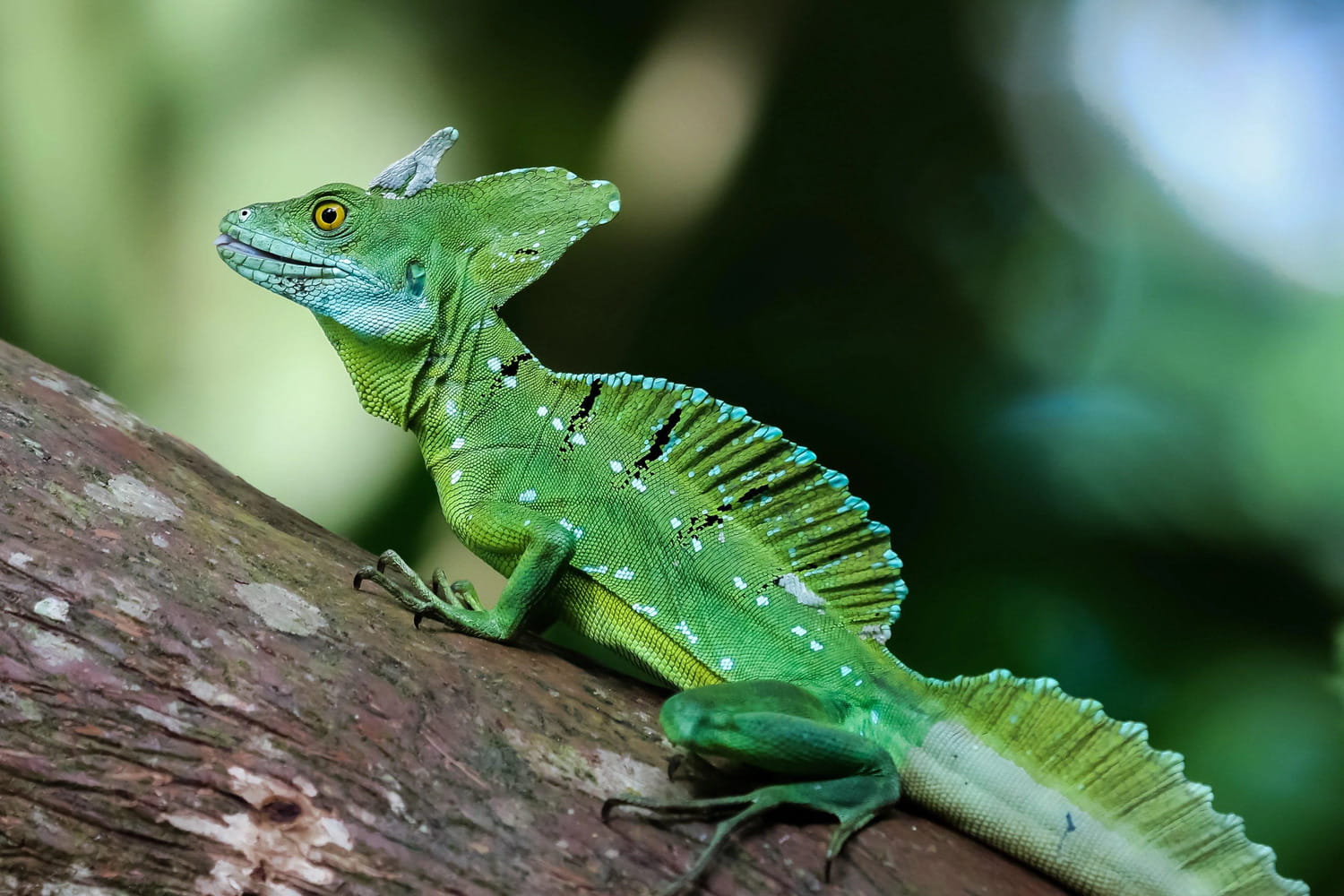
- Real basilisks belong to the genus Basiliscus within the iguana family and inhabit humid tropical forests from Mexico through Central America to Colombia. The most famous species is the common basilisk also known as the Jesus Christ lizard due to its extraordinary ability to run across water surfaces. These lizards display vibrant green coloration with prominent crests along their heads, backs, and tails that are especially pronounced in males during mating displays. They are diurnal creatures spending considerable time in trees near water sources where they hunt insects and escape predators.
- The most remarkable ability of basilisk lizards is their capacity to run bipedally across water surfaces for distances up to twenty meters without sinking. This phenomenon occurs through specialized foot structure where flaps of skin along their elongated toes unfurl upon striking the water, creating temporary air pockets that provide support. The lizard must maintain speeds exceeding fifteen kilometers per hour during this sprint to generate sufficient force against the water’s surface tension. Once fatigue sets in and speed decreases, the basilisk seamlessly transitions to swimming using all four limbs while remaining remarkably agile.
- Medieval Europeans considered the basilisk so dangerous that specialized methods for its destruction were detailed in numerous scholarly treatises and folklore collections. The most widespread legend maintained that a mirror could defeat the basilisk by causing it to perish from its own reflection’s deadly gaze. Other traditions claimed a rooster’s crow could kill the creature or that mongooses served as its natural predators immune to its venom. These beliefs frequently intertwined with Christian symbolism where the basilisk represented Satan himself and its defeat symbolized divine triumph over evil forces.
- Adult common basilisks reach lengths of up to eighty centimeters including their elongated tails which constitute approximately two-thirds of their total body length. Males significantly exceed females in size and display more prominent cranial crests used during courtship rituals and territorial displays. Their coloration ranges from brilliant emerald green to olive tones with the capacity for subtle hue shifts depending on mood, temperature, and ambient light conditions. Juveniles often exhibit lighter spotting or striping patterns that gradually disappear as they mature into adulthood.
- In ancient Greek mythology the basilisk or basiliskos was regarded as the serpent king bearing symbolic connections to power and dominion. The name derives from the Greek word basileus meaning king with the diminutive suffix iskos creating the meaning little king. Ancient Greeks believed the basilisk could kill other serpents with its mere breath while its venom proved so potent it could poison the earth over which it crawled. These concepts transferred into Roman culture and subsequently spread throughout Europe via natural history texts that influenced medieval thought.
- Basilisks are omnivorous feeders consuming insects, spiders, small worms, crustaceans, and occasionally small vertebrates including frogs, other lizards, and tiny mammals. Juveniles primarily subsist on insects while adults develop hunting strategies for larger prey using ambush tactics combined with bursts of remarkable speed. Interestingly these lizards occasionally supplement their diet with plant matter particularly fruits and flowers which enhances their adaptability to seasonal resource fluctuations. Their hunting occurs predominantly during daylight hours when they actively search for prey on forest floors or within tree canopies.
- Medieval bestiaries frequently illustrated the basilisk as a hybrid creature with a rooster’s head and forelimbs attached to a serpent or dragon’s body reflecting the synthesis of multiple legendary traditions. This composite image merged beliefs about the basilisk’s origin from a chicken-hatched egg with its serpentine nature as a monstrous entity. Such depictions often included symbolic elements like crowns or fiery breath to emphasize the creature’s supernatural essence and royal status among monsters. These artistic representations profoundly influenced European visual culture appearing in church architecture, illuminated manuscripts, and heraldic devices for centuries.
- Basilisks spend considerable portions of their lives in trees where they rest, hide from predators, and hunt canopy-dwelling insects. Their elongated digits equipped with sharp claws provide excellent grip for navigating branches while their bipedal running capability enables rapid movement between trees. When threatened these lizards will leap from branches directly into water below where they employ their water-running ability as an escape mechanism. This behavioral versatility makes basilisks among the most agile and adaptable inhabitants of neotropical rainforest ecosystems.
- Within medieval Christian symbolism the basilisk transformed into a personification of original sin and diabolical temptation frequently depicted locked in combat with the unicorn representing Christ. These allegorical representations circulated through religious sermons and illustrated manuscripts making the basilisk a familiar symbol across social strata. Sometimes the creature appeared vanquished by Saint George or other saints emphasizing faith’s victory over demonic forces. Such symbolic interpretations substantially elevated the basilisk’s mythological status within European cultural consciousness beyond mere monster lore.
- Basilisk reproduction occurs during rainy seasons when females excavate burrows in moist soil near water bodies to deposit clutches of fourteen to eighteen eggs. Incubation requires approximately sixty days after which fully independent hatchlings emerge measuring eight to ten centimeters in length. Fascinatingly the sex of developing embryos depends on incubation temperature with warmer conditions favoring female development in a phenomenon known as temperature-dependent sex determination. Juveniles reach sexual maturity within ten to twelve months while wild individuals typically survive four to five years in their natural habitats.
- Ancient Romans regarded the basilisk as so venomous that its mere presence could spoil food in vessels or poison well water through its gaze alone. Pliny the Elder in his Natural History described the basilisk as a serpent no longer than twelve inches yet possessing lethal potency beyond its modest size. He claimed the mongoose represented the sole creature capable of confronting the basilisk successfully owing to its immunity against venomous bites. These classical descriptions profoundly shaped European perceptions of the basilisk throughout subsequent millennia influencing both folklore and scholarly discourse.
- Basilisks possess remarkable chromatophore cells in their skin enabling rapid color shifts that facilitate camouflage across diverse environments from brilliant green in forest canopies to darker olive tones near water surfaces. This adaptive coloration occurs through expansion or contraction of specialized pigment-containing cells responding to environmental stimuli. Emotional states also trigger color changes particularly during stress responses or courtship behaviors when males display intensified hues to attract females or intimidate rivals. This physiological capability makes basilisks masters of visual deception complicating detection by both predators and researchers studying wild populations.
- In European alchemical tradition the basilisk became a powerful symbol of transmutation and spiritual transformation often associated with the creation of the philosopher’s stone. Alchemists believed the basilisk’s venom possessed unique properties that could facilitate metallic transmutation or contribute to formulating the elixir of life. Certain esoteric texts described rituals employing basilisk imagery to achieve spiritual awakening or mystical enlightenment. These mystical interpretations persisted until the Enlightenment era when empirical scientific approaches gradually displaced mythological frameworks in natural philosophy.
- Basilisks demonstrate surprising social complexity forming small groups particularly during breeding seasons or when resources become concentrated in specific areas. Males establish dominance hierarchies through visual displays including crest erection and ritualized body movements rather than physical combat which they generally avoid due to injury risks. These lizards communicate through subtle body language and color changes conveying information about territorial boundaries threat levels or reproductive readiness. Such sophisticated nonverbal communication enhances group coordination while minimizing energy expenditure on unnecessary conflicts.
- Literature features basilisks across numerous works from medieval epics to contemporary fantasy with the most famous modern example appearing in J.K. Rowling’s Harry Potter and the Chamber of Secrets. Rowling crafted her own interpretation of the mythological monster presenting the basilisk as a gigantic serpent with a lethal gaze that aligned with many traditional conceptions. This portrayal revitalized popular interest in basilisks particularly among younger generations introducing the creature to millions unfamiliar with historical folklore. Literary basilisks often diverge from historical descriptions incorporating creative elements to enhance dramatic impact while maintaining core mythological associations.
- Basilisks play ecologically significant roles in tropical forest ecosystems by regulating populations of insects and small vertebrates. As mid-level predators they help maintain balance within biological communities preventing pest species from achieving destructive population densities. Simultaneously they serve as prey for larger predators including snakes birds of prey and small mammals creating important energy transfer pathways within food webs. Conservation of basilisk populations functions as a valuable indicator of tropical ecosystem health given their sensitivity to habitat degradation and environmental pollution.
- Traditional medicine practices in certain Latin American regions historically utilized basilisk body parts in preparations intended to treat various ailments though scientific validation for these applications remains absent. Local healers believed lizard fat or bones possessed therapeutic properties particularly for rheumatism or dermatological conditions. Modern scientific investigation has not confirmed medicinal efficacy while wildlife conservation ethics discourage harvesting wild animals for unproven remedies. Contemporary legal protections now safeguard basilisk populations across much of their natural range recognizing their ecological importance and vulnerability to habitat loss.
- Basilisks exhibit extraordinarily rapid reflex responses enabling evasion of threats within milliseconds of detection. Their vision is highly adapted for diurnal hunting with exceptional motion detection capabilities across considerable distances. Though lacking mammalian auditory sophistication their sensory systems detect low-frequency vibrations warning of approaching predators through substrate transmission. This multisensory awareness creates a vigilant rainforest inhabitant rarely caught unprepared by danger making basilisks challenging subjects for field observation despite their relatively common occurrence.
- Contemporary popular culture frequently blends mythological basilisk characteristics with real lizard traits creating hybrid interpretations across video games films and graphic novels. These modern portrayals often depict basilisks as gigantic serpents or lizards possessing supernatural abilities that diverge significantly from historical sources. While such creative liberties sometimes distort original mythological and biological facts they maintain public fascination with the creature across generations. The enduring appeal of basilisks demonstrates humanity’s persistent attraction to mysterious beings that straddle boundaries between reality and imagination.
These captivating facts illustrate how mythological imagination and biological reality can coexist around a single name creating a multifaceted cultural phenomenon. From medieval legends of death-dealing serpents to modern scientific studies of water-walking lizards this dual-natured creature remains a powerful symbol of human curiosity and our drive to comprehend the extraordinary. The basilisk’s remarkable history reminds us of the importance distinguishing myth from reality while appreciating how nature often surpasses our most imaginative fantasies with genuine wonders. Exploring basilisks in all their manifestations continues offering a fascinating journey through time culture and scientific discovery revealing profound connections between ancient storytelling and contemporary natural history.


