
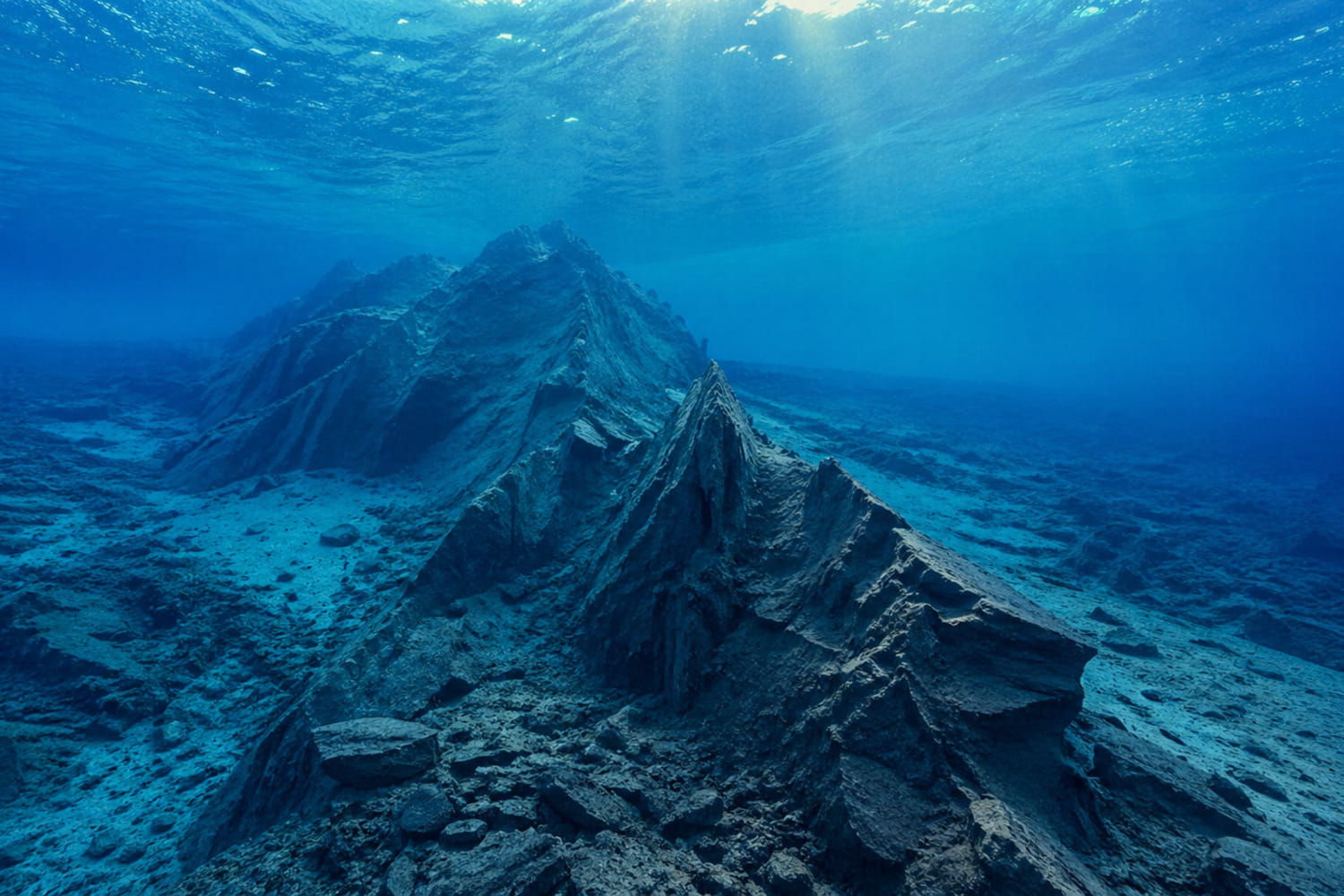
Underwater ridges, these grandiose mountain systems hidden beneath the thickness of oceanic waters, amaze with their scale and geological activity that you might not know about until today. These unique natural formations play a key role in forming the Earth’s crust and supporting marine ecosystems. Amazing facts about underwater ridges reveal the secrets of their origin, influence on climate, and significance for scientific research. Fascinating facts will help you understand why these underwater structures remain an object of close attention for geologists and oceanographers. Interesting facts compiled below will be useful for both enthusiasts of natural sciences and those who seek to learn more about the depths of our planet.
- Underwater ridges form the longest mountain system on Earth, extending more than sixty-five thousand kilometers through all oceanic basins. This global network exceeds in length any terrestrial mountain chains and covers approximately one third of the seafloor. It arises at locations where tectonic plates diverge, where magma rises from the mantle and creates new oceanic crust. This continuous process of Earth’s surface formation has been continuing for millions of years.
- Mid-ocean ridges are characterized by the presence of a central rift valley where direct seafloor spreading occurs. In this depression, magmatic material flows onto the surface, cools, and forms new rocks of basaltic composition. The rate of plate divergence can vary from one to twenty centimeters per year depending on the specific section of the ridge. Such geological processes directly influence the formation of oceanic relief.
- Hydrothermal vents, known as black and white smokers, are often found along underwater ridges and release hot mineralized solutions. These unique formations support ecosystems that exist through chemosynthesis rather than photosynthesis, like most life on Earth. Organisms inhabiting near such vents have adapted to extreme temperatures and high pressure of the deep-sea environment. Studying these communities helps scientists understand possible forms of life on other planets.
- Underwater ridges play a decisive role in plate tectonics theory since it is precisely here that new oceanic crust is formed. The discovery of these structures in the mid-twentieth century became key evidence for the hypothesis of seafloor spreading. The age of oceanic rocks increases with distance from the ridge axis, confirming the constant renewal of Earth’s surface. This process is compensated by subduction of old crust in plate convergence zones.
- Iceland is a unique example of an underwater ridge that has emerged onto the ocean surface thanks to the combination of tectonic activity and a mantle hot spot. This island is located directly on the Mid-Atlantic Ridge, where the Eurasian and North American plates are diverging. Visitors can observe geological processes that are usually hidden underwater, including volcanism and geothermal activity. Such location makes Iceland a natural laboratory for studying underwater ridges.
- Mineral deposits forming around hydrothermal vents of underwater ridges contain valuable metals such as copper, zinc, gold, and silver. These sulfide deposits form as a result of chemical reactions between hot solutions and cold seawater. Industrial extraction of such resources is considered promising but raises concerns about impact on fragile deep-sea ecosystems. International organizations are working on regulating activities in these sensitive areas.
- Underwater ridges influence global circulation of oceanic waters, creating barriers for deep currents and promoting vertical mixing. This process has important significance for distribution of heat, nutrients, and oxygen in the world ocean. Changes in ridge configuration over geological time could have influenced planetary climate conditions. Understanding these interactions helps model future climate scenarios.
- Seismic activity along underwater ridges usually manifests as numerous shallow earthquakes of moderate magnitude. These tremors are associated with faults forming during tectonic plate divergence and underwater volcanic eruptions. Although most such earthquakes do not pose a threat to human settlements, they provide valuable information about Earth’s internal structure. Monitoring this activity helps scientists better understand crustal dynamics.
- Underwater ridges serve as habitat for diverse marine organisms, including deep-sea corals, sponges, and unique fish species. The complex relief of these structures creates niches for settlement and reproduction of many marine species. Some areas of underwater ridges have high levels of endemism, meaning they contain species found nowhere else. Preserving these ecosystems is an important aspect of protecting marine biodiversity.
- Research on underwater ridges requires use of specialized equipment such as deep-sea vehicles, autonomous underwater robots, and multibeam echosounders. Remote sensing technologies allow mapping the seafloor with high precision and studying geological processes in real time. International scientific expeditions regularly investigate various sections of underwater ridges to collect new data. These efforts expand our knowledge about the least explored part of the planet.
- Chemical composition of hydrothermal solutions varies depending on the type of rocks through which they filter and the temperature of the source. Black smokers release hot water rich in metal sulfides, while white smokers have lower temperature and different mineral composition. Studying these differences helps understand geochemical cycles of elements in the ocean and their influence on marine chemistry. Such research has practical significance for mineral exploration and environmental risk assessment.
- Underwater ridges influence sound propagation in the ocean, which has significance for marine navigation, whale communication, and military applications. Mountain structures can reflect, refract, or absorb sound waves, changing their trajectory and intensity. Understanding these acoustic properties is important for developing underwater communication systems and monitoring the marine environment. Research in this field combines physics, geology, and biology.
- Ancient underwater ridges may be preserved in ophiolite complexes on land, where fragments of oceanic crust have been uplifted by tectonic processes. Studying such formations allows geologists to reconstruct conditions of underwater ridge formation in past geological epochs. This data helps understand evolution of tectonic processes and changes in distribution of oceans and continents. Ophiolites serve as a window into the deep past of our planet.
- Underwater ridges play a role in the global carbon cycle through chemical reactions between seawater and basaltic rocks. Weathering processes of oceanic crust can absorb carbon dioxide from atmosphere and ocean, influencing climate. Research on these mechanisms helps evaluate natural ways of regulating greenhouse gases on geological timescales. Understanding such processes is important for forecasting long-term climate changes.
- International cooperation is key for researching underwater ridges since these structures often cross boundaries of national jurisdictions. Organizations such as the International Seabed Authority regulate scientific activities and resource extraction in international waters. Joint expeditions allow combining resources and expertise of different countries for studying these complex systems. Such approach promotes peaceful use of oceanic spaces for the benefit of all humanity.
Fascinating facts about underwater ridges demonstrate how these grandiose underwater structures shape planetary geology, support unique ecosystems, and influence global processes. Amazing facts remind us of the importance of international cooperation and responsible attitude toward marine resources for preserving the oceanic environment. Interesting facts inspire deeper exploration of our planet’s depths and awareness of interconnection between geological processes and life on Earth. This collection of knowledge serves as a solid foundation for those who seek to better understand underwater ridges and their role in the complex mosaic of our planet.


