
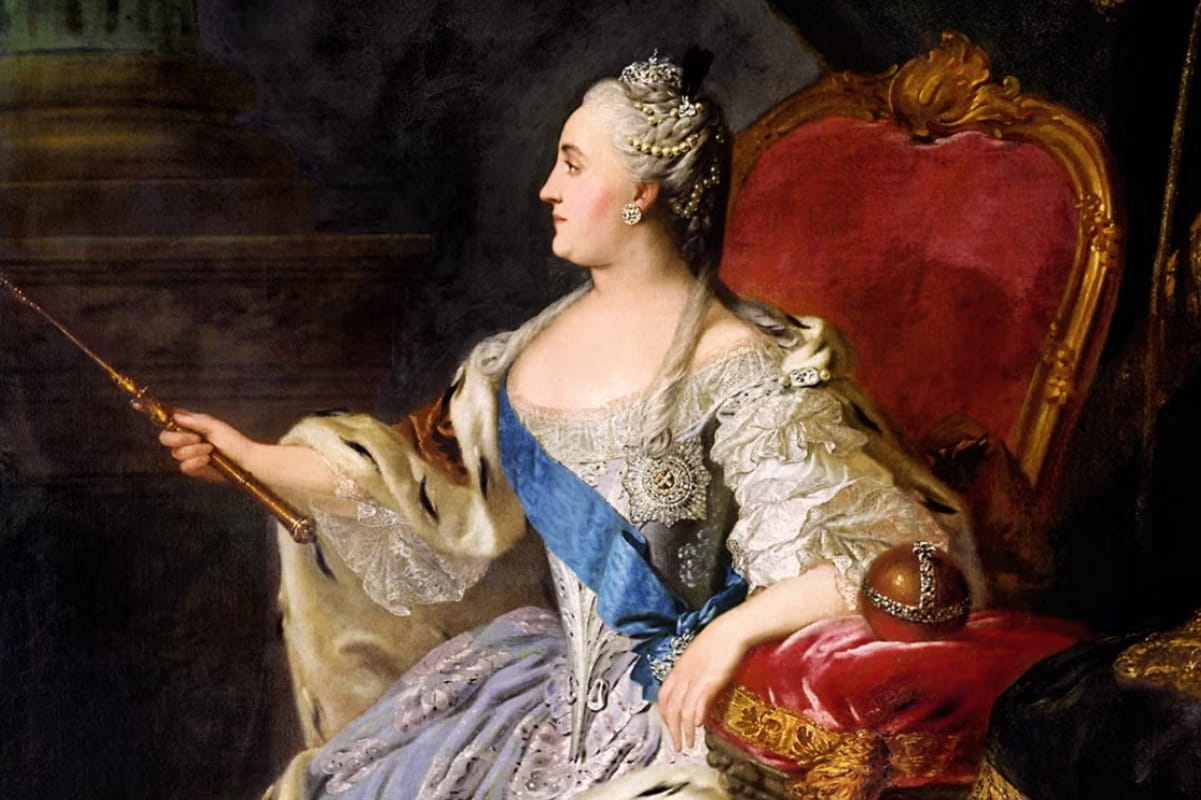
Catherine II was one of the most famous rulers of the eighteenth century and remains one of the most controversial figures in European history. Her reign lasted for more than three decades and had a profound influence on the political landscape of Eastern Europe. During her rule, major reforms, wars, territorial changes, and cultural transformations took place. The empress is surrounded by numerous legends, myths, and historical debates. Below are interesting facts about Catherine II, including fascinating details and information that you may not have known before.
- Catherine II was not born in the Russian Empire. The future empress was born in the Prussian city of Stettin, which is now located in Poland. At birth, she was given the name Sophie Augusta Frederica. Her family belonged to the German aristocracy.
- The future ruler moved to Russia while she was still young. The reason was an invitation to the imperial court in preparation for a dynastic marriage. After arriving, she began studying the Russian language and local customs. This helped her adapt more quickly to her new environment.
- Before her marriage, Sophie converted to Eastern Orthodoxy. Following her baptism, she received the name Catherine Alexeyevna. Changing her religion was an important condition for marrying the future emperor. This decision had a significant impact on the course of her life.
- Catherine’s husband was the future Emperor Peter III. Their marriage was complicated and was not considered a happy one. The couple often disagreed on matters of politics and personal life. These strained relations later became one of the factors contributing to a political crisis.
- Catherine came to power as a result of a palace coup in 1762. Peter III was removed from the throne only a few months after becoming emperor. As a result, authority passed into Catherine’s hands. She became one of the few women to rule such a vast state in her own right.
- Her reign lasted for more than thirty-four years. This was one of the longest periods of rule in the history of the Russian Empire. During that time, many important political and economic changes occurred. The length of her reign allowed her to implement large-scale projects.
- Catherine maintained active correspondence with prominent thinkers of the Enlightenment. Among her correspondents were famous French philosophers and writers. She was deeply interested in new political and cultural ideas. These connections helped shape her image as an educated monarch.
- The empress was fluent in several languages. In addition to her native German, she spoke Russian and French. She also had a strong interest in literature and history. Her education was regarded as one of her greatest strengths.
- Catherine was involved in literary work herself. She wrote plays, fairy tales, articles, and political texts. Some of her works were published during her lifetime. Such activity was rather unusual for a monarch of that era.
- During her reign, the borders of the empire expanded considerably. New territories were incorporated in the south and west. Through wars and diplomatic agreements, the influence of the empire increased significantly. This transformed the state into one of the leading powers in Europe.
- It was during Catherine II’s reign that Crimea was annexed. This occurred in 1783 after a lengthy period of political influence over the region. The event altered the balance of power in the Black Sea area. Its consequences were felt for generations afterward.
- During her rule, the three partitions of the Polish–Lithuanian Commonwealth took place. As a result, one of Europe’s largest states ceased to exist. Its territories were divided among neighboring powers. These events had a tremendous impact on the history of the region.
- Catherine devoted considerable attention to the development of education. She supported the establishment of new educational institutions. Particular emphasis was placed on the education of the nobility and urban populations. Educational initiatives became an important part of state modernization.
- During her reign, the Smolny Institute was established. It became one of the first educational institutions for women in the Russian Empire. Girls from noble families studied there. The institution played a significant role in the advancement of women’s education.
- Catherine supported the development of art and architecture. New palaces, theaters, and cultural institutions were created with her encouragement. She collected works of art from various European countries. This contributed to the formation of major museum collections.
- It was under Catherine that the collection of the Hermitage began to grow rapidly. Initially, it was the empress’s private collection. Over time, it developed into one of the largest art collections in the world. Today, the museum is among the most famous on the planet.
- Despite her interest in Enlightenment ideals, her reign did not lead to the abolition of serfdom. On the contrary, the situation of many peasants remained difficult. This became a source of criticism from some contemporaries and later historians. Such contradictions are among the most debated aspects of her policies.
- One of the greatest internal threats to her authority was the rebellion led by Yemelyan Pugachev. It spread across vast areas of the empire and lasted for several years. Large military forces were required to suppress it. The uprising revealed serious social tensions within the state.
- Catherine traveled extensively throughout her empire. One of her most famous journeys was her trip to Crimea in 1787. This expedition carried significant political importance. Its purpose was to demonstrate the success of imperial policies in newly acquired territories.
- The empress was interested in medicine and public health. She supported the development of hospitals and medical institutions. She also advocated for the spread of smallpox vaccination. For the eighteenth century, this was considered a remarkably progressive position.
- Catherine II became one of the most famous female monarchs in world history. Her name is often mentioned alongside those of Europe’s most distinguished rulers. She left a lasting mark on politics, culture, and international relations. Historians continue to study her life and legacy today.
- Numerous myths and legends emerged around Catherine II. Some of the most popular stories about her lack reliable historical evidence. As a result, researchers must carefully distinguish fact from fiction. This is one reason why her biography remains the subject of extensive scholarly study.
Interesting facts about Catherine II demonstrate how complex and multifaceted this historical figure truly was. You may not have known that her activities combined major reforms, cultural initiatives, and highly controversial political decisions. Fascinating facts about the empress help provide a deeper understanding of the era in which she lived and ruled. Her influence on European history continues to inspire discussion and research to this day.


