
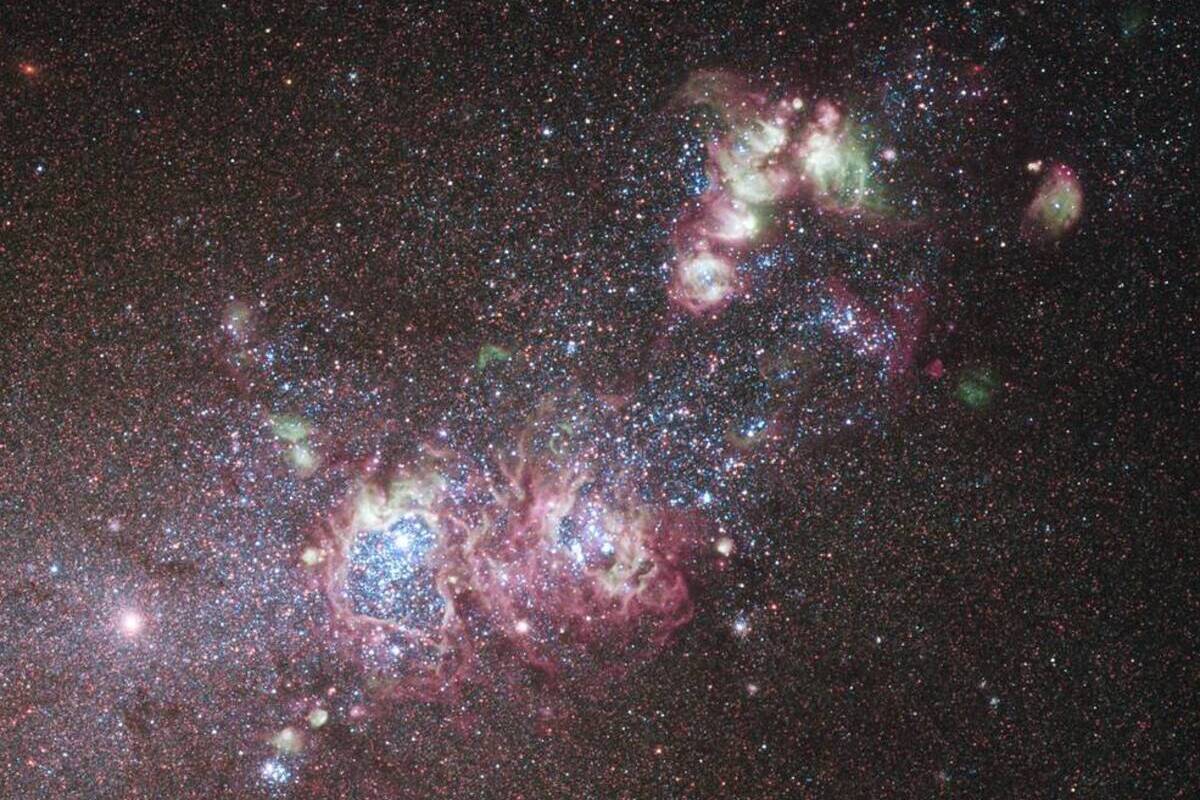
Irregular galaxies, these chaotic and mysterious cosmic formations, amaze with their diversity and unique properties that you might not know about until today. These celestial objects do not have a clear spiral or elliptical structure, which makes them special among billions of galaxies in the Universe. Amazing facts about irregular galaxies reveal the secrets of their origin, evolution, and role in forming cosmic space. Fascinating facts will help you understand why these galaxies remain an object of close attention for astronomers and astrophysicists. Interesting facts compiled below will be useful for both space enthusiasts and those who seek to learn more about the structure of our Universe.
- Irregular galaxies do not have a clearly expressed spiral or elliptical shape, which distinguishes them from most other types of galaxies in the Universe. Their chaotic structure is often the result of gravitational interactions or collisions with other galaxies. Such absence of symmetry makes them unique objects for studying processes of galactic evolution. Astronomers classify these galaxies separately precisely because of their irregular morphology.
- Irregular galaxies constitute approximately one quarter of all known galaxies in the observable Universe. This significant portion emphasizes their importance for understanding the overall structure of the cosmos. Many of these galaxies are quite small and faint, which complicates their detection at large distances. Modern telescopes allow astronomers to discover more and more such objects in distant space.
- These galaxies often contain large amounts of gas and dust, which contributes to active star formation processes. Young hot stars of blue hue often dominate their luminosity, giving galaxies a characteristic appearance. The high rate of new star birth makes irregular galaxies valuable laboratories for studying stellar evolution. Such processes help scientists understand how stellar populations form under various conditions.
- The Magellanic Clouds, Large and Small, are the most famous examples of irregular galaxies visible to the naked eye from the Southern Hemisphere. These satellite galaxies of our Milky Way are located at a distance of about one hundred sixty thousand light years. They demonstrate active star formation and contain numerous star clusters and nebulae. Studying the Magellanic Clouds provides valuable information about the evolution of satellite galaxies.
- Irregular galaxies are often classified into two main types Irr I and Irr II depending on their structure and properties. Type Irr I galaxies have some signs of structure, while Irr II appear completely chaotic. Such classification helps astronomers systematize the diversity of irregular galaxies for further research. Each type may have unique characteristics of star formation and chemical composition.
- Gravitational interactions with other galaxies are often the main cause of the irregular shape of these cosmic objects. Tidal forces can stretch stars and gas, creating bizarre structures and tails. Such processes can last millions of years, gradually changing the morphology of the galaxy. Studying these interactions helps understand the dynamics of galactic clusters and groups.
- Irregular galaxies often have lower metallicity compared to spiral galaxies, which indicates a smaller amount of heavy elements. This suggests that they have undergone fewer cycles of star formation and stellar explosions. Such chemical composition makes them valuable objects for studying early stages of Universe evolution. Astronomers use these data to reconstruct the history of chemical enrichment of the cosmos.
- Many irregular galaxies are dwarf in size and mass, which makes them one of the most common types of galaxies in the Universe. Their small mass makes them more vulnerable to external gravitational influences. Dwarf irregular galaxies often serve as building blocks for forming larger galaxies through mergers. This process plays a key role in the hierarchical model of galaxy formation.
- Irregular galaxies often contain significant reserves of neutral hydrogen, which can be detected using radio telescopes. This gas is the primary material for forming new stars and planetary systems. Observations of hydrogen distribution help astronomers understand the dynamics and evolution of these galaxies. Radio astronomical research reveals new aspects of irregular galaxy structure.
- Some irregular galaxies demonstrate signs of recent or prolonged star formation, which manifests in the presence of bright regions of ionized hydrogen. These regions, known as H II regions, glow thanks to ultraviolet radiation from young massive stars. Studying such regions helps determine star formation rates and the age of stellar populations. These data are important for understanding the life cycle of galaxies.
- Irregular galaxies are often located in groups or clusters, where gravitational interactions are more intense. Such environment promotes frequent collisions and exchange of matter between galaxies. Observations of these processes help astronomers model the evolution of galactic associations. Group environment can accelerate or suppress star formation depending on specific conditions.
- Some irregular galaxies can evolve into spiral or elliptical galaxies through processes of merging and matter accretion. This transformational path can last billions of years and depends on many factors. Studying such evolutionary scenarios helps understand the diversity of galaxy forms in the modern Universe. Computer modeling plays a key role in researching these long-term processes.
- Irregular galaxies often have complex internal structure with numerous star clusters and nebulae. These formations can be the result of star formation waves provoked by gravitational disturbances. Detailed study of their structure requires using powerful telescopes and modern image processing methods. Such research reveals details of star and planetary system formation in chaotic environments.
- The content of dark matter in irregular galaxies can significantly differ depending on their mass and formation history. Measurements of rotation speeds of stars and gas help astronomers estimate the distribution of dark matter. These data are important for testing cosmological models and understanding the nature of dark matter. Irregular galaxies provide unique opportunities for such fundamental research.
- Observations of irregular galaxies at large distances allow astronomers to look into the past of the Universe. Due to the finite speed of light, we see these galaxies as they were billions of years ago. Such cosmic time machine helps study galaxy evolution throughout cosmic history. These data are critically important for understanding the formation and development of Universe structure.
- Irregular galaxies are often sources of intense radio emission and X-ray emission thanks to active star formation processes. These observations in different ranges of the electromagnetic spectrum provide a comprehensive picture of physical processes in galaxies. Multi-wavelength astronomy has become a key tool for studying irregular galaxies. Such approach allows obtaining a more complete understanding of their nature and evolution.
- Some irregular galaxies demonstrate signs of active galactic nucleus, where a supermassive black hole absorbs matter. Such objects are rare among irregular galaxies, but their study provides valuable information about black hole evolution. The interaction between active nucleus and star formation is an important topic of modern astrophysical research. These processes can influence the evolution of the entire galaxy.
- Irregular galaxies often contain a significant number of variable stars, such as Cepheids, which are used as standard candles for measuring distances. These stars help astronomers refine the distance scale in the Universe and determine its expansion rate. Precise distance measurements to irregular galaxies are important for cosmological research. Such data help test theories of Universe formation and evolution.
- Studying irregular galaxies requires using the most modern telescopes, including space observatories and ground-based instruments with adaptive optics. These technologies allow obtaining high-resolution images and analyzing galaxy structure in detail. International cooperation in astronomy plays a key role in researching these distant objects. Joint efforts of scientists from different countries accelerate progress in understanding irregular galaxies.
- Irregular galaxies continue to surprise astronomers with new discoveries, such as unexpected chemical compositions or unique stellar populations. Each new observation can change our understanding of galaxy evolution and Universe structure formation. Fascinating facts about these cosmic objects inspire new generations of researchers to study space. Interesting facts about irregular galaxies serve as a solid foundation for those who seek to better understand the complex mosaic of our Universe.
Fascinating facts about irregular galaxies demonstrate how these chaotic cosmic formations play an important role in the formation and evolution of the Universe. Amazing facts remind us of the importance of international cooperation and modern technologies for researching distant galaxies. Interesting facts inspire deeper exploration of space and awareness of our place in the vast Universe. This collection of knowledge serves as a solid foundation for those who seek to better understand irregular galaxies and their role in the complex mosaic of cosmic evolution.


