
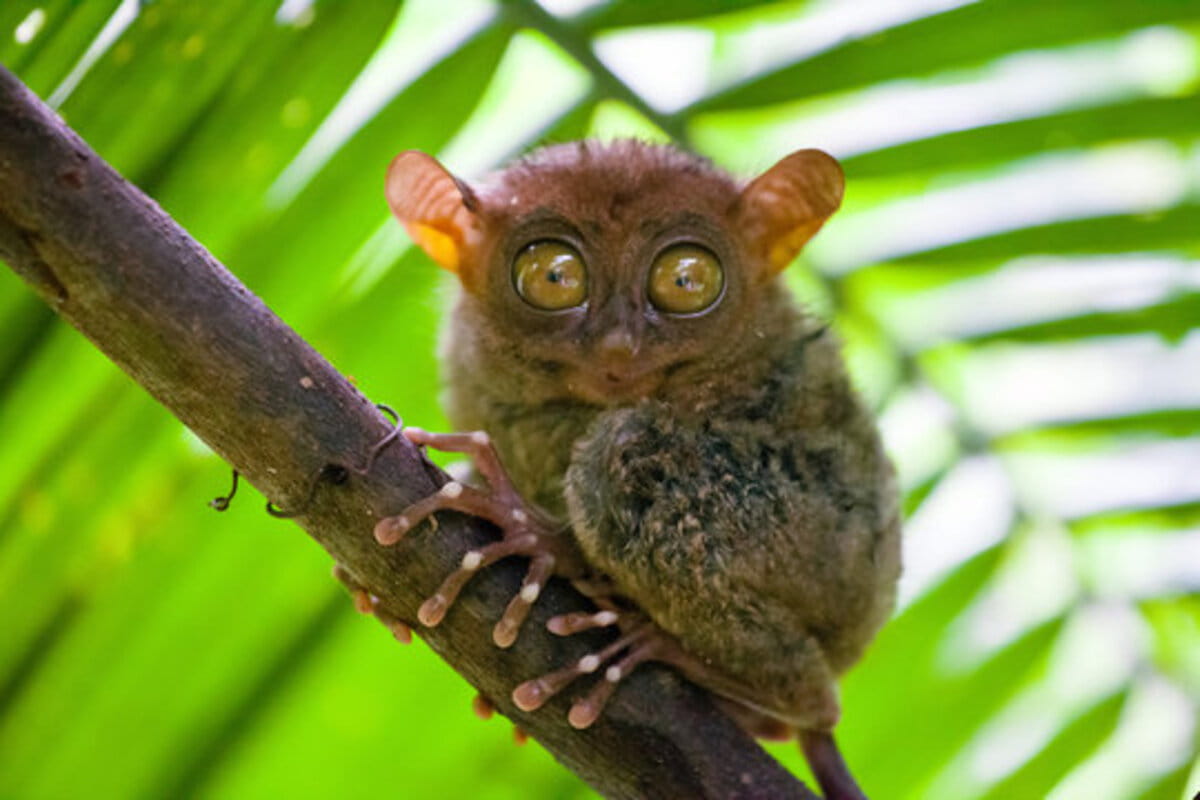
Tarsiers are among the most enigmatic and astonishing creatures on our planet, looking as though they were drawn by a fantasy artist. Their enormous eyes, which take up half of their face, their extraordinarily long fingers, and their ability to rotate their heads almost 360 degrees make them unlike any other animal in the world. These tiny primates hide in the tropical forests of South-East Asia and continue to guard many secrets that scientists are still working to uncover. If you think you know everything about the strange animals of our planet, then the fascinating facts about tarsiers will certainly make you reconsider your assumptions. We present to you interesting facts about these unique creatures that will reveal them from an unexpected angle.
- Tarsiers belong to the order of primates, yet they occupy a special place within its classification, forming a separate suborder known as Tarsiiformes. They are the only entirely carnivorous primates on Earth — their diet consists exclusively of insects, small lizards, frogs, and even small birds. No other primate is a one hundred percent predator, which makes tarsiers a truly exceptional case within their order.
- The eyes of a tarsier are absolutely record-breaking among all mammals in relation to body size. Each eye has a diameter of approximately 16 millimetres and weighs more than the animal’s brain. If human eyes were proportionally as large, each one would be roughly the size of a grapefruit.
- Unlike most nocturnal animals, tarsiers do not possess a layer of tapetum lucidum — the light-reflecting layer behind the retina that gives the eyes of cats and dogs their characteristic gleam in the dark. Nature has compensated for this with extraordinarily large eyes featuring a wide pupil capable of capturing the minimum amount of available light. The retina of a tarsier contains exclusively rod-shaped photoreceptors, which provides excellent night vision but virtually deprives the animal of the ability to distinguish colours.
- The eyeballs of a tarsier are so large that they are physically incapable of moving within their sockets — they are literally fixed in place by bony structures. It is for this very reason that nature has endowed these animals with the ability to turn their head almost 180 degrees in each direction, which together provides a field of vision of approximately 360 degrees. This remarkable mobility of the neck is achieved through the special structure of the cervical vertebrae.
- Tarsiers received their name thanks to the extraordinarily elongated bones of the tarsus — tarsius in Latin, which literally means the flat surface of the foot. These bones are so long that they effectively function as an additional knee joint, significantly increasing the length of the animal’s leap. Thanks to this anatomical feature, tarsiers are capable of jumping a distance forty times greater than the length of their own body.
- The fingers of tarsiers end in rounded pads resembling suckers, which allow them to cling to perfectly smooth vertical surfaces. In addition, the second and third toes of the hind limbs bear claws rather than nails, which are used for grooming the fur. All the remaining digits are equipped with flat nails, as in humans and other primates.
- Tarsiers communicate with one another by means of ultrasound — frequencies that the human ear is incapable of perceiving. They are the only primates in which exclusively ultrasonic communication has been recorded, with no sounds whatsoever falling within the range audible to humans. This discovery was made comparatively recently and caused a genuine sensation in the world of zoology.
- The gestation period in tarsiers lasts approximately six months — an extraordinarily long time for an animal of such tiny dimensions. The female gives birth to a single offspring, which enters the world already fully formed, covered in fur, and with its eyes open. A newborn tarsier is capable of clinging to branches independently from the very first hours of its life.
- The body of an adult tarsier is exceptionally small — most species weigh between 80 and 160 grams, which is comparable to the weight of a small apple. Despite such modest dimensions, these animals are skilled hunters, capable of catching an insect in mid-flight. Their reaction speed is so lightning-fast that scientists continue to study the neural mechanisms that make it possible.
- Tarsiers are monogamous animals and typically form pairs for extended periods of time. A pair occupies a shared territory, which both partners actively mark and defend against intruders. The social structure of their groups is relatively simple compared to that of other primates; however, the internal bonds between family members are quite strong.
- All species of tarsier known to science inhabit exclusively the islands of South-East Asia — the Philippines, Borneo, Sulawesi, and Sumatra. Not a single species of these animals is found on the mainland of Asia or on any other continent. Such a restricted geographic range makes them exceptionally vulnerable to the destruction of their natural habitats.
- Tarsiers possess a remarkable ability to freeze their body completely for several seconds before leaping, focusing intently on their target. This state of momentary stillness resembles the behaviour of predatory felines before an attack and ensures the maximum precision of the jump. Scientists have established that during this moment the animal’s heart rate slows down sharply.
- Fossil remains of tarsier ancestors date back approximately 45 to 55 million years, making them one of the most ancient lineages of primates. The ancient forms of these animals were considerably more widespread and inhabited a far greater territory, including North America and Europe. Modern tarsiers are living witnesses to evolution, having remained virtually unchanged over millions of years.
- Tarsiers tolerate captivity poorly and are among the few animals that it is practically impossible to keep in zoological gardens for any extended length of time. Under conditions of stress they may inflict injuries upon themselves and refuse food to the point of death. It is for precisely this reason that the majority of zoologists and conservationists are categorically opposed to keeping tarsiers as pets.
- Certain Philippine species of tarsier have the unique habit of sleeping in a vertical position pressed against the trunk of a tree, gripping it firmly with all four limbs. This manner of resting is not characteristic of most primates and constitutes yet another testament to the extraordinary adaptations of these animals. Even in sleep they remain on alert and are capable of reacting to danger with lightning speed.
- Tarsiers play an important role in the ecosystems of tropical forests as regulators of the populations of insects and small invertebrates. Their high degree of specialisation as predators makes them exceptionally sensitive indicators of the state of the surrounding environment. A decline in tarsier populations is one of the early warning signs of the degradation of tropical forest.
Tarsiers are a true triumph of evolutionary imagination — creatures that combine within themselves the traits of different epochs and adaptations accumulated over tens of millions of years. The incredible facts about these animals remind us of just how diverse and unpredictable the world of living nature truly is. You might not have known that such tiny creatures could simultaneously be so complex, so mysterious, and so defenceless. The preservation of tarsiers and their natural habitats is not only a scientific undertaking but also our shared moral duty towards the natural world.


