
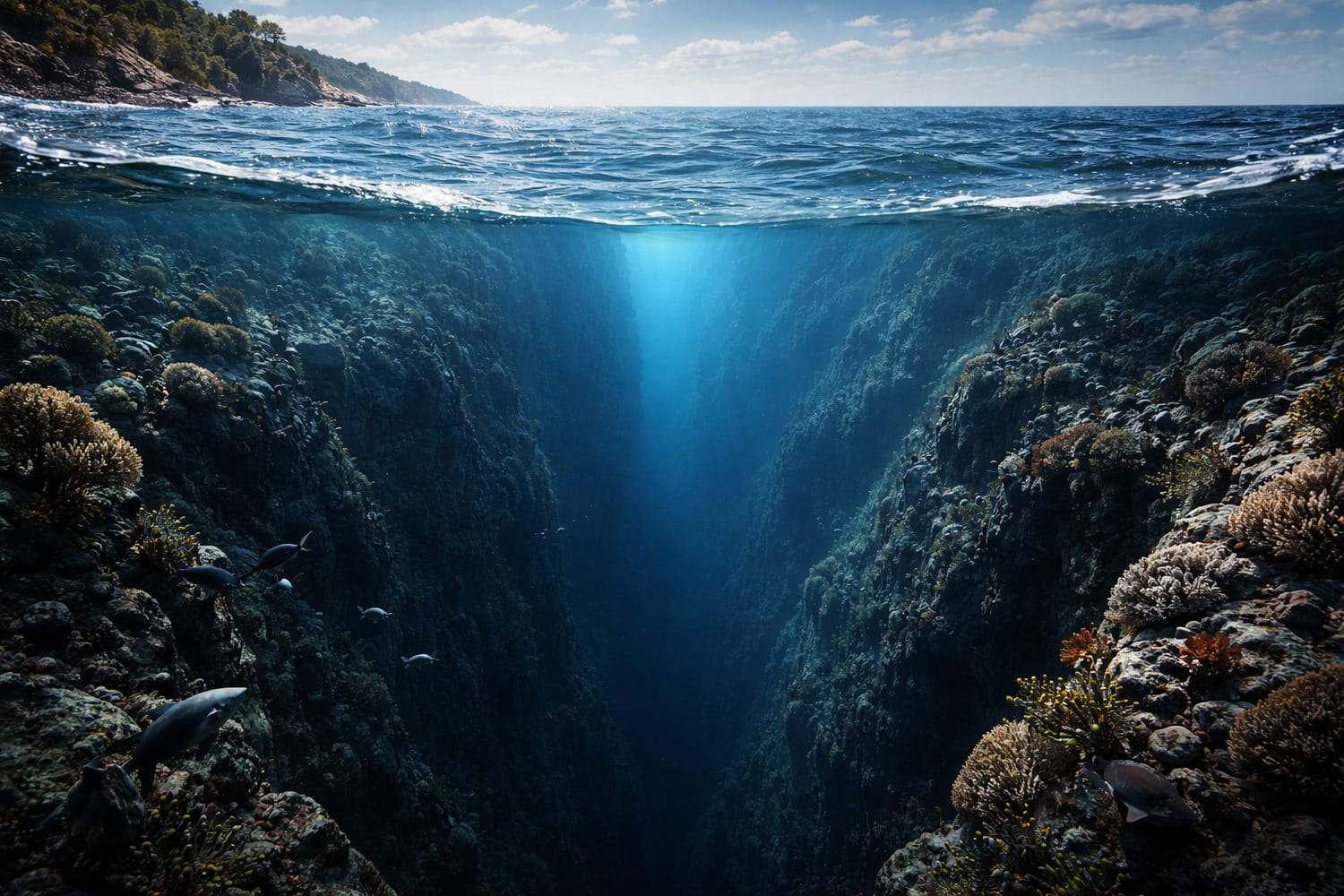
Oceanic trenches remain some of the least explored and most mysterious corners of our planet, hidden beneath layers of water at kilometer depths. You might not know that these underwater depressions form as a result of tectonic plate collisions and can reach depths that exceed the height of the highest mountain peaks. Interesting facts about the extreme living conditions in trenches amaze the imagination and demonstrate nature’s incredible ability to adapt. Fascinating facts about geological processes in these zones help scientists better understand Earth’s dynamics and predict natural disasters. Let us dive into the world of oceanic depths to learn more about these unique natural formations.
- The Mariana Trench in the Pacific Ocean is considered the deepest place on Earth with a maximum known depth of more than eleven kilometers. Its lowest point, known as the Challenger Deep, could completely swallow Mount Everest while still leaving several kilometers of water above the summit. This trench formed as a result of the subduction of the Pacific Plate beneath the Philippine Plate, creating extreme pressure at the bottom. Research in this zone is conducted only using specialized deep-sea vehicles due to the impossibility of human presence there without protection.
- Water pressure at the bottom of oceanic trenches exceeds atmospheric pressure at the surface by more than a thousand times and amounts to approximately 110 megapascals. Such extreme impact can instantly crush any ordinary underwater vehicle or even the hull of a modern submarine. Only specially designed bathyscaphes with thick-walled spheres made of titanium or special alloys can withstand these conditions. This fact explains why detailed exploration of trenches remains one of the most challenging tasks of modern oceanography.
- Unique ecosystems of oceanic trenches are inhabited by organisms that have evolved to live in conditions of complete darkness, cold, and enormous pressure. Many of these creatures, such as deep-sea anglerfish or amphipods, possess special adaptations including bioluminescence for attracting prey. Some microorganisms found in trenches are capable of processing organic matter descending from upper ocean layers, playing an important role in the global carbon cycle. These life forms demonstrate the remarkable resilience of biological systems to the harshest environmental conditions.
- Oceanic trenches are often epicenters of powerful earthquakes and can trigger devastating tsunamis that threaten coastal regions. When one tectonic plate subducts beneath another in a subduction zone, enormous stress accumulates and is released in the form of seismic shocks. The strongest earthquakes in history, such as the event off the coast of Japan in 2011, were directly associated with activity in trench zones. Monitoring these processes helps scientists develop early warning systems to protect populations.
- Deep-sea trenches received the name hadal zone in honor of Hades, the ancient Greek god of the underworld, emphasizing their gloomy and mysterious nature. This zone encompasses depths from six to eleven kilometers and remains one of the least studied parts of the planet. Less than twenty percent of oceanic trench floors have been mapped in detail with high resolution. Each new expedition to these waters brings scientists unexpected discoveries about the geology and biology of the depths.
- Some oceanic trenches contain unique deposits of mineral resources including rare earth metals and polymetallic nodules. These resources form over millions of years through the settling of mineral particles from seawater and hydrothermal activity. Potential extraction of these materials sparks debates about economic benefits and environmental risks to fragile deep-sea ecosystems. The international community is developing regulatory frameworks for responsible use of ocean floor resources.
- Water temperature at the bottom of oceanic trenches typically ranges from zero to four degrees Celsius, creating a stable cold environment. Such a low temperature regime slows metabolic processes in deep-sea organisms, allowing them to conserve energy under conditions of limited resources. Cold water also has greater density, which influences ocean current circulation and global climate. These factors make trenches important elements of the planet’s thermoregulation system.
- The Tonga-Kermadec Trench in the southern Pacific Ocean is one of the fastest subduction zones where the plate subducts at a rate of up to twenty-four centimeters per year. Such high geological activity contributes to frequent underwater volcanic eruptions and the formation of new islands. Research of this trench helps scientists better understand tectonic plate movement mechanisms and predict volcanic activity. The subduction rate also affects the intensity of seismic events in the region.
- The Puerto Rico Trench in the Atlantic Ocean is the deepest location in this oceanic basin with a depth exceeding eight kilometers. It is located at the boundary of the Caribbean and North American plates and is characterized by complex geological structure. This trench is significant for understanding Atlantic tectonics and assessing seismic risks for the Caribbean region. Studies of its structure are conducted using modern seismic surveying methods.
- Oceanic trenches play a key role in the global carbon cycle by absorbing organic material descending from surface ocean layers. This process, known as the biological pump, helps reduce atmospheric carbon dioxide concentrations and mitigate climate change impacts. Microorganisms at trench bottoms process organic matter, converting it into forms that can be preserved in sedimentary rocks for millennia. Understanding these mechanisms is important for modeling future climate scenarios.
- Specialized underwater vehicles such as the bathyscaphe Trieste or unmanned probes are the only means of directly exploring oceanic trenches. These devices are equipped with powerful spotlights, manipulators for sample collection, and high-resolution cameras for documenting discoveries. Developing such technologies requires significant investment and cooperation among scientific institutions from different countries. Each successful descent into a trench brings valuable data for geology, biology, and oceanography.
- Acoustic properties of water in oceanic trenches differ from surface layers due to extreme pressure and low temperature, affecting sound wave propagation. This feature is used for underwater navigation and communication as well as for studying marine organisms that rely on sound for orientation. Research on trench acoustics helps develop more effective sonar systems for scientific and military purposes. Sound signals can also be used for real-time monitoring of seismic activity.
- Sedimentary rocks at the bottom of oceanic trenches contain valuable information about climate changes and Earth’s geological history over the past millions of years. Analysis of these deposits allows scientists to reconstruct past ocean conditions, identify glacial period intervals, and track the evolution of marine life. Cores obtained from trenches are unique natural archives that help predict future ecological changes. These studies are significant for understanding long-term climate trends.
- Bioluminescent organisms inhabiting trenches produce their own light through chemical reactions, enabling them to communicate, attract prey, or deter predators in complete darkness. This phenomenon is particularly common among deep-sea jellyfish, fish, and crustaceans that have adapted to life without sunlight. Studying bioluminescence has potential applications in medicine, biotechnology, and creating new light sources. Natural light production mechanisms inspire engineers to develop energy-efficient technologies.
- Some oceanic trenches such as the Japan Trench have hydrothermal vents that emit hot water enriched with minerals, creating unique chemical environments. Specialized ecosystems form around these vents where organisms rely on chemosynthesis instead of photosynthesis to obtain energy. Such discoveries expand our understanding of possible life forms on other planets with similar conditions. Hydrothermal systems are also promising targets for searching for new bioactive compounds.
Incredible facts about oceanic trenches demonstrate how complex and diverse the underwater world of our planet truly is. You might not know that these deep depressions play a decisive role in maintaining global climate and Earth’s geological stability. These fascinating facts only partially reveal the mysteries of oceanic depths, leaving room for new scientific discoveries. Exploring trenches continues to inspire humanity to search for answers about the origin of life and the future of our planet.


