
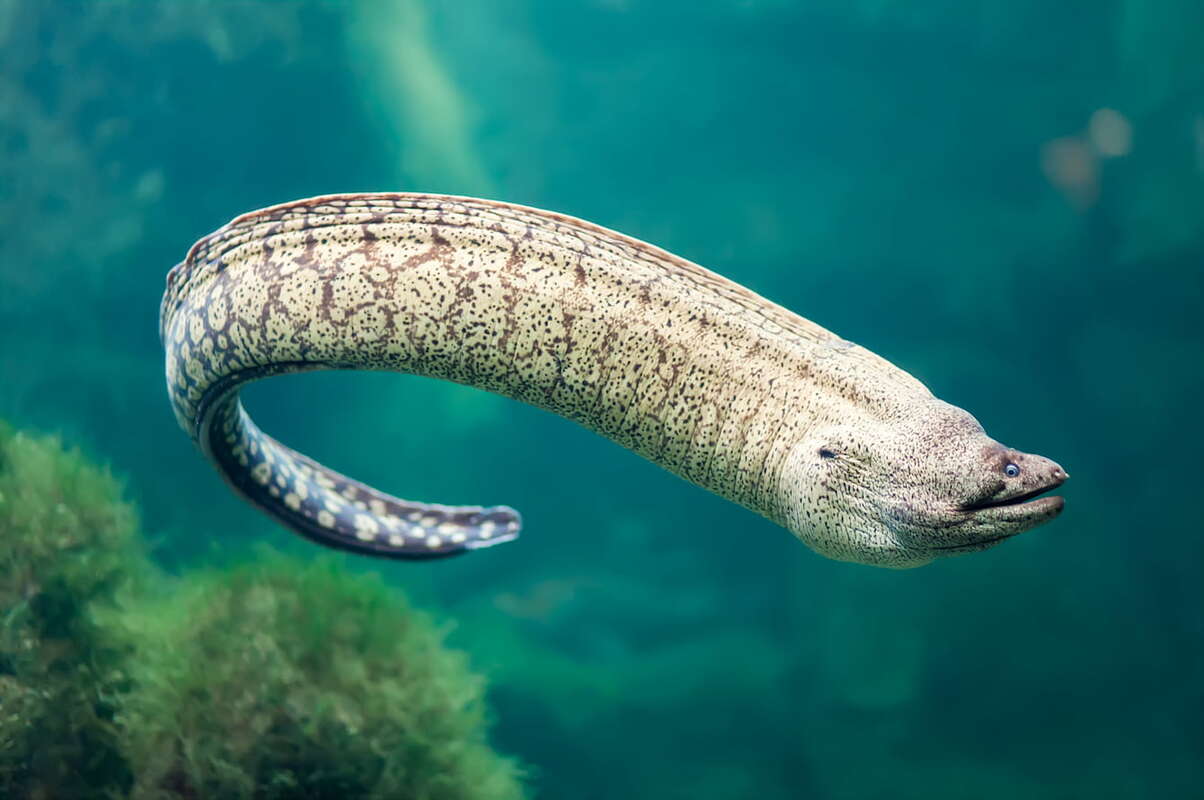
Moray eels are among the most mysterious inhabitants of the ocean depths. Their snake-like bodies, sharp teeth, and unusual behavior often inspire both fascination and caution in people. These fish inhabit warm seas and oceans, where they play an important role in marine ecosystems. Many people know moray eels only as dangerous predators, yet their way of life hides many remarkable features. Below are interesting facts about moray eels, including some surprising details that you may not have known before.
- Moray eels belong to the order of eel-like fishes. Their long and flexible bodies allow them to move easily through narrow crevices between corals and rocks. This enables them to hide in places that are inaccessible to most other predators. Such a body structure also helps them launch sudden attacks on unsuspecting prey.
- More than 200 species of moray eels exist around the world. They differ in size, coloration, and habitat. Some species are less than half a meter long, while others can exceed four meters in length. These fish inhabit nearly all tropical and subtropical seas.
- Most moray eels live among coral reefs. These environments provide both protection from predators and abundant food sources. During the day, they often remain hidden in crevices, exposing only their heads. At night, they emerge to hunt.
- Unlike many fish species, moray eels do not possess pectoral fins. Their bodies resemble a continuous, undulating ribbon. They move by creating wave-like motions along the entire length of their bodies. This makes them extremely agile in confined spaces.
- Many people are frightened by the fact that moray eels constantly open and close their mouths. In reality, this is not a sign of aggression. They perform this movement to pump water over their gills for breathing. As a result, they often appear as though they are preparing to attack.
- Moray eels have very sharp teeth that point backward. This arrangement prevents captured prey from escaping easily. Even slippery fish and octopuses have little chance of breaking free. This feature makes moray eels highly effective predators.
- One of the most remarkable characteristics of moray eels is the presence of a second set of jaws. These jaws are located deep within the throat. After the prey is captured, the inner jaws extend forward to grasp it and pull it toward the esophagus. This mechanism is extremely rare among vertebrate animals.
- The skin of moray eels is almost completely devoid of scales. Instead, it is covered by a thick layer of mucus. This mucus protects the fish from parasites, bacteria, and physical injuries. It also helps them glide smoothly through narrow openings.
- The coloration of moray eels serves as excellent camouflage. Various spots, stripes, and patterns allow them to blend into coral reefs and rocky environments. Predators and prey alike may fail to notice them until the last moment. This significantly increases their hunting success.
- The diet of moray eels mainly consists of fish, squid, octopuses, and crustaceans. They do not usually chase prey over long distances. Instead, they wait in ambush and strike with incredible speed. This hunting strategy helps conserve energy.
- Some moray eels are capable of cooperating with other predators during hunting. Their partnership with coral groupers is particularly well known. The grouper locates potential prey and signals the moray eel. Together, they increase their chances of capturing an animal attempting to escape.
- Despite their intimidating appearance, moray eels rarely attack humans without provocation. Most bites occur when divers attempt to touch or feed them. When defending their shelters, they can react very aggressively. For this reason, marine experts recommend maintaining a safe distance.
- A bite from a large moray eel can be extremely painful. This is due not only to its sharp teeth but also to its powerful jaws. The resulting wounds often have irregular edges and require careful treatment. There is also a risk of infection from marine bacteria.
- Some species of moray eels accumulate toxins within their tissues. This occurs because of their position in the food chain. Consuming such fish can sometimes cause serious poisoning. As a result, they are not recommended as food in certain parts of the world.
- Moray eels are capable of living at considerable depths. While many species inhabit shallow waters, others can be found hundreds of meters below the surface. Conditions at such depths involve very different levels of pressure and light. This demonstrates the remarkable adaptability of these fish.
- The eyes of moray eels are relatively small, and vision is not their primary sense. A highly developed sense of smell plays a much more important role. They can detect the scent of potential prey even in murky water. This ability makes them highly effective nighttime hunters.
- Moray eels can live to an impressive age. Some individuals survive for more than twenty years in the wild. Under favorable conditions, their lifespan may be even longer. Slow growth is characteristic of many larger species.
- One of the largest members of the family is the giant moray eel. It can grow to more than three meters in length. Such fish may weigh several dozen kilograms. Encountering one of these enormous reef inhabitants leaves a lasting impression even on experienced divers.
- Young moray eels often differ in coloration from adults. As they grow, their appearance can change significantly. These changes help them adapt to different stages of life. In some cases, this makes species identification more difficult.
- Moray eels play an important role in maintaining the balance of marine ecosystems. They help regulate populations of many smaller animals. This reduces the risk of certain species becoming overly abundant. Their presence contributes to environmental stability.
- In ancient times, moray eels were well known throughout the Mediterranean region. The Romans even kept them in specially designed pools. They were regarded as symbols of wealth and social status. Historical records indicate that moray eels were highly valued by Roman aristocrats.
- Because of their unusual appearance, moray eels frequently appear in films, documentaries, and works of fiction. They are often portrayed as terrifying sea monsters. In reality, most species are far less aggressive than popular myths suggest. Their true behavior is much more fascinating than the legends surrounding them.
Fascinating facts about moray eels demonstrate just how extraordinary ocean creatures can be. Many people may not realize that behind their fearsome appearance lies a complex set of adaptations developed over millions of years. These remarkable facts help us better understand the diversity of life beneath the waves. The more scientists learn about moray eels, the more secrets of the ocean continue to be revealed.


