
Skydiving has long since evolved from being solely a military discipline into an exciting form of recreation and a highly competitive sport. For some people, it is a way to test their courage, while for others it becomes a lifestyle closely connected with the sky and a sense of freedom. Many are fascinated by amazing facts about parachute flights and the unique sensation of freefall. Skydiving combines modern technology, physical preparation, and precise calculations. You may not know that over more than two centuries of existence, this sport has produced countless remarkable achievements and records.
- The first documented parachute jump took place at the end of the eighteenth century. It was performed by the Frenchman André-Jacques Garnerin, who ascended in a hot air balloon and successfully descended to the ground. The parachute he used was very different from modern designs. Nevertheless, this experiment marked the beginning of the development of skydiving.
- The concept of a parachute was proposed several centuries before practical designs appeared. Leonardo da Vinci described a pyramid-shaped device intended for safe descent from great heights. Many researchers consider this project one of the most brilliant inventions of the Renaissance. Modern tests have demonstrated that the design could actually function.
- During freefall, a person typically reaches a speed of approximately 190 to 220 kilometers per hour. The exact speed depends on body position and weather conditions. When wearing specialized aerodynamic suits, the speed can become even greater. This is why learning proper body positioning in the air is extremely important.
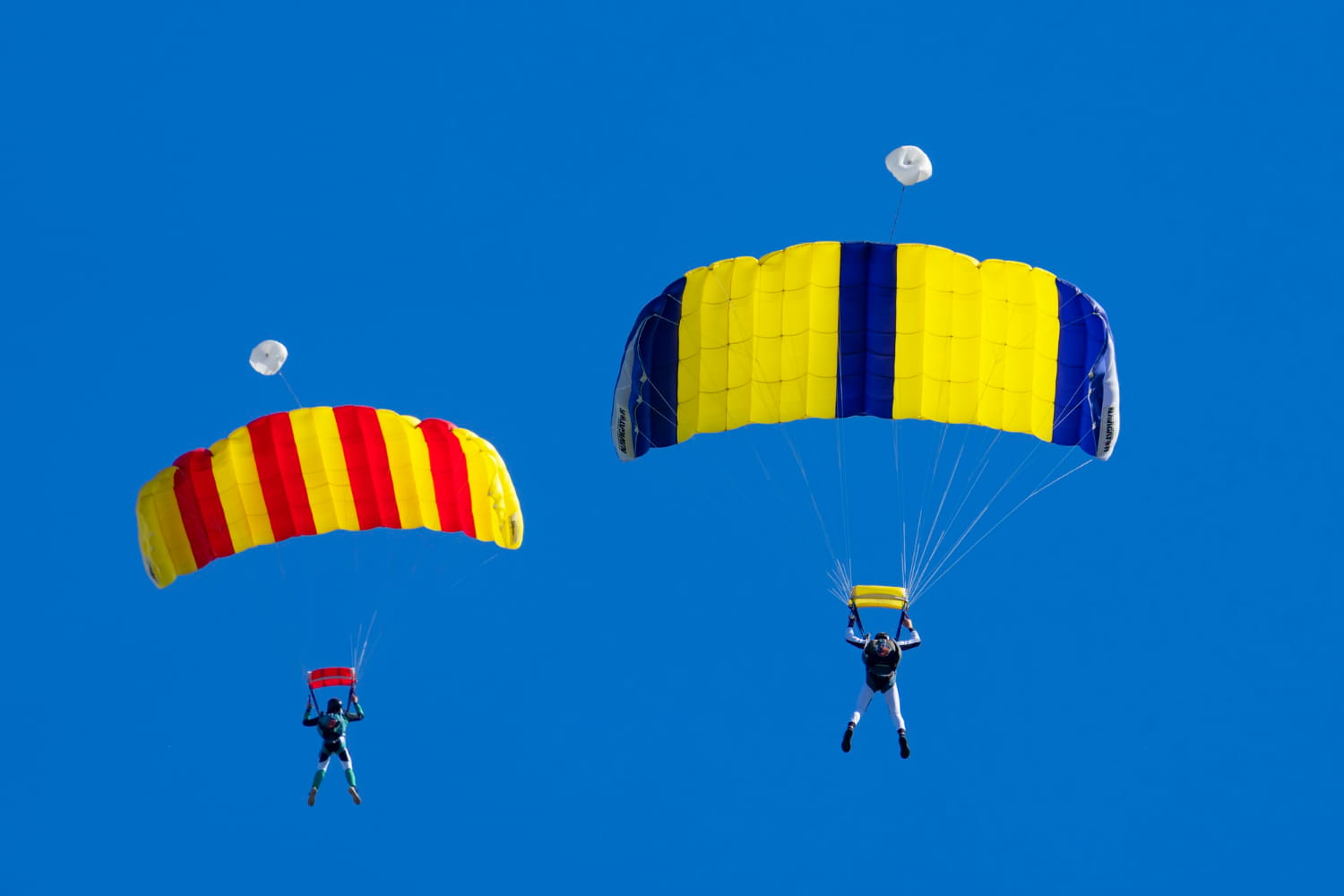
- Modern sport parachutes are rectangular rather than round. This design allows skydivers to control their direction of flight and perform complex maneuvers. The canopy essentially functions according to the same principles as an aircraft wing. This significantly improves landing accuracy.
- In most countries, beginners perform their first jump in tandem with an instructor. This allows them to focus on the experience without worrying about technical details. The instructor manages the entire process from exiting the aircraft to landing safely. As a result, the level of risk is greatly reduced.
- To enhance safety, modern skydivers use not one but two parachutes. The main canopy is intended for normal use, while the reserve parachute is deployed in the event of a malfunction. In addition, many systems are equipped with automatic activation devices. These systems can deploy the reserve parachute automatically when necessary.
- One of the most demanding disciplines in skydiving is formation skydiving. During flight, dozens of athletes create various formations while holding onto one another. Such performances require flawless coordination. Even a small mistake can disrupt the entire formation.
- Skydiving competitions are held in landing accuracy disciplines. Participants must land as close as possible to the center of a designated target. Sometimes the winner is determined by a difference of only a few centimeters. This requires exceptional skill and extensive experience.
- There is a discipline known as freestyle skydiving. In this event, athletes perform complex spins, flips, and other acrobatic movements in the air. Their performance is recorded by a camera flyer who jumps alongside them. Judges then evaluate both technical execution and difficulty.
- Skydiving has contributed significantly to the development of aviation safety technologies. Engineers have continually improved canopy materials, harness systems, and safety equipment. Many of these innovations have later been applied in other fields. This has helped make flying safer for thousands of people.
- The highest parachute jumps have been made from altitudes exceeding 39 kilometers. Such jumps took place near the boundary of space. Participants in these missions wore specialized pressurized suits. During their descent, they established new speed records.
- Skydiving is not only a sport but also an important part of rescue operations. Parachutes are used to deliver supplies to remote and difficult-to-reach areas. They are also employed during disaster relief efforts. This makes it possible to provide assistance quickly when it is needed most.
- Many athletes describe freefall as a sensation of flying rather than falling. Because the airflow around the body is relatively constant, people often do not perceive their tremendous speed. Instead, they experience the feeling of floating through the sky. This sensation is one of the main attractions of the sport.
- Modern parachutes are manufactured using extremely durable synthetic fabrics. These materials are lightweight, resistant to heavy loads, and capable of withstanding moisture. They can endure enormous forces during canopy deployment. This greatly increases the reliability of the equipment.
- Large international skydiving championships are held around the world. Hundreds of competitors from numerous countries participate in these events. The competitions include several disciplines, each with its own rules and requirements. Winning such tournaments is considered a prestigious achievement.
- Skydivers pay close attention to weather forecasts. Wind strength, cloud cover, and visibility can significantly affect the safety of a jump. Because of unfavorable conditions, competitions are sometimes postponed for several hours or even days. This helps prevent dangerous situations.
- One of the most famous records involved the creation of a massive formation consisting of several hundred skydivers in the sky. Such attempts require years of preparation and meticulous planning. Participants must act with exceptional synchronization. Records of this kind demonstrate an extraordinary level of teamwork.
- Many countries operate specialized vertical wind tunnels. These facilities make it possible to simulate freefall conditions without having to board an aircraft. Athletes use them for training and practicing complex maneuvers. This significantly accelerates the learning process.
- Skydiving requires excellent physical fitness and strong concentration. Athletes must quickly assess situations and make appropriate decisions. Coordination and spatial awareness are particularly important. These skills improve with every jump.
- Every year, thousands of people around the world decide to make their first parachute jump. For many, it becomes one of the most memorable experiences of their lives. Some continue their training afterward and obtain a skydiving license. This marks the beginning of their fascinating journey into the world of skydiving.
Interesting facts about skydiving demonstrate just how diverse and multifaceted this sport can be. It combines science, technology, physical conditioning, and a genuine passion for flight. Fascinating facts about parachute jumping show that every descent is supported by decades of technological development and the experience of many generations of athletes. You may not know that for many people, the sky becomes a place where they discover new possibilities and test the limits of their abilities.


