
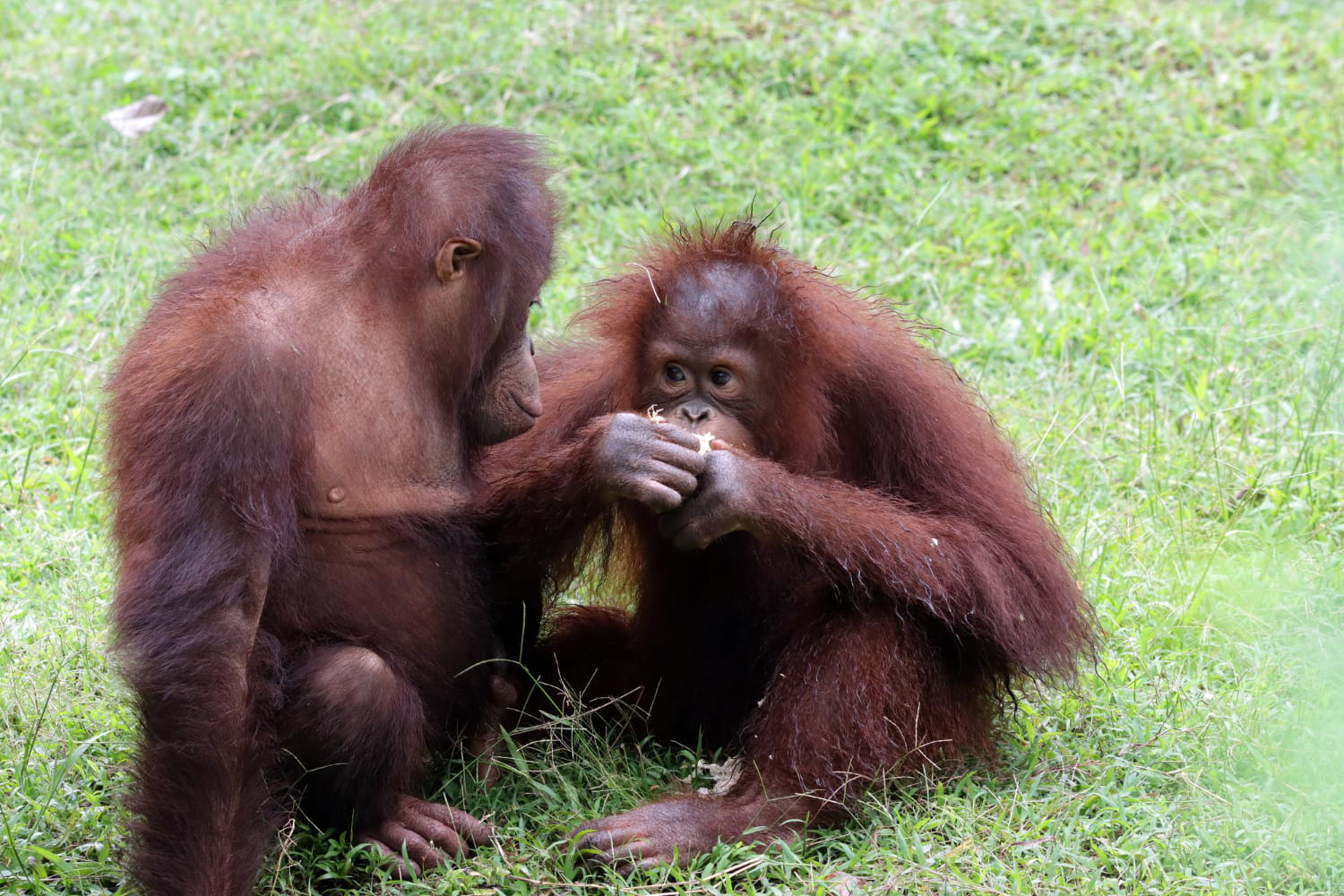
Orangutans are among the most remarkable and intelligent inhabitants of the tropical forests of our planet. Their behavior, lifestyle, and cognitive abilities have fascinated scientists and nature enthusiasts for decades. These great apes share many characteristics with humans, making them especially interesting subjects of study. They live in dense jungles and spend most of their lives high above the ground. Below are interesting facts about orangutans, including many fascinating details that you may not have known before.
- The word “orangutan” comes from the Malay language. It is derived from words that literally mean “person of the forest.” These animals received this name because of their resemblance to humans. Local communities noticed their intelligence and unusual behavior long ago.
- Orangutans naturally live on only two major islands in the world. Their wild populations survive on Borneo and Sumatra. In the past, the range of these primates was much larger. Over time, it declined because of human activity and deforestation.
- Scientists currently recognize three species of orangutans. These are the Bornean orangutan, the Sumatran orangutan, and the Tapanuli orangutan. The last species was officially described only in the twenty-first century. It is considered one of the rarest great apes on Earth.
- Orangutans are among the largest tree-dwelling animals in the world. They spend most of their lives among branches and forest canopies. Even large males can move skillfully at considerable heights. This lifestyle helps them avoid many dangers.
- The arm span of an adult male can exceed two meters. This is considerably greater than the animal’s height. Their long arms allow them to reach distant branches with ease. As a result, orangutans can travel through forests without frequently descending to the ground.
- Orangutans are regarded as some of the most intelligent animals on the planet. They can solve complex problems and learn through observation. In scientific studies, these primates demonstrate impressive logical reasoning skills. Their intelligence is often compared to that of young children.
- These animals actively use tools. They may use sticks to extract insects or seeds from difficult locations. Some populations have developed their own traditions regarding tool use. This suggests the presence of cultural behaviors.
- Orangutans are capable of teaching their offspring. Young individuals carefully observe their mothers and gradually acquire essential skills. In this way, knowledge about finding food and moving safely through the forest is passed from one generation to the next. The learning process can continue for many years.
- Maternal care among orangutans is one of the longest in the animal kingdom. A young orangutan may remain with its mother for as long as eight or nine years. During this period, it learns everything necessary for independent survival. Such a prolonged bond is rare among animals.
- Orangutans reproduce very slowly. Females typically give birth to a single infant every seven or eight years. This is the longest interval between births among all land mammals. As a result, populations recover very slowly when their numbers decline.
- Fruit forms the foundation of the orangutan diet. They are especially fond of figs, durians, and other tropical fruits. In addition to fruit, they may consume leaves, bark, flowers, and insects. Their diet changes depending on the season and food availability.
- Orangutans play an important role in seed dispersal. By eating fruit, they transport seeds across large distances. This helps regenerate tropical forests. Because of this ecological function, they are sometimes called the gardeners of the jungle.
- Every evening, orangutans build a new nest for sleeping. They accomplish this by bending and weaving together tree branches. The structure can be completed in just a few minutes. The old nest is usually abandoned the following morning.
- Some nests contain additional features. Orangutans may create roof-like coverings from leaves to protect themselves from rain. They sometimes add soft bedding for greater comfort. Such behavior demonstrates a high level of ingenuity.
- Male orangutans are capable of producing extremely loud vocalizations. Their so-called long call can be heard from several kilometers away. They use this sound to announce their presence and establish territory. It is one of the most distinctive characteristics of the species.
- Adult males develop large cheek pads. These structures consist of fatty and connective tissues. They make the face of a mature male instantly recognizable. Scientists believe they help impress both rivals and potential mates.
- Genetically, orangutans are very closely related to humans. They share approximately 97 percent of their DNA with people. For this reason, they are frequently studied to better understand primate evolution. Their behavior provides valuable insights into the development of human ancestors.
- Unlike gorillas and chimpanzees, orangutans are primarily solitary animals. Adult individuals spend most of their time alone. Mothers and their offspring are the main exception. This trait makes orangutans unusual among the great apes.
- Orangutans possess an excellent memory for the locations of fruit-bearing trees. They can remember when particular plants are likely to produce fruit. This ability helps them plan movements across large territories. It also demonstrates highly developed spatial memory.
- Some studies have shown that orangutans may use medicinal plants. They apply certain leaves to their bodies or chew them. Researchers believe this behavior may help relieve irritation or inflammation. Such actions continue to be the subject of scientific investigation.
- One of the greatest threats facing orangutans is the destruction of tropical forests. As their habitat disappears, their population numbers continue to decline. Forest fires and illegal wildlife trade create additional dangers. For these reasons, all orangutan species are protected.
- In the wild, orangutans can live for more than forty years. In zoos and specialized care centers, some individuals survive beyond fifty years of age. Their long lifespan allows them to accumulate extensive experience. This is another characteristic that brings them closer to humans.
- Orangutans possess distinct personalities. Some individuals are highly curious, while others behave more cautiously. Researchers have observed signs of patience, creativity, and even a sense of humor. These qualities make each orangutan unique.
Interesting facts about orangutans demonstrate just how extraordinary our closest relatives in the natural world can be. You may not have known that these primates combine remarkable intelligence, complex behavior, and an important ecological role in maintaining tropical forests. Fascinating facts about orangutans help us better appreciate the richness of life on Earth. The more people learn about these animals, the more evident the need becomes to protect them for future generations.


