
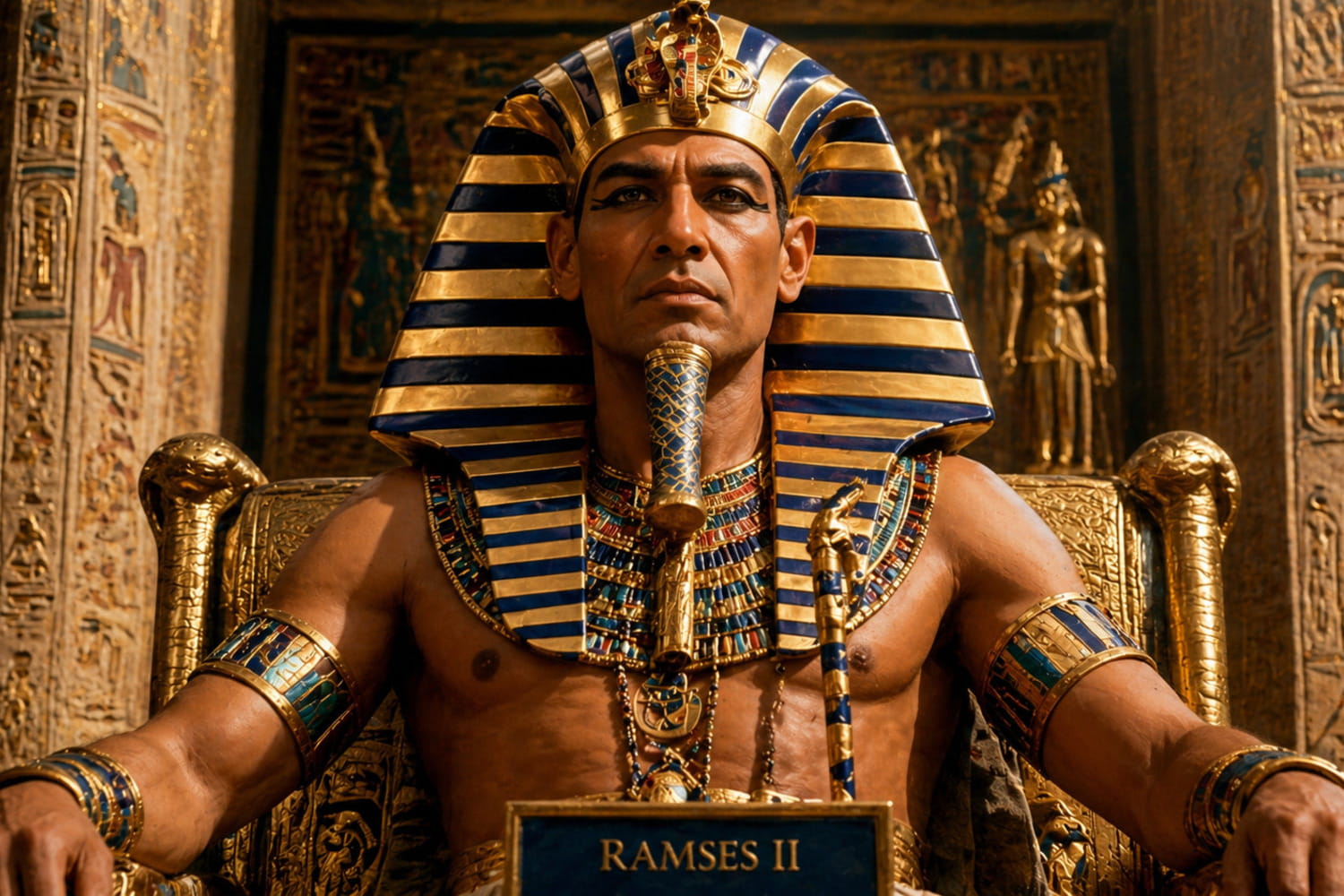
Ramesses II, one of the most outstanding pharaohs of Ancient Egypt, amazes with his long reign, grandiose construction projects, and legendary military campaigns that you might not know about until today. This ruler of the nineteenth dynasty left an indelible mark on human history, creating an empire that stretched from Nubia to Syria. Amazing facts about Ramesses II reveal the secrets of his personal life, political achievements, and cultural heritage. Fascinating facts will help you understand why this pharaoh is called Ramesses the Great and why his name remains known even three thousand years after his death. Interesting facts compiled below will be useful for both history enthusiasts and those who seek to learn more about one of the greatest figures of antiquity.
- Ramesses II ruled Egypt for sixty-six years, making him one of the longest-reigning pharaohs in the country’s history. His reign lasted from twelve seventy-nine to twelve thirteen BCE, encompassing an entire era of flourishing Egyptian civilization. Such a long reign allowed him to implement ambitious construction programs and strengthen Egypt’s international prestige. Many historians consider this period the golden age of the New Kingdom.
- Ramesses II was born approximately in thirteen hundred three BCE and lived about ninety-six years, which was an extremely rare achievement for that time. His longevity allowed him to outlive many of his heirs and personally control the development of the state for decades. Archaeological research on the pharaoh’s mummy confirms that he suffered from arthritis and dental problems in old age. Despite this, he maintained activity and mental clarity until the end of his life.
- Ramesses II had over one hundred children from numerous wives and concubines, which speaks to his large family and strategic marriage alliances. His chief wife was Queen Nefertari, to whom he dedicated one of the temples at Abu Simbel. Many of the pharaoh’s sons held high positions in the army and administration, ensuring dynastic stability. Such a large number of descendants also served as a guarantee of lineage continuation and power transfer.
- Ramesses II is known as one of the most active builders in Egyptian history, erecting numerous temples, statues, and monuments throughout the country. The most famous of these are the magnificent temple at Abu Simbel, carved into rock, and the Ramesseum, his mortuary temple at Thebes. These structures demonstrate not only the architectural mastery of the Egyptians but also the pharaoh’s desire to immortalize his name for eternity. Many of these monuments have survived to this day and amaze with their grandeur.
- The Battle of Kadesh, which took place approximately in twelve seventy-four BCE, became one of the most famous military campaigns of Ramesses II. The pharaoh personally commanded the Egyptian army in confrontation with the Hittites for control over Syria. Although the battle’s outcome was ambiguous, Ramesses II depicted it as a great victory on the walls of his temples. This event became an important element of his propaganda and image as a mighty warrior.
- After the Battle of Kadesh, Ramesses II signed one of the first known peace treaties in human history with the Hittite king Hattusili III. This treaty, known as the Treaty of Kadesh, established borders, mutual assistance, and prisoner exchange between the two states. The text of the agreement was recorded in both Egyptian and Hittite languages, which speaks to the diplomatic skill of both parties. The original treaty is preserved in museums in Cairo and Istanbul as a symbol of ancient diplomacy.
- Ramesses II moved Egypt’s capital from Thebes to the newly created city of Per-Ramesses in the Nile Delta, which had strategic significance for controlling the eastern borders. This city became a flourishing center of trade, crafts, and administrative management of the empire. Archaeological excavations have uncovered remains of palaces, temples, and residential quarters, testifying to the grandeur of the former capital. Moving the capital also allowed the pharaoh to be closer to Egypt’s Asian possessions.
- Ramesses II was known for his tendency to appropriate monuments of previous pharaohs, on which he ordered his name to be carved. Such practice allowed him to quickly increase the number of monuments bearing his name without having to build them from scratch. Modern Egyptologists can distinguish original inscriptions from later additions by the style of hieroglyphs and carving technique. This feature complicates the precise determination of authorship for many ancient Egyptian monuments.
- The mummy of Ramesses II was discovered in eighteen eighty-one in the cache at Deir el-Bahari, where priests hid royal mummies from grave robbers. Research on the mummy showed that the pharaoh had red hair, tall stature, and suffered from atherosclerosis. In nineteen seventy-four, the mummy was transported to Paris for restoration, where it was issued an official passport with the profession “king”. This case became a unique example of the treatment of ancient artifacts in the modern world.
- Ramesses II depicted himself in the form of a god on numerous statues and reliefs, which emphasized his divine status in Egyptian religion. He was often depicted together with the gods Ra, Amun, and Ptah, which symbolized his connection with divine forces. Such iconography strengthened the pharaoh’s authority among the priesthood and the population. Many of these images have been preserved on temple walls and in tombs.
- Ramesses II founded the city of Ramesses in the region of Goshen, where, according to biblical traditions, the Israelites lived during their stay in Egypt. This city became an important center for foreign workers and traders, which contributed to the economic development of the region. Archaeological finds confirm the presence of Semitic peoples in this area during the pharaoh’s reign. This fact arouses interest among researchers of biblical history and the ancient Near East.
- Ramesses II pursued an active foreign policy, concluding marriage alliances with foreign states to strengthen international relations. He married a Hittite princess, which became a symbol of peace and cooperation between two former enemies. Such diplomacy allowed Egypt to maintain influence in the region without constant military conflicts. Marriage alliances also contributed to cultural exchange and trade between countries.
- Ramesses II is known for his grandiose statues, some of which reach heights of over twenty meters and weigh hundreds of tons. The most famous is the colossal statue of the pharaoh in Memphis, which amazes with its detail and craftsmanship. These monuments served not only as decoration for temples but also as reminders of the might and eternity of the pharaoh’s power. Many statues have been damaged by time, but their remains continue to amaze modern visitors.
- Ramesses II paid great attention to the development of irrigation systems and agriculture, which ensured the prosperity of the Egyptian economy. The construction of canals and reservoirs allowed increasing the area of cultivated land and raising yields. Such infrastructure projects also created jobs and strengthened the population’s loyalty to authority. Economic stability became the foundation for implementing the pharaoh’s ambitious construction programs.
- Ramesses II left behind numerous inscriptions and accounts of his achievements, which became valuable sources for studying ancient Egyptian history. These texts, carved on temple walls and stelae, describe military campaigns, construction work, and religious ceremonies. Although they often have a propagandistic character, they provide unique information about the politics and culture of that time. Modern historians carefully analyze these sources to reconstruct ancient events.
- Ramesses II became the prototype of the pharaoh in many literary works, films, and artistic works of modernity, which emphasizes his cultural influence. His image is often associated with power, wisdom, and longevity, inspiring creators of different eras. The film “The Ten Commandments” and other popular works popularized the name of Ramesses II among a wide audience. Such cultural heritage ensures continued interest in his personality and era.
- Ramesses II was known for his love of lion hunting, which was considered a symbol of courage and royal power in Ancient Egypt. Temple reliefs depict the pharaoh defeating wild beasts, which emphasized his role as protector of order and harmony. Such images had not only decorative but also ideological significance, strengthening the ruler’s authority. Hunting also served as a form of military training and demonstration of physical strength.
- Ramesses II established a cult of his own personality during his lifetime, which was a rare phenomenon in ancient Egyptian tradition. He ordered himself to be worshipped as a god in temples throughout the country, which strengthened his divine status. Such a cult contributed to the centralization of power and strengthening the loyalty of the priesthood to the pharaoh. After Ramesses II’s death, his cult continued to exist, influencing Egypt’s religious life for centuries.
- Ramesses II left behind a legacy that influenced subsequent generations of pharaohs, who tried to emulate his achievements. His name became a symbol of power and success, inspiring rulers to ambitious projects and military campaigns. Many later pharaohs added his name to their titles, seeking to associate themselves with his glory. This influence testifies to the exceptional place of Ramesses II in the history of Ancient Egypt.
Fascinating facts about Ramesses II demonstrate how this outstanding personality combined military mastery, political wisdom, and cultural heritage, leaving an indelible mark on history. Amazing facts remind us of the importance of preserving ancient monuments and studying history to understand the modern world. Interesting facts inspire deeper exploration of ancient Egyptian civilization and awareness of Ramesses II’s contribution to human development. This collection of knowledge serves as a solid foundation for those who seek to better understand the era of Ramesses II and its significance for world history.


