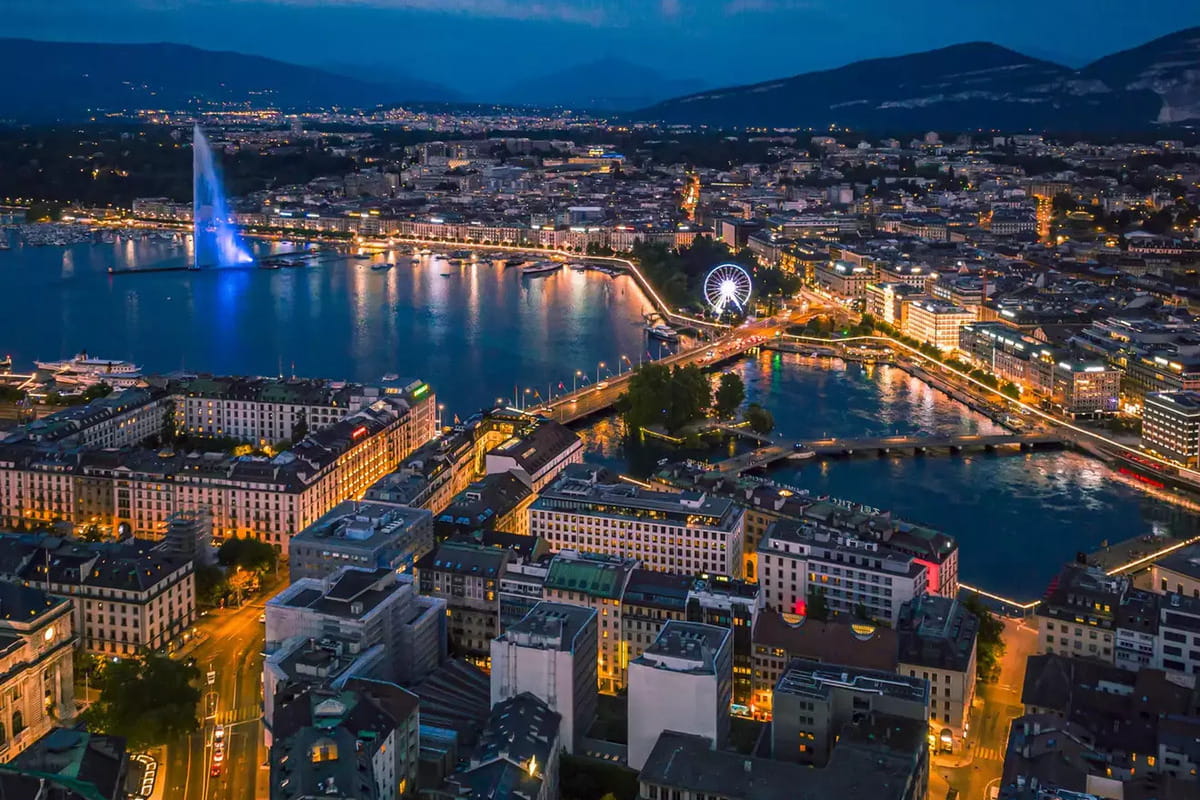
Geneva is a city that contains an entire world within itself, despite being one of the smallest major cities in Europe. Hundreds of international organisations are based here, a famous fountain sends its jet soaring above the blue lake, and the streets unite medieval architecture with ultramodern scientific laboratories. Geneva is a symbol of neutrality, diplomacy, and humanism — it is from here that, over the course of centuries, voices rang out that changed the destinies of nations. If you think you know everything about this city, then the fascinating facts about Geneva will reveal entirely unexpected facets of this unique point on the map of the world. We present to you interesting facts about Geneva that will make you look at this city with completely new eyes.
- Geneva is the city with the greatest number of international organisations per capita of any city in the world. The headquarters of the World Health Organization, the International Labour Organization, the World Trade Organization, the United Nations Office, and dozens of other influential bodies are all located here. Thanks to this, Geneva is known as the unofficial capital of world diplomacy, yielding only to New York in terms of the number of international institutions.
- The famous Jet d’Eau fountain on Lake Geneva is one of the tallest fountains in the world — its jet of water rises to a height of 140 metres. Every second it propels 500 litres of water into the air, which disperses into fine droplets and in windy weather can drench passers-by on the embankment. The fountain was originally created in 1891 as a safety valve to release excess pressure in the city’s hydraulic system.
- Geneva is home to the European Organisation for Nuclear Research, known as CERN — one of the most influential scientific institutions in the world. It was here, in 1989, that British scientist Tim Berners-Lee invented the World Wide Web, which changed human civilisation forever. Beneath the ground on the border between Switzerland and France runs the Large Hadron Collider, which is 27 kilometres in length.
- Geneva is among the cities with one of the highest standards of living in the world and regularly occupies top positions in international quality-of-life rankings. The average salary in the city is one of the highest in Europe; however, the cost of living here is correspondingly high. A cup of coffee in a Genevan café can cost more than a full meal in many other European cities.
- The Red Cross — one of the most well-known humanitarian organisations in the world — was founded in Geneva in 1863 by Swiss businessman Henri Dunant. Dunant was so deeply shaken by the horrors of the Battle of Solferino that he dedicated his life to creating a system for the protection of wounded soldiers. Today the headquarters of the International Committee of the Red Cross remains in Geneva.
- The Geneva Conventions — four international treaties governing the rules of warfare and the protection of civilian populations — were signed in this very city. The first convention was adopted as early as 1864, and their modern version, signed in 1949, has been ratified by virtually every state in the world. These documents form the foundation of international humanitarian law and remain relevant to this day.
- Geneva is one of the world’s leading centres of the watchmaking industry, although the majority of production is concentrated in the neighbouring cantons. The Genève hallmark on a watch dial is a quality mark confirming compliance with the highest standards of Swiss watchmaking. The city is home to the offices of such legendary brands as Rolex, Patek Philippe, and Chopard.
- Lake Geneva, on the shore of which the city is situated, is the largest freshwater lake in Western Europe. Its surface area is approximately 580 square kilometres, and its maximum depth reaches 310 metres. The lake is shared between Switzerland and France, with the Swiss portion bearing the name Lac Léman rather than Lac de Genève, as many foreign tourists mistakenly assume.
- Jean Calvin, one of the most influential figures of the Protestant Reformation, made Geneva his base in the sixteenth century and transformed it into the centre of Calvinism. Under his influence the city acquired a reputation as a strict religious centre where theatres, card games, and even excessively bright clothing were all prohibited. Calvin’s legacy continues to be felt in the urban culture and architecture of Geneva to this day.
- Geneva is the birthplace or long-term home of many outstanding figures in world history. The philosopher Jean-Jacques Rousseau, who was born in Geneva in 1712 and whose ideas profoundly influenced the French Revolution, lived and worked here. Geneva was also the long-term residence of Voltaire, Lord Byron, and Mary Shelley, who wrote Frankenstein while staying in the city.
- The city has a trilingual character — the official language of the canton of Geneva is French; however, owing to the enormous number of international civil servants, English and numerous other languages are widely used here. Approximately 40 percent of the city’s population consists of foreign nationals, making Geneva one of the most cosmopolitan cities in Europe. In certain districts of the city, French can be heard on the streets less frequently than English or Spanish.
- Geneva occupies a very modest area — the canton of Geneva is the smallest canton in Switzerland after the canton of Basel-City. The total area of the canton amounts to only approximately 282 square kilometres, with the city being almost entirely surrounded by French territory and connected to the rest of Switzerland only by a narrow corridor a few kilometres wide. This geographical peculiarity makes Geneva a genuine enclave within Switzerland.
- Geneva is home to one of the oldest universities in Europe — the University of Geneva, founded by Jean Calvin in 1559. Today it is one of the world’s leading research universities, educating students from more than 150 countries. The university is particularly renowned for its faculties of law, international relations, and the natural sciences.
- Geneva is one of the greenest cities in Europe — more than one third of its area is occupied by parks, gardens, and green spaces. The Parc des Bastions, laid out in the nineteenth century, is a favourite place of rest for Genevans and tourists alike, where one can play giant chess in the open air. The lake embankments are adorned with flower beds and tree-lined avenues, making walks along the water a genuine pleasure at any time of year.
- The Palace of Nations in Geneva is the second largest United Nations headquarters in the world after the one in New York. It was built between 1929 and 1938 as the seat of the League of Nations — the predecessor of the United Nations. Every year thousands of international negotiations, conferences, and sessions are held here, and tourists may visit the building on organised tours.
Geneva is a city that long ago transcended the boundaries of an ordinary national capital and became a true heritage of all humanity. The incredible facts about Geneva demonstrate that this small patch of land concentrates a disproportionately large share of the world’s diplomacy, science, and humanism. You might not have known how profoundly this city has influenced the formation of modern international law, science, and even the internet. Geneva continues to be a place where ideas are born that change the world — and it is precisely in this that its unrivalled uniqueness lies.


