
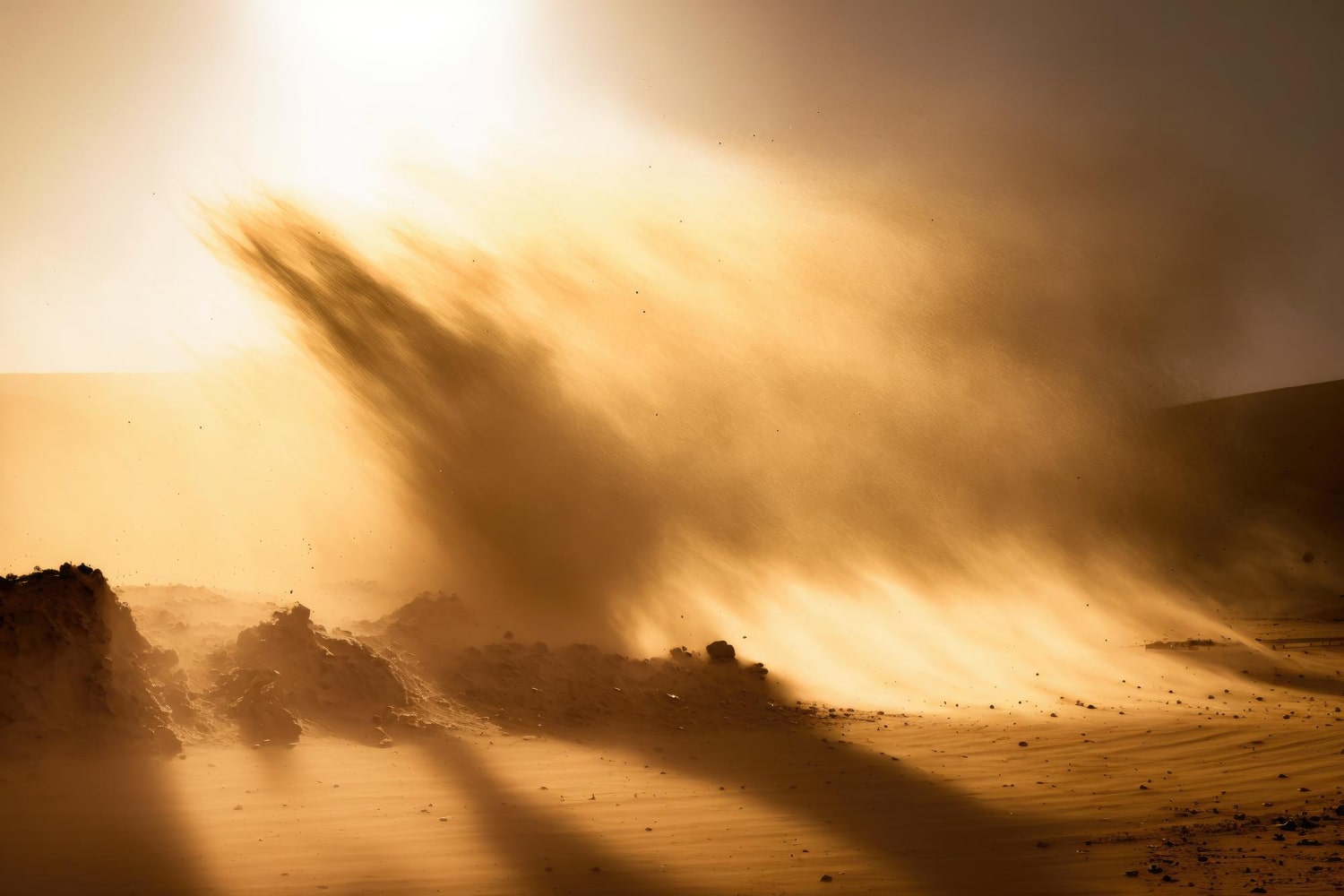
Sandstorms have fascinated and frightened people for centuries with their power, scale, and unpredictability. Within just a few hours, they can transform landscapes, disrupt climate conditions, and affect the daily lives of entire regions. You may not know that these phenomena are not purely destructive but also play an important role in natural processes. Interesting facts and incredible facts about sandstorms help explain how they form and why they are significant on a global scale. Fascinating facts from both history and modern science reveal unexpected sides of this dramatic natural event.
- Sandstorms occur when strong winds lift vast amounts of sand and dust from the ground. They are most common in arid and semi-arid regions. The lack of vegetation leaves the soil exposed and vulnerable to wind erosion. As a result, fine particles are easily carried into the air.
- During a sandstorm, dust and sand particles can rise several kilometers above the surface. These particles may travel thousands of kilometers from their original source. This is why dust from African deserts can reach Europe and the Americas. You may not know that such movements are closely monitored by satellites.
- Sandstorms can drastically reduce visibility. In extreme cases, visibility drops to nearly zero. This creates highly dangerous conditions for transportation. Air travel and road traffic are often delayed or completely suspended.
- The force of some sandstorms is strong enough to damage buildings. Fine particles act like abrasive material and slowly wear down surfaces. Glass, metal, and painted structures suffer long-term erosion. This is one of the incredible facts showing how sandstorms cause gradual but serious damage.
- Sandstorms have a negative impact on human health. Dust particles can penetrate deep into the respiratory system. This may trigger breathing difficulties, allergic reactions, and worsening of chronic illnesses. Children and elderly people are especially vulnerable.
- Not all sandstorms consist mainly of sand. Many are dominated by extremely fine dust. This dust remains suspended in the atmosphere for longer periods. As a result, air quality deteriorates across large regions.
- Sandstorms influence the global climate system. Dust particles can reflect or absorb sunlight. This affects the balance of solar radiation reaching the Earth’s surface. In some areas, temporary cooling of the air can be observed.
- Dust carried by sandstorms contains minerals and nutrients. When it settles, it enriches soils far from desert regions. This process improves fertility in distant ecosystems. It is one of the fascinating facts showing that sandstorms can have beneficial effects.
- Sandstorms also affect ocean ecosystems. Dust that settles into the sea often contains iron and other elements. These nutrients stimulate the growth of phytoplankton. This influences marine food chains and biological productivity.
- Some sandstorms last only a few hours. Others can persist for several days without weakening. Their duration depends on weather patterns and terrain features. The largest storms may cover the territory of entire countries.
- Sandstorms have been known to humanity since ancient times. They were described in historical records and religious texts. In the past, people viewed them as signs of nature’s wrath. Modern science has provided clear explanations of their causes.
- In different parts of the world, sandstorms have their own local names. These names reflect regional climate conditions and cultural traditions. This shows how widespread the phenomenon is. You may not know that sandstorms behave differently depending on location.
- Sandstorms can reshape desert landscapes. Wind-driven sand dunes migrate over time. Gradually, the terrain takes on a completely new appearance. These changes occur slowly but continuously.
- Modern technology makes it possible to predict sandstorms. Meteorologists rely on satellite imagery and advanced computer models. This allows authorities to warn populations in advance. Early warnings help reduce risks to life and property.
- Human activity can intensify sandstorms. Excessive farming and removal of vegetation expose the soil. This makes it easier for dust to be lifted by wind. In this way, human actions contribute to increased storm frequency.
- Sandstorms are capable of transporting microorganisms. Bacteria and fungal spores can travel with dust clouds. They may cross vast distances before settling. This influences biological processes in regions far from the storm’s origin.
- In some countries, sandstorms are part of a regular seasonal cycle. Local populations have adapted their lifestyles to these conditions. Special building techniques and protective clothing are commonly used. This demonstrates human adaptation to harsh natural forces.
- Sandstorms also affect solar energy production. Dust accumulates on solar panels and reduces their efficiency. Regular cleaning becomes essential. This is one of the modern challenges linked to sandstorm activity.
Interesting facts about sandstorms show that this phenomenon is far more complex than it appears at first glance. Incredible facts about their impact on climate, nature, and human life reveal their global significance. Fascinating facts help us understand that sandstorms are not only a threat but also a key element of natural balance. You may not know that understanding this phenomenon is essential for preparing for future environmental challenges.


