
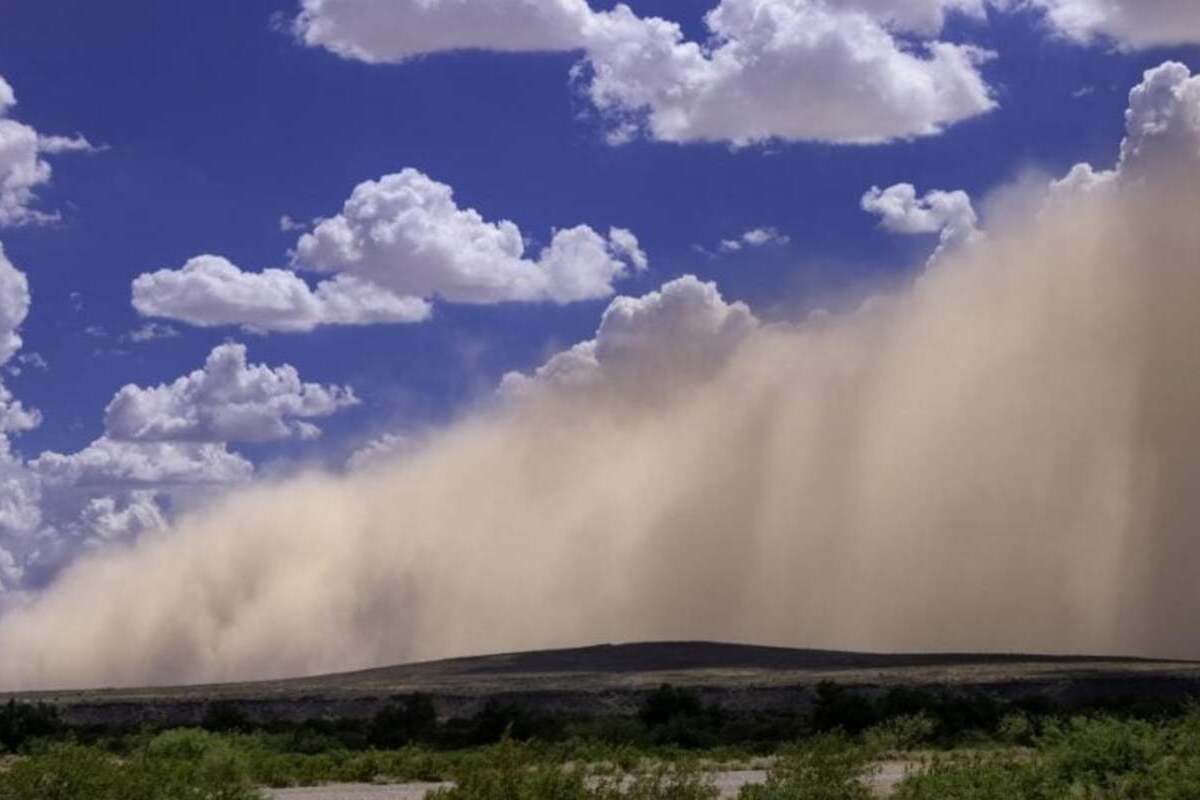
Dust devils have long captured people’s attention with their unusual shape and their ability to appear suddenly even on a perfectly clear day. They often look mysterious or even unsettling, yet the phenomenon itself is driven by well-understood physical processes. In this article you will find interesting facts you may not have known, as well as explanations of how these rotating air columns form. Their impressive variety shows that dust devils can appear both in deserts and in cities, creating fascinating facts about air motion and the interaction of natural forces. Such knowledge helps us better understand atmospheric behaviour and the role of small-scale phenomena in its dynamics.
- Dust devils form when the ground becomes strongly heated by the sun, releasing upward streams of warm air. As this rising air begins to rotate, it pulls in dust, leaves or sand from the surface. Due to the high speed of the swirling particles, the column takes on a cone-like or cylindrical shape. This structure makes the phenomenon visible from a considerable distance.
- Dust devils can form only during calm or very light wind conditions. Stronger airflow disrupts the vortex and prevents it from developing fully. This is why they appear most often on hot, sunny days. Their dependence on weather explains why dust devils are more common in certain seasons than in others.
- Dust devils are not related to thunderstorms, although they may resemble miniature tornadoes. Their key difference is the lack of a storm cloud or any higher energy source feeding the vortex. They form independently and usually last only a short time. As a result, they are generally harmless in most situations.
- The height of dust devils can range from just a few metres to several hundred metres. Their size depends on how intensely the ground is heated and the turbulence level of the surrounding air. The hotter the surface, the more energetic the vortex becomes. This is why desert dust devils tend to be especially large and striking.
- In urban areas dust devils often form above asphalt or concrete surfaces, which heat up more quickly than natural soil. These conditions produce small whirlwinds that lift dust, lightweight trash or leaves into the air. Such mini vortices are easy to spot during hot summer days. They demonstrate the sensitivity of dust devil formation to thermal contrasts.
- A dust devil may abruptly change direction due to subtle variations in airflow around it. The vortex can shift unpredictably, making its path hard to anticipate. Sometimes it turns suddenly or dissipates in an instant. This instability is characteristic of turbulent atmospheric processes.
- In desert regions dust devils can carry large amounts of sand, creating temporary sand curtains that reduce visibility. This makes travel more challenging for people and vehicles. Occasionally the vortex picks up small stones which may cause minor damage. Caution is essential when moving through such environments.
- Dust devils are short-lived because they lack a stable energy source. They typically vanish within seconds or minutes once the airflow pattern changes. Their brief lifespan makes them difficult to study directly in the field. Scientists often rely on video recordings and computer simulations to analyse their behaviour.
- Although usually small, some dust devils can strengthen enough to lift light objects. These stronger vortices form when there is a sharp temperature difference between the ground and the air above it. They are still not destructive, but can surprise or frighten observers. Such events are uncommon but well documented.
- Dust devils are often confused with fire whirls, though the two phenomena are entirely different. Fire whirls emerge in burning environments, carrying flames and embers, and are extremely dangerous. Ordinary dust devils, by contrast, contain no combustion. Distinguishing between them is important for safety.
- The air inside a dust devil can be slightly warmer than the surrounding atmosphere. This occurs because rising warm air combines with the rotating motion of the vortex. Together these factors create a small zone of increased turbulence. These effects can be felt clearly when standing close to a dust devil.
- Dust devils are observed not only on Earth but also on Mars. Due to the planet’s thin atmosphere and strong temperature contrasts, Martian dust devils can be far larger than their terrestrial counterparts. Some reach several kilometres in height. This makes Mars an exceptional natural laboratory for studying such phenomena.
- Martian dust devils play an important role in redistributing dust across the planet’s surface. They influence how sunlight is reflected and affect climate processes. They may also pose risks to rovers and scientific instruments. For this reason, space agencies continuously monitor them using orbital spacecraft.
- Dust devils provide valuable clues about temperature distribution over land surfaces. Their formation indicates areas of especially strong heating. This helps meteorologists better understand local weather anomalies. Such observations aid in forecasting certain atmospheric processes.
- In agricultural regions dust devils can transport seeds and tiny soil particles. In some cases this helps plants spread to new areas. However, it can also lead to the mixing or depletion of fertile topsoil. The overall impact depends on the type of soil and local climate conditions.
- Large dust devils can produce distinctive sounds when swirling sand or gravel rubs together. The resulting noise may resemble a soft hiss or whistle, adding to the phenomenon’s mysterious atmosphere. These sounds arise from particle friction within the rotating air flow. They are most easily heard in desert environments.
These fascinating facts about dust devils show how varied and impressive this natural phenomenon can be. You may not have known how such small whirlwinds influence climate processes, particle transport and local weather patterns. Studying them helps us better understand atmospheric dynamics on Earth and on other planets. Dust devils serve as a reminder of the complexity and beauty of natural processes shaping our world.


