
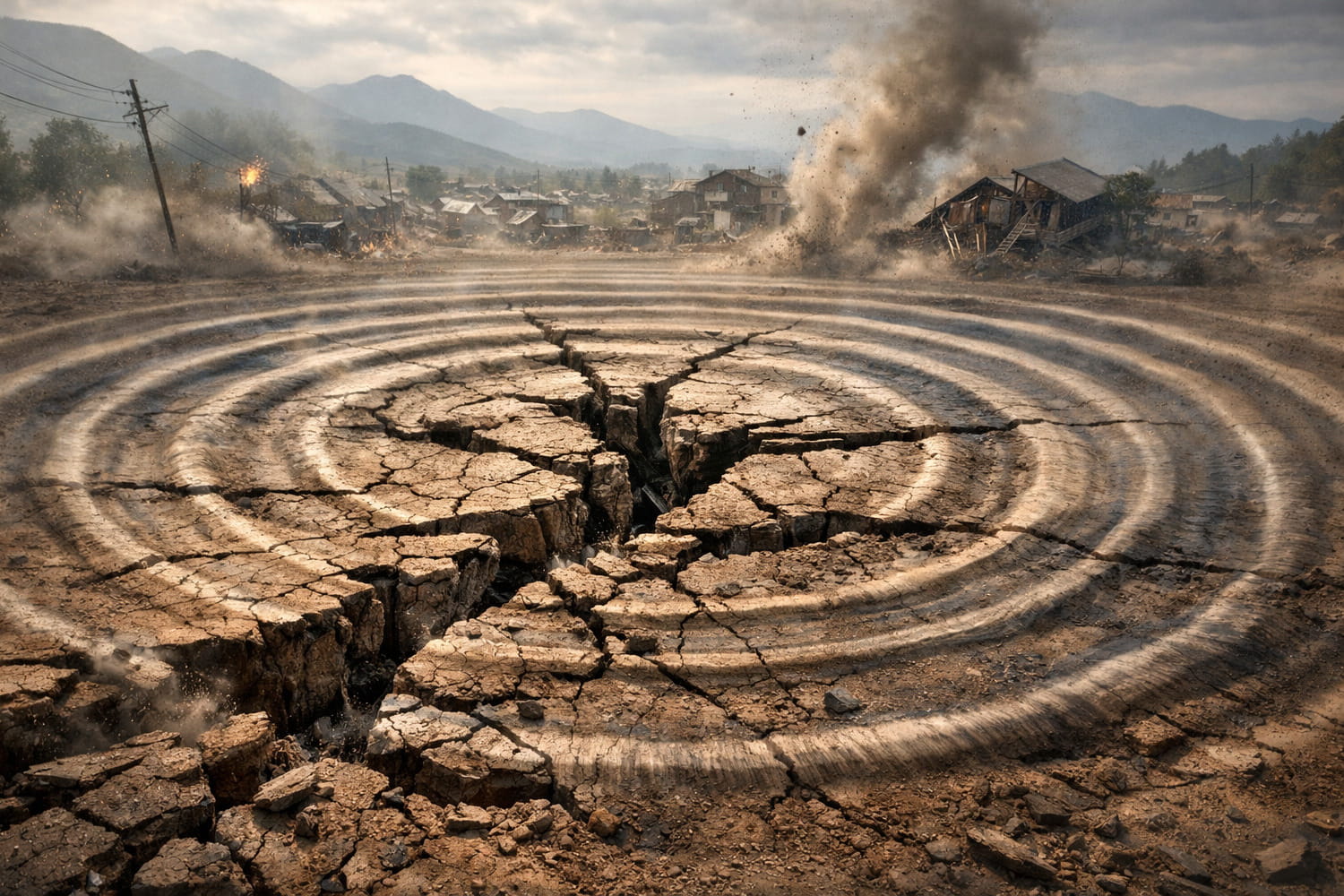
When the ground shakes beneath our feet during an earthquake, few people stop to consider what a complex and simultaneously remarkable physical picture is unfolding at that very moment in the depths of the planet. Seismic waves are not merely vibrations of the ground — they are a kind of language in which the Earth tells scientists about its internal structure, its history, and even its future. Interesting facts about seismic waves reveal a fascinating world in which physics, geology, and mathematics merge into a single instrument for understanding our planet. Thanks to the study of these waves, humanity has learned what lies hidden at depths of thousands of kilometres beneath our feet, without having drilled a single borehole to such depths. Incredible facts about seismic waves will convince you that these invisible vibrations are one of the most powerful tools for the scientific understanding of nature.
- Seismic waves are divided into two principal types — body waves, which travel through the interior of the Earth, and surface waves, which move along the surface of the planet. Body waves are in turn divided into primary, or P-waves, and secondary, or S-waves. Surface waves come in two varieties — Rayleigh waves and Love waves, named after the scientists who described them theoretically. It is precisely the surface waves that cause the greatest destruction during earthquakes, despite the fact that they travel more slowly than body waves.
- P-waves, or primary waves, are the fastest of all types of seismic waves and are the first to be recorded by seismographs after an earthquake — it is precisely for this reason that they received their name. They are longitudinal compression waves in which the particles of the medium vibrate in the same direction as the wave is travelling. P-waves are capable of travelling through solids, liquids, and gases, which distinguishes them from other types of seismic waves. In the upper mantle of the Earth their speed reaches approximately 8 kilometres per second, whereas in the Earth’s crust it amounts to approximately 6 kilometres per second.
- S-waves, or secondary waves, are transverse shear waves in which the particles of the medium vibrate perpendicularly to the direction in which the wave is travelling. They move approximately twice as slowly as P-waves and are recorded by seismographs second in sequence. The most important property of S-waves is that they are incapable of travelling through liquids. It was precisely this property that became the key evidence that the outer core of the Earth is in a liquid state — scientists discovered that S-waves do not pass through it.
- Rayleigh waves, named after the English physicist Lord Rayleigh, who theoretically predicted their existence in 1885, represent a particular kind of surface wave during the propagation of which the particles of the medium move along elliptical trajectories in the vertical plane. This kind of motion resembles the motion of waves on the surface of the ocean, which is why Rayleigh waves are sometimes referred to as an underground sea. They travel at a speed amounting to approximately 92 percent of the speed of S-waves and are the most destructive of all types of seismic waves. During a powerful earthquake it is precisely the Rayleigh waves that are responsible for the characteristic swaying of buildings and of the surface of the ground.
- Love waves, discovered by the British mathematician Augustus Love in 1911, are horizontal transverse surface waves in which the particles of the ground vibrate horizontally and perpendicularly to the direction in which the wave is travelling. They move more quickly than Rayleigh waves and are particularly dangerous for underground pipelines, cables, and the foundations of structures. Love waves are generated only under conditions where the speed of S-waves increases with depth, which is a typical situation in real geological cross-sections. Their characteristic horizontal motion is not infrequently the cause of the destruction of buildings when they are subjected to lateral loads for which they were not structurally prepared.
- By studying the character of the passage of seismic waves through the Earth, scientists were able to construct a detailed model of the internal structure of our planet — identifying the Earth’s crust, the mantle, the liquid outer core, and the solid inner core. This method of investigating the interior of the planet by means of seismic waves is often compared to medical tomography — both methods make it possible to see inside an opaque object. The boundary between the Earth’s crust and the mantle, discovered by the Croatian seismologist Andrija Mohorovičić in 1909, is called the Moho discontinuity and remains to this day the subject of intensive research. It is precisely thanks to the analysis of seismic waves that we know the Earth is composed of concentric layers that differ significantly from one another in their composition and physical properties.
- The speed at which seismic waves travel depends on the elastic properties and density of the rock through which they pass, and consequently changes in different layers of the Earth. At the boundaries between layers of different composition, waves are refracted and reflected, in a manner similar to the way in which light is refracted at the boundary between water and air. By analysing these effects, seismologists are able to determine the depth and composition of geological layers at great depths. A sharp change in the speed of seismic waves at a particular depth is a reliable indicator of a change in the composition or state of matter in the interior of the planet.
- Seismic waves generated by powerful earthquakes are capable of travelling around the entire Earth several times and of being recorded by seismographs throughout the world long after the seismic disturbance itself has ceased. After an earthquake of enormous magnitude, the planet literally rings like a bell, and scientists record what are known as the free oscillations of the Earth. The longest-lasting of these oscillations have very low frequencies, and the duration of a single cycle ranges from several minutes to several tens of minutes. The study of these free oscillations has provided scientists with extraordinarily valuable information about the elastic properties of the deep interior of the Earth.
- The solid inner core of the Earth was discovered in 1936 by the Danish seismologist Inge Lehmann, precisely through the analysis of the pattern of propagation of P-waves. She noticed that P-waves, which were expected to fall within the so-called seismic shadow zone — a region where they are not recorded owing to the liquid outer core — were nevertheless detected there, albeit with a displacement. This meant that inside the liquid outer core there had to exist a solid inner core that refracts and reflects the waves. Lehmann’s discovery is one of the most striking examples of how seismic waves make it possible to peer into the very deepest layers of the interior of the planet.
- Seismic waves are used not only for the study of earthquakes but also for applied purposes — above all in the exploration for oil and gas. The method of seismic prospecting is based on the analysis of reflected and refracted waves generated by artificially created explosions or vibrational sources, and makes it possible to map geological structures at depths of up to several kilometres. Thanks to this method, the overwhelming majority of known oil and gas deposits throughout the world have been discovered. Modern three-dimensional seismic surveying makes it possible to construct detailed three-dimensional models of subsurface geological structures with a resolution measured in metres.
- Tsunamis, which are frequently confused with seismic waves, are in reality a separate phenomenon — they are waves on the surface of the ocean excited by an underwater earthquake, a volcanic eruption, or an underwater landslide. However, an underwater earthquake generates both genuine seismic waves in the solid rocks of the ocean floor and a tsunami in the body of the water. Seismic waves from an underwater earthquake reach the shore considerably earlier than a tsunami, which makes it possible to use them for early warning of danger. Modern early warning systems for tsunamis are based precisely on the instantaneous recording of seismic waves and the calculation of the parameters of a potential tsunami.
- Seismic waves are recorded not only on Earth — seismometers were installed on the Moon as part of the Apollo missions and recorded lunar earthquakes, known as moonquakes. Moonquakes proved to be extraordinarily unusual in comparison with terrestrial earthquakes — they last considerably longer, sometimes up to an hour, whereas terrestrial earthquakes last seconds or minutes. The reason for this difference is the absence of water on the Moon and the more brittle, homogeneous structure of lunar rocks, which absorb virtually no seismic energy. Analysis of lunar seismic waves demonstrated that the Moon also possesses an internal structure comprising a crust, a mantle, and possibly a small metallic core.
- Extremely powerful nuclear explosions generate seismic waves that in terms of their pattern of propagation closely resemble waves from underground earthquakes, which makes it possible to use the global network of seismographs to monitor prohibited nuclear tests. The International Monitoring System, which functions within the framework of the Comprehensive Nuclear-Test-Ban Treaty, includes more than 170 seismic stations distributed throughout the world. Experienced seismologists are able to distinguish an underground nuclear explosion from a natural earthquake on the basis of characteristic differences in the ratio of the amplitudes of P-waves and S-waves. This capability has made seismology an important instrument of international security and nuclear arms control.
Captivating facts about seismic waves demonstrate beyond any doubt that these invisible vibrations are something considerably greater than merely a side effect of earthquakes. Thanks to them, humanity has gained the ability to peer into the interior of the planet to depths of thousands of kilometres, to learn about the structure of other celestial bodies, and even to monitor compliance with international agreements on nuclear disarmament. What you might not have known about seismic waves opens up a new perspective on the way in which fundamental science, born of the need to understand a natural phenomenon, becomes a powerful instrument of technological and social progress. Seismic waves are the language of the planet, and humanity is gradually learning to read it.


