
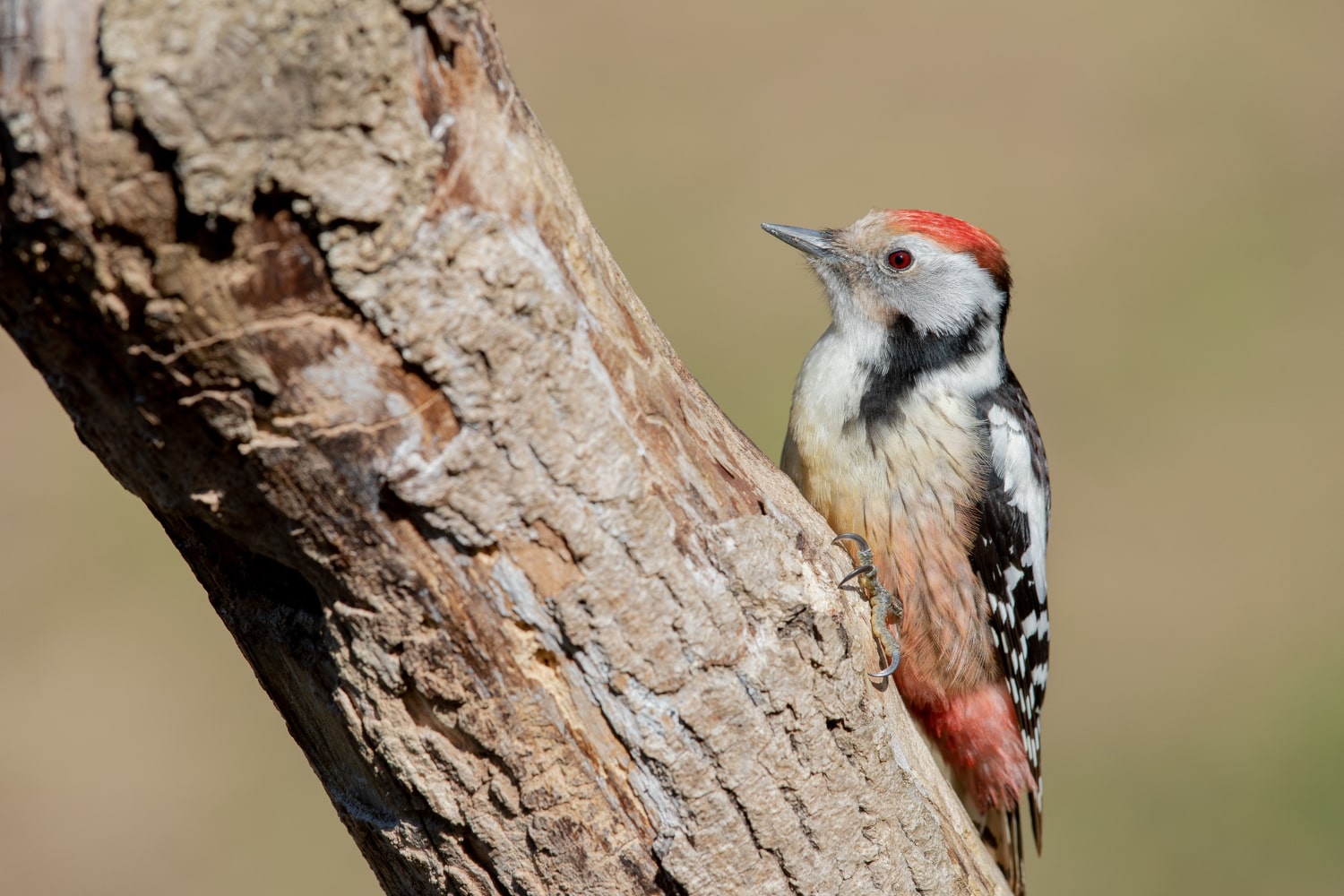
Woodpeckers may seem like familiar forest birds, yet behind their constant tapping lies an extraordinary world of biological adaptations and complex behavior. Interesting facts about woodpeckers reveal how unique their anatomy is and why they play such an important role in natural ecosystems. Fascinating facts help explain how these birds perform actions that are impossible for most other species. You may not know that the daily activity of woodpeckers directly affects the lives of many animals and plants. For this reason, learning about woodpeckers is always both educational and captivating.
- Woodpeckers are able to strike tree trunks with remarkable speed and precision. In a single second, they can deliver dozens of blows without damaging their brains. This is made possible by the special structure of their skull and powerful neck muscles. The force of each impact is safely distributed throughout the body.
- The skull of a woodpecker functions as a natural shock absorber. Its bone structure reduces vibrations caused by constant hammering. The brain is tightly secured and does not move inside the skull. This protection allows woodpeckers to peck for long periods without injury.
- A woodpecker’s tongue is extremely long relative to its body size. In some species, it wraps around the skull and extends behind the eyes. This adaptation allows the bird to extract insects from deep crevices in wood. The tip of the tongue is often sticky or equipped with tiny barbs.
- The beak of a woodpecker grows continuously while also wearing down. Daily pecking keeps it at an optimal length and shape. Without this natural abrasion, the beak would become too long and interfere with feeding. Nature has created a perfect balance between growth and wear.
- Woodpeckers have strong claws and a stiff tail. The tail acts as a support when the bird climbs vertically along tree trunks. Two toes face forward and two backward, providing excellent grip on bark. This structure makes woodpeckers experts at vertical movement.
- Most woodpeckers feed on insects hidden beneath tree bark. By consuming pests, they help protect trees from damage. In this way, woodpeckers contribute significantly to forest health. They are often described as natural caretakers of woodland ecosystems.
- Woodpeckers use drumming not only to find food but also to communicate. Each species has its own rhythm and pattern of strikes. These sounds allow individuals to recognize one another from a distance. In many cases, drumming replaces vocal singing.
- Woodpeckers excavate their own nests inside tree trunks. They usually choose soft or partially decayed wood. Creating a nesting cavity can take several weeks. Once abandoned, these cavities are often used by other animals.
- Cavities created by woodpeckers are vital for many species. Owls, songbirds, bats, and small mammals frequently move into them. Without woodpeckers, the number of natural shelters in forests would be greatly reduced. This highlights their crucial ecological role.
- Woodpeckers possess extremely sharp hearing. They can detect the subtle movements of insect larvae beneath the bark. Even faint sounds trigger targeted pecking. This sensitivity helps them conserve energy while searching for food.
- The plumage of woodpeckers often features strong contrasts. Black, white, and red markings help individuals identify members of their own species. Bright colors may also intimidate rivals. Coloration plays an important role during mating displays.
- Most woodpeckers lead a largely sedentary lifestyle. They rarely migrate over long distances. During winter, when insects are scarce, they switch to seeds, nuts, and berries. This dietary flexibility supports their survival in cold seasons.
- There are more than two hundred species of woodpeckers worldwide. They inhabit nearly every continent except Australia and Antarctica. Each species has adapted to its own environment and feeding habits. This makes the woodpecker family remarkably diverse.
- Woodpeckers sometimes peck at surfaces other than trees. Wooden houses, utility poles, or fences may attract their attention. This behavior is usually linked to food searching or attempts to attract a mate. For humans, such activity can be surprising.
- Young woodpeckers learn how to peck gradually. Their first attempts are weak and inaccurate. Over time, their muscles strengthen and their technique improves. This learning process is essential for survival in adulthood.
Woodpeckers clearly demonstrate how precisely evolution can shape living organisms. Fascinating facts about these birds reveal an impressive combination of strength, endurance, and accuracy. Surprising facts help us understand how important woodpeckers are for maintaining healthy forest ecosystems. You may not know that the familiar tapping sound in the forest represents a complex and beneficial activity that supports life all around it.


