
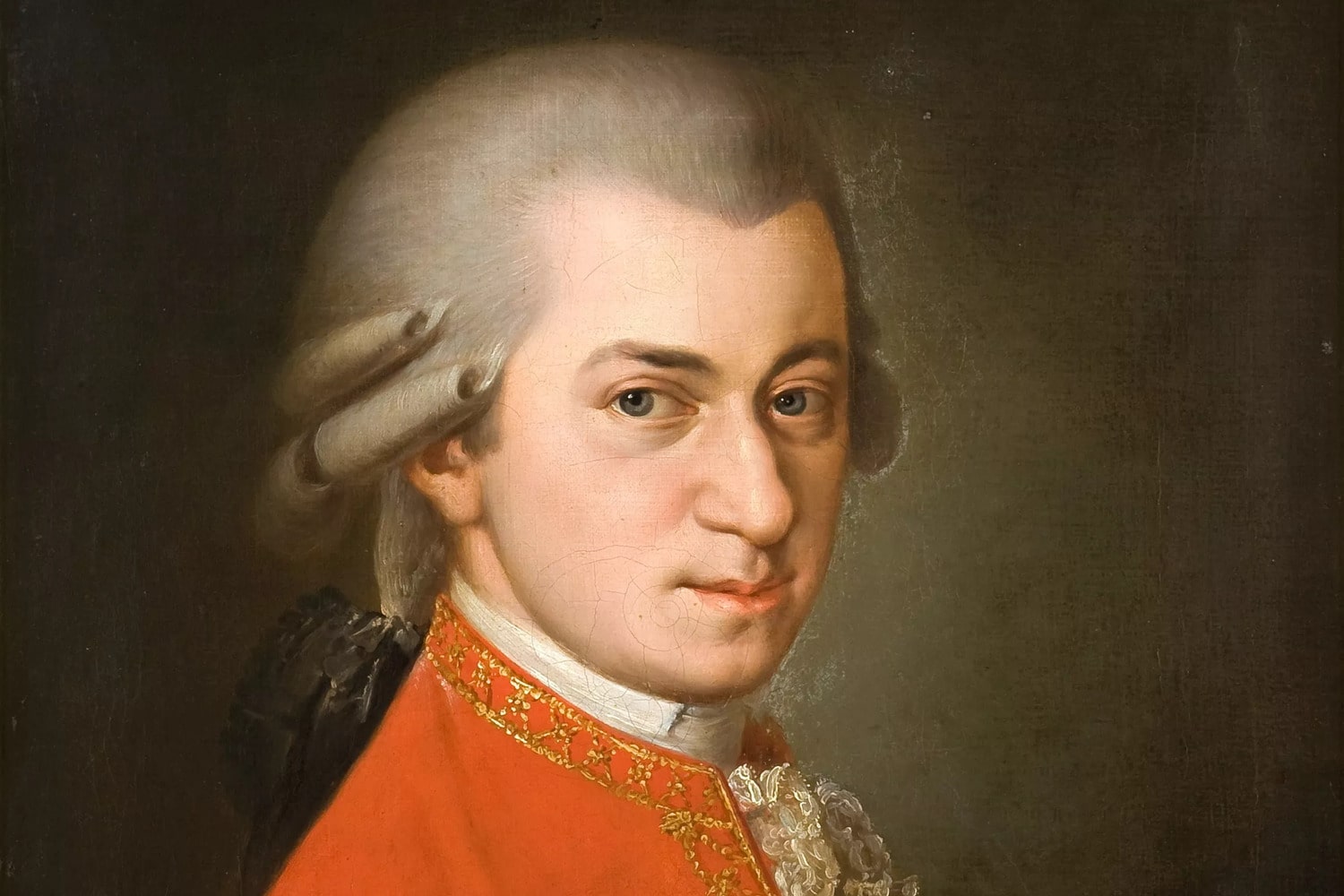
Wolfgang Amadeus Mozart is one of the greatest composers in human history, whose music continues to captivate millions of listeners around the world. This Austrian genius lived an extraordinarily short but incredibly fruitful life, leaving behind more than 600 musical works. His name has become synonymous with musical perfection and innate talent. We present to you fascinating facts about the life and work of this legendary composer that you may not have known.
- Mozart was born on January 27, 1756, in the city of Salzburg, which was then part of the Holy Roman Empire. His full name at baptism was Johann Chrysostom Wolfgang Theophil Mozart. He later Latinized his name Theophil to Amadeus, which means one who loves God. The house where the composer was born is now a museum and receives hundreds of thousands of visitors annually.
- Mozart began demonstrating musical abilities at the age of three when he started playing the harpsichord. By the age of five, he was already composing small musical pieces, which his father Leopold wrote down. At six years old, little Wolfgang, along with his sister Nannerl, embarked on his first concert tour across Europe. These early performances before royal courts brought him fame as a child prodigy.
- Mozart’s father Leopold was a renowned violinist, composer, and author of an influential treatise on violin playing. He dedicated a significant portion of his life to developing his children’s talents and organizing their tours. Leopold was a strict teacher, but it was precisely thanks to his persistence that Wolfgang received a thorough musical education. The relationship between father and son was complicated, especially in the final years of Leopold’s life.
- Mozart’s sister Maria Anna, known as Nannerl, was also an extraordinarily gifted musician. In childhood, she performed alongside her brother and was considered equally talented. However, upon reaching marriageable age, she had to end her concert career according to the social norms of the time. She outlived her brother by 38 years and died in 1829.
- At the age of six, Mozart performed before Austrian Empress Maria Theresa in Vienna. During this visit, according to legend, he slipped on the palace floor, and the young Archduchess Marie Antoinette helped him get up. The touched boy supposedly promised to marry her when he grew up. This story, although not documented, became part of Mozart mythology.
- Mozart possessed absolute pitch and a phenomenal memory. At the age of fourteen, he heard the composition Miserere by Gregorio Allegri in the Sistine Chapel, which was carefully guarded by the Vatican. After a single hearing, he wrote out the entire score from memory with minimal errors. This feat astounded the musical world and cemented his reputation as a genius.
- During his short life, Mozart created more than 600 musical works across various genres. His legacy includes 41 symphonies, 27 piano concertos, 23 string quartets, and numerous sonatas. He wrote more than 20 operas, among which are such masterpieces as The Marriage of Figaro, Don Giovanni, and The Magic Flute. Many of his works are considered the pinnacle of their respective musical genres.
- Mozart was not only a brilliant composer but also a virtuoso performer on the piano and violin. He often performed as a soloist in his own piano concertos, improvising cadenzas directly on stage. His playing technique amazed contemporaries with its lightness and elegance. Many considered him the best pianist of his time.
- In 1782, Mozart married Constanze Weber against his father’s will. Their marriage was filled with both happiness and financial difficulties. Of the couple’s six children, only two sons survived, Karl Thomas and Franz Xaver. Constanze outlived her husband by 51 years and did much to preserve and popularize his musical legacy.
- Mozart had a complicated relationship with the Archbishop of Salzburg, Hieronymus von Colloredo, at whose court he served. The conflict reached its peak in 1781 when the composer was literally kicked out of the palace. After this humiliating incident, Mozart settled in Vienna as a freelance artist. This was a risky move, as most musicians of that time depended on aristocratic patronage.
- The opera The Marriage of Figaro, written in 1786, was initially banned in some cities due to its socially critical content. The work was based on a play by Beaumarchais that ridiculed the aristocracy and the privileges of the upper class. Despite initial difficulties, the opera was hugely successful, especially in Prague. Today it is considered one of the greatest operas in history.
- Mozart and Joseph Haydn shared deep mutual respect and friendship. Haydn, who was 24 years older, highly valued the talent of his younger colleague. He once told Mozart’s father that Wolfgang was the greatest composer he knew personally or had heard of. Mozart dedicated six string quartets to Haydn, known as the Haydn Quartets.
- Mozart’s relationship with Antonio Salieri was far more complex than depicted in popular culture. Although professional rivalry existed between them, there is no evidence of personal animosity or poisoning. Salieri was a successful court composer and had a more stable position at the Viennese court. The legend of his involvement in Mozart’s death appeared only after both composers had died.
- Mozart was a member of the Masonic lodge Zur Wohltätigkeit in Vienna from 1784. Masonic ideals of brotherhood and enlightenment deeply influenced his worldview and creativity. The opera The Magic Flute contains numerous Masonic symbols and allegories. He also wrote several works specifically for Masonic ceremonies.
- Despite his fame, Mozart often had financial problems due to his extravagant lifestyle. He loved fine clothes, gambling, and luxurious apartments. The composer’s letters contain numerous requests for loans from friends and patrons. Paradoxically, in the last years of his life, he earned quite decent money but spent it faster than he received it.
- Mozart had a peculiar sense of humor that often shocked his contemporaries. His letters to family and friends contain crude jokes and scatological humor. He even wrote several canons with obscene texts for entertainment among friends. This aspect of his personality was long suppressed by biographers who sought to create an idealized image of the genius.
- The Requiem in D minor became Mozart’s last work, which he did not manage to complete. The commission for this work came from a mysterious messenger who turned out to be a servant of Count Franz von Walsegg. The count wanted to pass off the work as his own in honor of his deceased wife. The Requiem was completed by Mozart’s student Franz Xaver Süssmayr after the composer’s death.
- Mozart died on December 5, 1791, in Vienna at the age of only 35. The exact cause of his death remains a subject of debate among historians and physicians. Among the hypotheses are rheumatic fever, kidney failure, trichinosis, and even mercury poisoning during treatment. Modern research tends toward the theory of a streptococcal infection complicated by acute kidney failure.
- Mozart’s funeral was conducted according to the third class, which was standard practice for middle-class Viennese of that time. He was buried in a communal grave at St. Marx Cemetery without a headstone. The exact burial location is unknown, although a memorial monument was later erected at the cemetery. This circumstance gave rise to numerous legends about the poverty and oblivion in which the genius supposedly died.
- Constanze Mozart actively worked on publishing her husband’s works and organizing memorial concerts after his death. In 1809, she married Danish diplomat Georg Nikolaus von Nissen. Nissen devoted the last years of his life to writing a biography of Mozart. Constanze died in 1842 in Salzburg and was buried next to the composer’s father Leopold.
- Mozart’s younger son Franz Xaver also became a composer and pianist. He lived under the burden of his father’s fame and often used the name Wolfgang Amadeus Mozart the Younger. Despite some success, he was never able to emerge from the shadow of his father’s genius. Franz Xaver never married and died in 1844 without leaving descendants.
- Mozart’s music had an enormous influence on the further development of classical music. Beethoven, Schubert, Tchaikovsky, and many other composers acknowledged his influence on their work. Beethoven considered his Piano Concerto No. 20 to be one of the greatest works in the genre. Mozart’s influence is felt in music even today.
- The so-called Mozart effect became a popular theory in the late 20th century. According to it, listening to Mozart’s music supposedly improves cognitive abilities and intelligence. Although scientific research has not confirmed a long-term impact on intelligence, Mozart’s music can indeed temporarily improve spatial reasoning. This theory led to the creation of an entire industry of developmental programs for children.
- Salzburg, Mozart’s hometown, is today a true mecca for admirers of his work. The famous Salzburg Festival dedicated to his music is held here annually. The house where the composer was born and the house where he lived have been converted into museums. Mozart’s name is used in the names of streets, hotels, cafes, and even the famous Mozartkugeln chocolates.
- The opera Don Giovanni, which premiered in Prague in 1787, is considered one of the greatest operatic works of all time. Mozart wrote the overture to the opera literally the night before the premiere. According to legend, the ink on the score had not yet dried when the musicians began to play. This opera combines comic and tragic elements in an innovative way.
- Mozart wrote his first symphony at the age of eight while staying in London. His last symphony, No. 41, known as the Jupiter Symphony, was written in 1788. Mozart created his last three symphonies during an incredibly short period of six weeks. The Jupiter Symphony is considered the pinnacle of the symphonic genre of the 18th century.
- The Magic Flute became Mozart’s last completed opera and one of the most popular operas in the world. It was written for a popular theater and performed in German rather than Italian, as most operas of that time were. The work combines fairy-tale elements with the philosophical ideas of the Enlightenment and Freemasonry. The premiere took place on September 30, 1791, just two months before the composer’s death.
- Mozart was an extremely productive composer and could work on several pieces simultaneously. He often composed music mentally and then wrote down finished works almost without corrections. His manuscripts are remarkable for their cleanliness and lack of erasures. This ability testified to his phenomenal musical memory and inner ear.
- The catalog of Mozart’s works was systematized by Austrian musicologist Ludwig von Köchel in 1862. This is why the composer’s works are designated with the letter K or KV followed by the corresponding number. Köchel devoted years of his life to researching and classifying Mozart’s entire legacy. His catalog has been updated multiple times as new research and discoveries have emerged.
These incredible facts reveal the multifaceted personality of Wolfgang Amadeus Mozart, who was not only a musical genius but also a living person with his own weaknesses and contradictions. His legacy continues to inspire musicians, composers, and millions of listeners around the world for more than two centuries. Mozart’s music remains an eternal testament to what human talent is capable of and finds new devoted admirers every year.


