
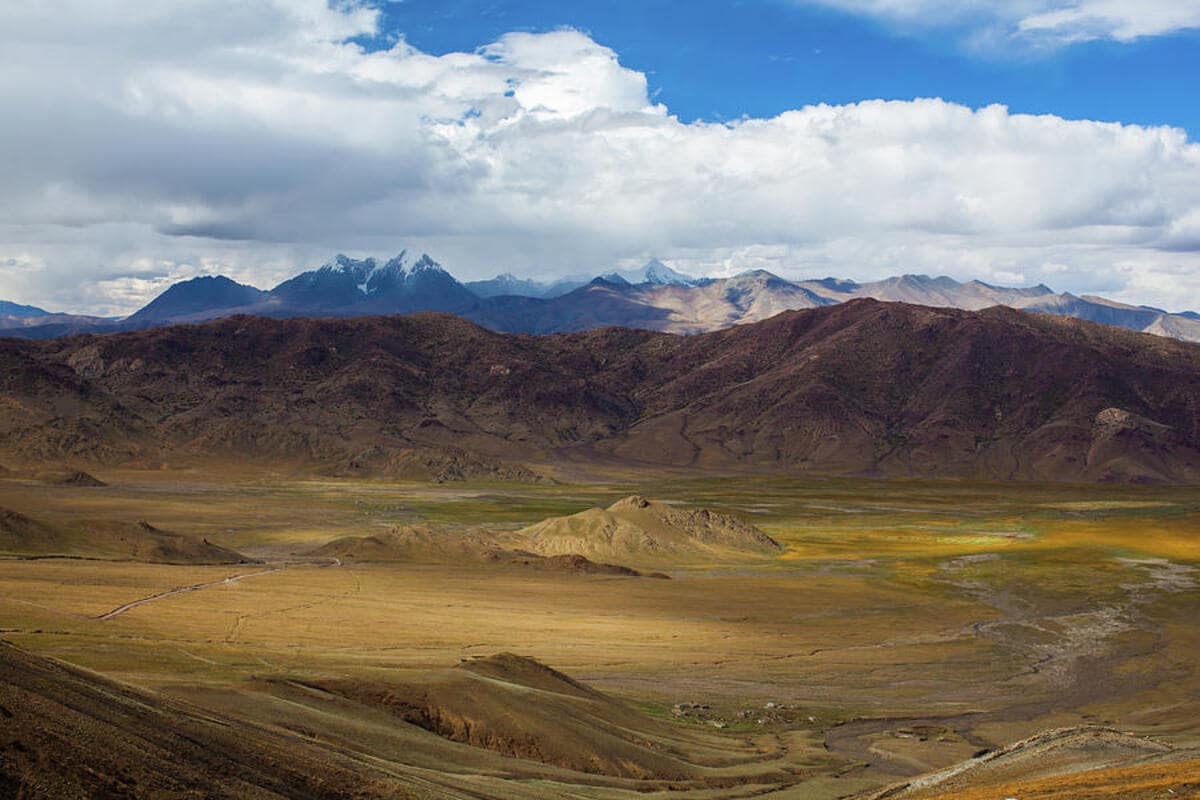
The Tibetan Plateau has fascinated travelers, scientists, and thinkers for centuries with its immense scale and sense of mystery. It is a place where nature appears almost untouched, and humans often feel like a small part of an overwhelming landscape. Many interesting facts about this region relate to its geography, climate, and living conditions, and you may not know them even from school textbooks. Remarkable facts help explain why the plateau is considered one of the most unique regions on Earth. Below is a collection of fascinating facts that reveal the extraordinary character of this high-altitude world.
- The Tibetan Plateau is the highest and largest plateau on Earth. Its average elevation exceeds 4,500 meters above sea level. Because of this, it is often referred to as the roof of the world. Such extreme altitude influences not only local weather but also global atmospheric processes.
- The total area of the Tibetan Plateau is about 2.5 million square kilometers. It covers a significant part of modern China and extends into India, Nepal, and Bhutan. In terms of size, it can be compared to large sovereign states. This makes it a key geographical region in Asia.
- The formation of the Tibetan Plateau is linked to the collision of the Indian and Eurasian tectonic plates. This process began tens of millions of years ago and is still ongoing today. As a result, not only the plateau itself but also the Himalayan mountain range was uplifted. Geologists consider this area one of the most tectonically active regions in the world.
- The climate of the Tibetan Plateau is extremely harsh. Winters are long and very cold, while summers are short and relatively cool. Due to the high elevation, the air contains significantly less oxygen. These conditions create serious challenges for both humans and wildlife.
- The Tibetan Plateau is often called the water tower of Asia. Many major rivers originate here, including the Yangtze, Yellow River, Indus, and Brahmaputra. The waters of these rivers support hundreds of millions of people downstream. For this reason, the state of the plateau’s glaciers is of strategic importance.
- A vast number of glaciers are concentrated on the plateau. In terms of ice reserves, this region is second only to the polar areas. Glaciers play a crucial role in regulating climate and water supply. At the same time, they are highly vulnerable to global warming.
- The plant life of the Tibetan Plateau is adapted to extreme environmental conditions. Low-growing grasses, mosses, and shrubs dominate the landscape. Many plants are capable of surviving strong winds and sharp temperature changes. A significant portion of the flora is endemic to this region.
- The animal life of the plateau shows remarkable adaptation. Species such as yaks, Tibetan antelopes, snow leopards, and wild asses known as kiangs live here. Many animals have thick fur and specialized respiratory systems. These adaptations allow them to survive in oxygen-poor environments.
- People living on the Tibetan Plateau reside at very high altitudes. Local populations have developed physiological traits that help them cope with low oxygen levels. Their bodies are able to use oxygen more efficiently than those of lowland populations. These adaptations are actively studied by medical researchers.
- The Tibetan Plateau plays an important role in the formation of Asian monsoons. It affects the movement of air masses and the distribution of precipitation. As a result, weather patterns in many Asian countries depend on processes occurring in this region. Climatologists consider the plateau a key component of Asia’s climate system.
- Large parts of the plateau are sparsely populated or completely uninhabited. This is due to severe natural conditions and complex terrain. Some areas have changed very little over hundreds of years. This makes them especially valuable for scientific research.
- The Tibetan Plateau has great cultural significance. It is the heartland of Tibetan civilization and its spiritual traditions. The surrounding environment has strongly influenced local worldviews and beliefs. The landscape is often perceived as sacred by the people who live there.
- Because of its elevation, solar radiation on the plateau is much more intense. People must protect their skin and eyes from strong ultraviolet exposure. At the same time, the large number of sunny days supports the development of renewable energy. Solar power is considered a promising resource for the region.
- Temperature differences on the Tibetan Plateau can be extreme. During the day, conditions may be relatively mild, while at night temperatures can drop sharply. Such fluctuations demand great resilience from all living organisms. For this reason, the plateau’s ecosystem is considered particularly fragile.
- The Tibetan Plateau frequently attracts scientific expeditions. Researchers study climate change, biodiversity, and geological processes in this area. The data collected have global significance. They help scientists better understand future environmental challenges.
The Tibetan Plateau is widely regarded as one of the most extraordinary regions on the planet. Interesting facts about it reveal the close connection between nature, climate, and human life. Remarkable facts highlight its importance not only for Asia but for the entire world. Fascinating facts confirm that this high-altitude region deserves careful attention and responsible stewardship.


