
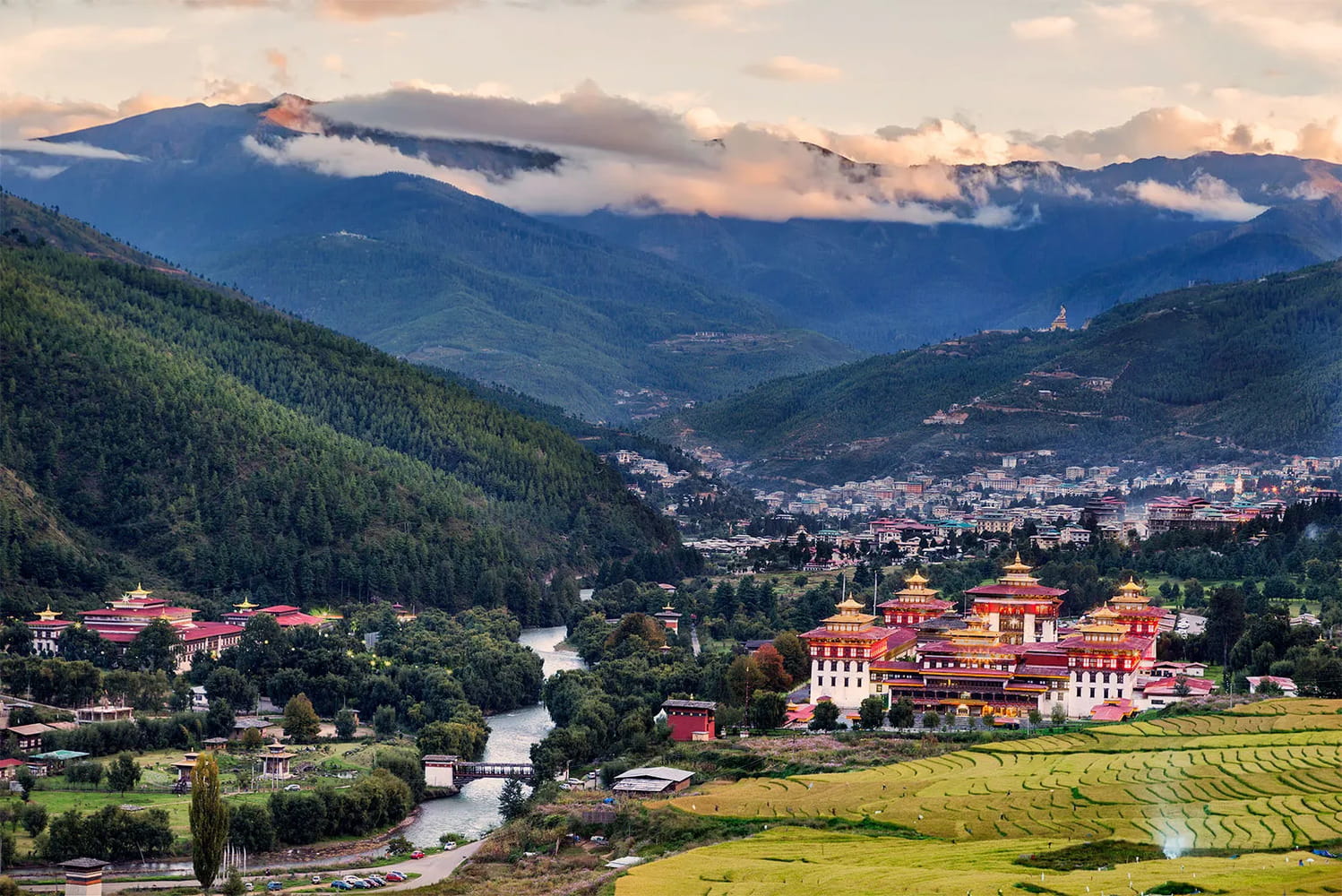
Nestled among the Himalayan peaks at an elevation of over two thousand three hundred meters above sea level, Thimphu astonishes with its unique ability to harmoniously blend ancient Buddhist traditions with modern technologies without losing its spiritual essence. This peaceful capital of Bhutan, where the sound of loud car horns is replaced by prayers and towering skyscrapers give way to temples, invites travelers on a journey that is not merely geographical but also spiritual. You might not have known that behind the modest facades of dzong-style buildings lies one of the most original capitals in the world, which has consciously rejected many attributes of a contemporary metropolis. Amazing facts about Thimphu will reveal to you a world where happiness is measured not by gross domestic product but by quality of life and harmony with nature. Fascinating facts about this city will help you understand how a country can develop while remaining faithful to its values and cultural heritage.
- Thimphu is the only capital city in the world that does not have traffic lights at its intersections, reflecting the Bhutanese philosophy of peace and harmony in everyday life. Instead of automatic devices, police officers work at major intersections, regulating traffic with graceful gestures that resemble dancers’ movements. This uniqueness became possible thanks to the small number of vehicles and the conscious policy of limiting automobiles in the city.
- The city is situated at an altitude of approximately two thousand three hundred meters above sea level, making it one of the highest capitals in the world among landlocked countries. Such elevation ensures a cool climate throughout the year with moderate summer temperatures and frosty winters when the peaks of surrounding mountains are covered with snow. The clean mountain air and low pollution levels make Thimphu a true oasis for those seeking respite from the noise of metropolises.
- Thimphu became the capital of Bhutan only in 1961, replacing the city of Punakha, which had served this role for many centuries. This change occurred at the initiative of Bhutan’s third king, Jigme Dorji Wangchuck, who sought to modernize the country and create a contemporary administrative center. Despite its capital status, Thimphu has remained a relatively small city with a population of less than one hundred thousand residents.
- The city enforces a law that requires all residents and visitors to wear traditional national clothing when visiting government institutions and religious sites. Men must wear the gho, a long robe tied with a belt, while women wear the kira, a long dress consisting of several layers of fabric. This tradition not only preserves cultural heritage but also symbolizes respect for Bhutan’s national identity.
- Tashichho Dzong, the magnificent monastery-fortress located on the banks of the Wang Chu River, is one of the most important religious and administrative centers of the country. This historical complex houses the offices of the king, government ministries, and a monastery where hundreds of monks reside. Annually at the end of February, a grand Tshechu festival takes place here, during which monks perform sacred cham dances wearing masks depicting deities and demons.
- On a hill overlooking the city stands a gigantic bronze statue of Buddha Dordenma, fifty-one meters tall, which ranks among the highest Buddha statues in the world. This monumental structure was opened in 2004 and contains one hundred twenty-five thousand smaller Buddha statues arranged throughout various parts of the construction. From the hilltop, a panoramic view of the Thimphu valley unfolds, and the statue itself has become a symbol of the spirituality and peacefulness of the Bhutanese people.
- Thimphu is one of the few cities in the world where a complete ban on smoking in public places is enforced, and the sale of tobacco products is prohibited by law. This policy forms part of the national health strategy that prioritizes citizens’ well-being over commercial interests. Bhutan became the first country in the world to introduce such strict tobacco restrictions as early as 2004.
- The city is surrounded by Jigme Dorji National Park, which serves as home to rare animal species, particularly the takin, Bhutan’s national animal resembling a cross between a deer and a yak. In the Thimphu Cheri reserve, one can observe these unique animals in semi-wild conditions while enjoying the pristine nature of the Himalayan forests. The park also contains the ancient Cheri monastery, founded in 1620, which serves as an important pilgrimage site for Buddhists.
- Thimphu houses the National Textile Museum, which preserves exceptionally intricate and colorful handwoven textiles that form part of Bhutan’s cultural heritage. Each region of the country possesses its own unique weaving techniques and patterns that have been passed down through generations for several centuries. Masters use natural dyes obtained from plants, mountain herbs, and minerals, which give the fabrics unique shades and longevity.
- Thimphu has consciously rejected mass tourism by implementing a policy of controlled tourism, requiring each visitor to pay a daily fee for their stay in the country. These funds are directed toward education, healthcare, and environmental conservation, allowing Bhutan to develop infrastructure without sacrificing its culture and natural environment. Such an approach ensures not only financial stability but also preserves the authenticity of the Bhutanese way of life.
- The city does not have an international airport, with the nearest Paro Airport located thirty-six kilometers from Thimphu in challenging mountainous terrain. Landing at Paro Airport is considered one of the most difficult in the world due to surrounding peaks exceeding six thousand meters in height and a short runway. Only a few pilots worldwide possess the special certification required to land at this airport, making the journey to Bhutan a genuine adventure.
- Thimphu operates a unique system for assessing the country’s development called Gross National Happiness, which has replaced the traditional gross domestic product as the primary indicator of progress. This concept considers not only economic indicators but also spiritual well-being, cultural preservation, ecological balance, and quality of governance. The philosophy of Gross National Happiness has influenced Thimphu’s urban development, ensuring the preservation of traditional architecture and the natural environment.
- Buildings in the city center must be constructed according to strict architectural standards that require adherence to the traditional dzong style with wooden elements, carvings, and characteristic sloping roofs. These regulations prohibit the construction of modern skyscrapers and glass facades, helping to preserve the city’s unique appearance and its harmonious integration into the mountain landscape. Even modern hotels and offices must comply with these standards, making Thimphu a true open-air museum.
- The National Library of Bhutan, located in Thimphu, preserves the oldest manuscripts and books written in Sanskrit, Tibetan, and Dzongkha on handmade paper made from the bark of the deysho tree. This unique paper is known for its durability and resistance to insects, allowing texts to be preserved for several centuries without damage. The library also serves as a center for studying Buddhist philosophy, where young monks learn traditional methods of copying sacred texts.
- The city features the Memorial of Queen Mother Ashi Kesang Choden Wangchuck, which serves not only as a monument but also as an active cultural center where craft exhibitions and traditional ceremonies take place. This elegant complex with white walls and golden roofs is situated on a hill from which a magnificent view of the Thimphu valley unfolds. The memorial also houses a museum dedicated to the life of the queen mother, who made significant contributions to the development of education and healthcare in Bhutan.
- Thimphu maintains a unique tradition of holding the annual Thimphu Tshechu festival each autumn, when thousands of local residents and pilgrims gather near Tashichho Dzong. The main event of the festival is the display of a massive thongdrel, a silk tapestry depicting Guru Rinpoche, which is hung on the monastery’s facade only at dawn on a single day. It is believed that seeing this sacred tapestry brings spiritual purification and protection from negative karma.
- The city has its own zoo dedicated exclusively to takins, Bhutan’s national animal, which is a rare species of mountain ungulate. The takin is considered a sacred animal associated with the legend of Drukpa Kunley, known as the Divine Madman, who created this creature by combining parts of different animals at the request of villagers. The Thimphu zoo is the only specialized facility in the world where one can observe these unique animals in specially created conditions.
- Thimphu is home to the Royal Botanical Garden, covering an area of over ninety hectares and containing more than six hundred species of native Himalayan plants. The garden was established to preserve the region’s biodiversity and conduct scientific research in the fields of botany and ecology. For visitors, walking trails have been created that pass through various ecosystems, from subtropical forests to alpine meadows.
- Despite its capital status, Thimphu lacks typical modern city nightlife such as nightclubs, cinemas, or large shopping malls. Instead, evenings in the city pass peacefully with walks along the river, visits to local restaurants serving traditional Bhutanese cuisine, or meditation in temples. This simplicity represents the conscious choice of Bhutanese people who value inner peace and family values over the entertainment industry.
- The city operates an energy conservation system where street lighting is turned off at night on many sections to reduce electricity consumption and preserve the natural nighttime landscape. This practice allows residents and visitors to enjoy a clean dark sky where thousands of stars are visible, a rarity for inhabitants of modern metropolises. Such an approach reflects the Bhutanese philosophy of harmonious relationships with nature and responsible resource management.
- Thimphu ranks among the cleanest cities in the world in terms of air pollution levels thanks to strict environmental laws and a limited number of industrial enterprises. The Bhutanese government has committed to remaining a carbon-neutral country, with most electricity generated by hydroelectric power plants utilizing water from mountain rivers. This policy enables Thimphu to maintain crystal-clear air and a healthy environment for residents and visitors alike.
- On the city streets, one can see thousands of colorful prayer flags called lungta fluttering in the wind, spreading blessings and prayers into the space. Each flag color symbolizes one of the five Buddhas and corresponds to a specific element of nature: blue for sky, white for air, red for fire, green for water, yellow for earth. Believers consider that each gust of wind moving the flags disperses the sacred texts written on them, bringing peace and harmony to the world.
- Thimphu houses the National Institute of Traditional Medicine, where physicians employ ancient diagnostic and treatment methods based on Tibetan medicine. Treatment includes the application of medicinal plants, minerals, and animal products, as well as procedures such as acupuncture and massage. The institute also cultivates medicinal plants in special gardens to ensure a steady supply of raw materials for preparing traditional medicines.
- The city maintains a unique educational system where children learn not only modern sciences but also traditional crafts such as weaving, wood carving, and deysho paper production. This integration of ancient knowledge into the modern educational system helps preserve cultural heritage and transmit it to younger generations. Many schools in Thimphu have workshops where students can practice traditional crafts under the guidance of experienced masters.
- Thimphu serves as home to several important Buddhist monasteries, among which the Drub Wangyal monastery stands out, located on a hill above the city. This monastery serves as the residence of Je Khenpo, the head of Bhutan’s Buddhist clergy, and contains numerous sacred relics and statues. Daily hundreds of monks gather here for collective prayers and meditation, creating an atmosphere of spirituality that can be felt even from a distance from the monastery.
These fascinating facts only partially reveal the uniqueness of Thimphu, a city that has skillfully found balance between progress and traditions, spirituality and modernity. Every street, every temple, and every resident of this city tells the story of a country that has chosen the path of happiness instead of unlimited economic growth. We hope these incredible facts will inspire you to reflect on how true progress is measured not only by material achievements but also by the quality of human life and harmony with the surrounding world.


