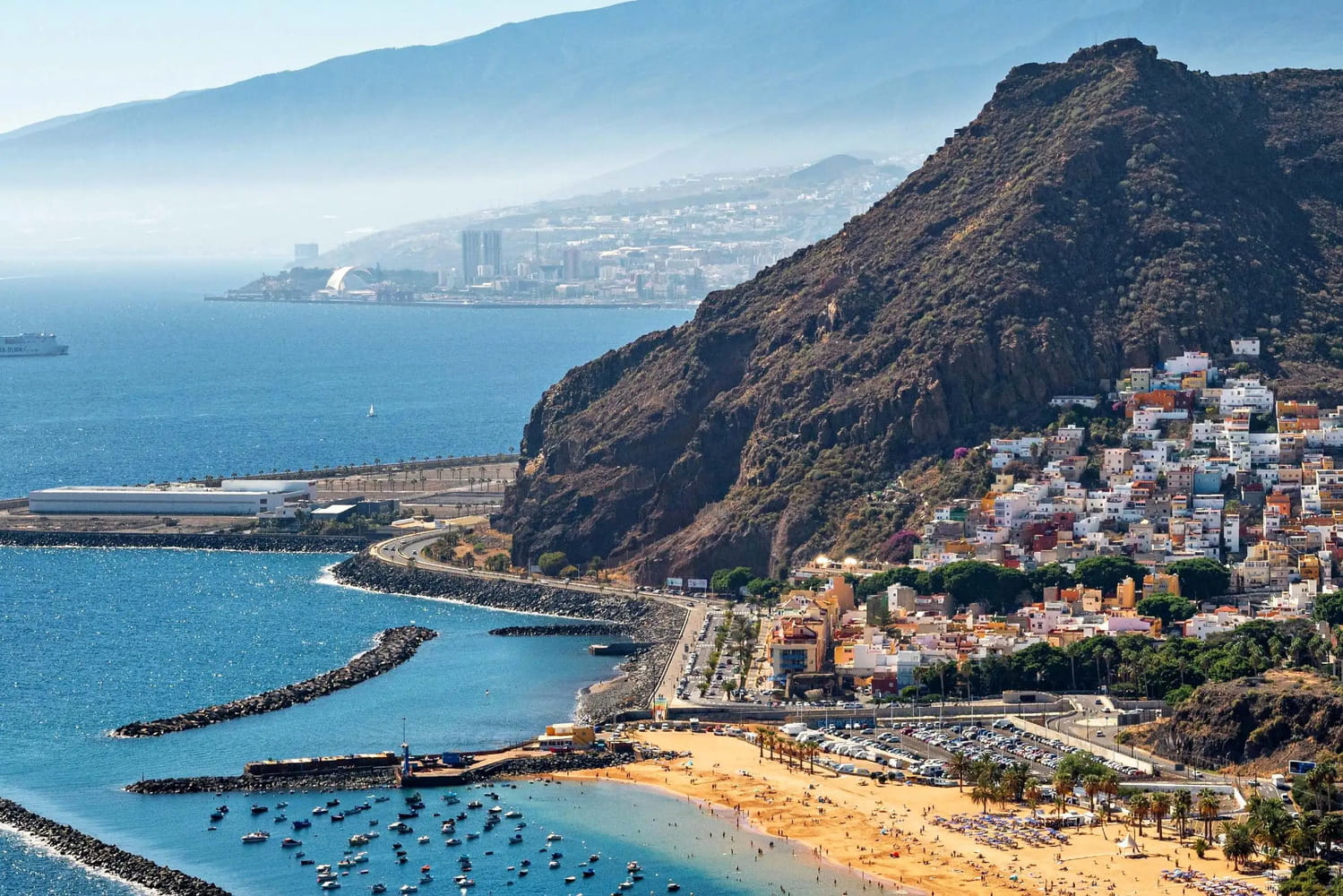
Amid the azure waters of the Atlantic Ocean rises a true natural wonder that combines volcanic power with paradise landscapes. Tenerife, the largest of the Canary Islands, has captivated travelers for centuries with its unique blend of climate zones, cultural traditions, and natural marvels. Today we invite you to discover incredible facts about this island where within just a few dozen kilometers you can witness both snow and palm groves simultaneously. You might not have known how many secrets this small territory holds, with every valley preserving its own unique story.
- Tenerife is the largest Canary Island by area covering approximately two thousand square kilometers. Its shape resembles a triangle with sides measuring about ninety kilometers creating a unique geographical structure. The island formed through the merging of three separate volcanic islands millions of years ago which explains its complex and diverse terrain.
- Mount Teide represents the highest point not only of Tenerife but of all Spain reaching an elevation of three thousand seven hundred eighteen meters above sea level. When measured from its base on the ocean floor its height exceeds seven thousand meters making it the third tallest volcano on the planet. This dormant volcano last erupted in 1909 yet remains under constant monitoring by volcanologists.
- Tenerife features a unique phenomenon known as the sea of clouds where clouds form at altitudes between six hundred and two thousand meters enveloping the mountain slopes. This natural phenomenon creates ideal conditions for the formation of laurel forests which are relics from the Tertiary period. These misty forests provide the island with fresh water through the condensation of moisture on plant leaves.
- The laurel forests of Tenerife are inscribed on UNESCO’s World Heritage List and represent remnants of prehistoric subtropical forests that once covered significant portions of Europe. These forests are home to endemic animal species among which the most famous is the Tenerife lizard found nowhere else in the world. The plant life of the laurel forest comprises over four hundred species many of which are unique to the island.
- The Dragon Tree in the town of Icod de los Vinos is considered one of the oldest trees in the world with its age estimated between six and eight centuries. This plant exudes a dark red resin that ancient island inhabitants called dragon’s blood and used for medicinal purposes. Today this tree serves as a symbol of Tenerife and is protected as a natural monument of national significance.
- Tenerife has two capital cities — Santa Cruz de Tenerife and La Laguna which represents a unique phenomenon among Spanish autonomous communities. Santa Cruz functions as the administrative center and main port while La Laguna inscribed on UNESCO’s World Heritage List has preserved the historical structure of a Renaissance era city. This dual capital system has existed since 1833 and results from historical agreements between the island’s regions.
- The Carnival of Santa Cruz de Tenerife ranks as the second largest in the world after Brazil’s Rio de Janeiro. This celebration lasts more than two weeks and attracts over a million participants annually transforming the city into a giant dance floor. Particularly impressive is the burial of the sardine ceremony which symbolically concludes the carnival festivities.
- On the slopes of Mount Teide sits one of the world’s premier astronomical observatories thanks to ideal conditions for observation. Air purity minimal light pollution and elevation above sea level create exceptional opportunities for studying the cosmos. International scientific research is regularly conducted here and the observatory welcomes visitors offering the chance to view the starry sky through powerful telescopes.
- Tenerife’s black volcanic beaches such as Playa Jardín or Playa El Bollullo formed as a result of volcanic eruptions thousands of years ago. This sand consists of basalt and possesses unique thermal properties quickly warming in the sun and retaining heat for extended periods. Many such beaches feature modern infrastructure making them popular among tourists despite their unconventional color.
- The island is divided into two climate zones due to the influence of Mount Teide which blocks the passage of clouds. The northern part of the island receives significantly more rainfall and features lush vegetation while the southern part is considerably drier with sunny weather throughout the year. This characteristic allows tourists to choose their vacation spot based on desired climate even within a single island.
- The ancient inhabitants of Tenerife — the Guanches — left behind unique archaeological monuments among which the most famous are the caves in Cuevas de Guayadeque. These caves served as dwellings and burial sites for the island’s indigenous population before the Spanish conquest in the fifteenth century. The Guanches developed a complex social structure and had their own language traces of which remain in the island’s toponymy.
- Teide National Park is Spain’s most visited national park and one of the most popular in Europe. It encompasses an area of over one hundred eighty thousand hectares and was inscribed on UNESCO’s World Heritage List in 2007. The park astonishes with its unique volcanic landscape where red orange and black rock colors create surreal vistas.
- In the city of Puerto de la Cruz lies the famous botanical garden founded in 1788 for the acclimatization of tropical plants. This garden became the first scientific institution of its kind in Spain and today contains over two thousand plant species from around the world. Particularly impressive are the collections of palms banana trees and exotic flowers that bloom throughout the year.
- Tenerife is home to a unique species of marine mammal — the Atlantic sperm whale which permanently inhabits the island’s coastal waters. These waters also serve as a migration route for over twenty species of whales and dolphins making the island one of the world’s best locations for observing these animals. Special excursion vessels offer the opportunity to see orcas humpback whales and bottlenose dolphins in their natural habitat.
- The Lago Martiánez artificial pools in Puerto de la Cruz represent an architectural masterpiece designed by local artist César Manrique. This complex with smooth transitions between pools and the ocean creates the illusion of a natural lagoon among volcanic rocks. Construction lasted over ten years and was completed in 1977 becoming one of the island’s main tourist attractions.
- Tenerife maintains a unique tradition of producing cheese from goat’s milk passed down through generations. The most renowned variety — Queso Palmero — is made according to ancient recipes and holds protected geographical indication status from the European Union. These cheeses are often served with local honey and dates creating a unique flavor combination.
- The island of Tenerife was the first Canary Island discovered by Europeans in the fourteenth century and its conquest by the Spanish lasted nearly a century. The last Guanche king Bentor died in 1496 during the final resistance against Spanish invaders. Today annual historical battle reconstructions are held on the island to commemorate these events.
- The Museum of Nature and Archaeology in Santa Cruz de Tenerife houses one of the finest collections of Guanche mummies outside of Egypt. These mummies were created using a complex embalming technique passed down orally among local priests. The museum exhibits tell the story of the daily life beliefs and burial rituals of the island’s indigenous population.
- Tenerife hosts the world’s only theme park dedicated to marine mammals — Loro Parque founded in 1970. This park gained fame not only for its entertaining shows but also for serious scientific work breeding endangered species particularly parrots and orcas. In 2006 the first orca in history conceived in captivity without artificial insemination was born here.
These fascinating facts about Tenerife only partially reveal the richness of this unique island where nature and culture intertwine into an irreplaceable mosaic. Every visitor to Tenerife carries away not merely vacation memories but also a deep understanding of how harmoniously volcanic force and human creativity can coexist. Incredible facts about this island remind us that even within a small territory an entire world of amazing discoveries and extraordinary experiences can be found.


