
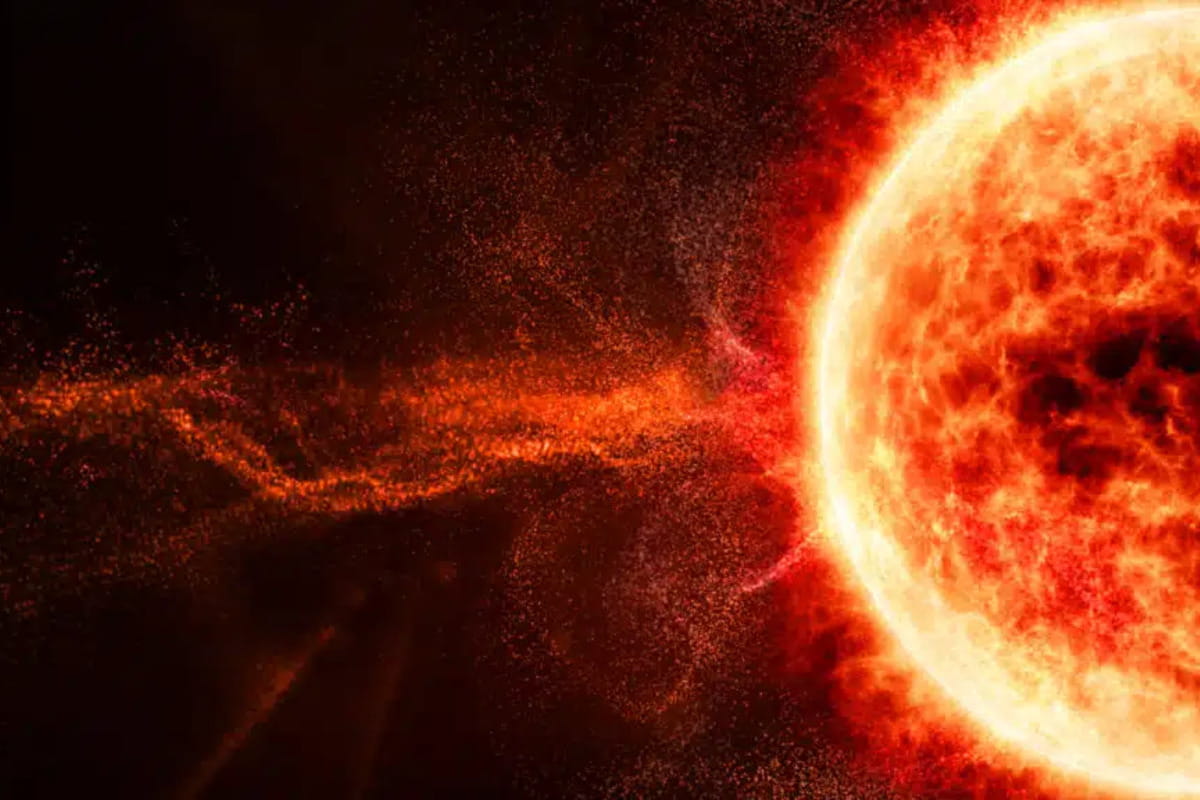
The Sun appears to us as a calm celestial body that gives warmth and light, but in reality it constantly emits an invisible stream of charged particles. This phenomenon affects the entire Solar System and even protects us from interstellar radiation thanks to its pressure. Many people do not even suspect how strongly this process affects the life of our planet and technical devices. We have prepared amazing facts for you that will reveal the secrets of this cosmic force. Read on to learn interesting facts and fascinating facts that you might not have known before.
- Solar wind consists primarily of plasma, which contains free electrons and protons with a small admixture of helium nuclei. These particles constantly escape from the upper layers of the solar atmosphere and move through space at tremendous speed. They carry the Sun’s magnetic field with them, creating complex interactions with planets along their path.
- The velocity of the particle stream is not a constant value and can change significantly depending on the activity of our star. During quiet periods it is about four hundred kilometers per second, but during flares it can reach eight hundred kilometers per second. Such a difference in speed creates shock waves that can reach Earth and cause magnetic storms.
- The origin of this phenomenon lies in the solar corona, where temperatures reach millions of degrees Celsius. It is precisely the high temperature that gives particles enough energy to overcome the Sun’s gravitational pull and fly into open space. This process has been occurring continuously for billions of years of our stellar system’s existence.
- Earth has its own magnetic shield that deflects most charged particles and protects the surface from harmful effects. Without this magnetospheric barrier, our planet’s atmosphere could gradually disappear under the pressure of solar radiation. This protective field creates a unique region around the planet known as the magnetosphere.
- When particles do penetrate through the protective fields near the poles, they collide with atmospheric gases and cause luminescence. This natural light show is known to us as the northern or southern lights and has various colors depending on the type of gas. Green shades arise from interaction with oxygen, while red or purple colors are associated with nitrogen.
- The influence of the particle stream on satellites and space stations can be quite destructive for electronics and navigation systems. Engineers are forced to develop special protection for equipment so that it can withstand bombardment by high-energy particles. Sometimes strong flares lead to temporary communication outages or malfunctions in global positioning systems.
- The boundary of the Sun’s influence is called the heliosphere and it extends far beyond Pluto’s orbit into interstellar space. It is here that the pressure of the solar wind equals the pressure of the interstellar medium and a sort of bubble-like barrier forms. This region protects the entire Solar System from part of the galactic cosmic radiation.
- The Voyager spacecraft became the first human-made objects to cross this boundary and enter interstellar space. They transmitted unique data to Earth about changes in particle density and magnetic fields at the edge of our stellar system. This event became a historic milestone in space exploration and understanding the structure of the heliosphere.
- Comets always have tails that point away from the Sun regardless of the direction of their orbital motion. This happens precisely because of the pressure of solar wind and light, which blow gas and dust from the comet’s nucleus in the opposite direction. The ion tail of a comet always points directly away from our star and glows under the influence of ultraviolet radiation.
- The history of studying this phenomenon is associated with the name of American physicist Eugene Parker, who theoretically predicted its existence. Initially the scientific community viewed his ideas skeptically, but later observations completely confirmed his theory. A space probe that is currently studying the Sun from close range was even named in his honor.
- The intensity of the particle stream changes cyclically and is related to the eleven-year cycle of solar activity. During the activity maximum, the number of spots on the surface increases and the wind becomes more unstable and powerful. Astronomers constantly monitor these changes to forecast space weather and its impact on Earth.
- Mars lost most of its atmosphere precisely due to the absence of a global magnetic field and the constant impact of solar wind. Without a magnetosphere, charged particles gradually stripped away the planet’s gaseous envelope and made its surface cold and dry. This process demonstrates the importance of magnetic protection for sustaining life on a planet.
- Solar wind exerts physical pressure on any objects in the Solar System although this pressure is extremely small for human perception. For spacecraft with large solar sails this pressure can be used as a propulsive force for movement. Such technology allows traveling through space without using traditional chemical fuel.
- Coronal mass ejections differ from ordinary solar wind in their massiveness and suddenness of material ejection into space. They carry much more material and can cause powerful geomagnetic storms on Earth that are significantly stronger than usual. Such events can lead to power outages in large regions of our planet.
- The upper layers of Earth’s atmosphere become ionized under the influence of the particle stream which affects the propagation of radio waves over long distances. Radio amateurs and communication specialists take into account the state of the ionosphere when tuning their transmitters and receivers. During magnetic storms radio communication can deteriorate or completely disappear on certain frequencies.
- Other stars in our galaxy also generate similar particle streams which astronomers call stellar wind. Studying these processes helps us better understand stellar evolution and their influence on exoplanets orbiting them. Some stellar winds can be much more aggressive than the one we observe from our Sun.
- The particle stream constantly changes its density and this can be measured with special instruments in Earth’s orbit. When density increases sharply, the probability of auroras occurring at lower latitudes than usual increases. Observers at mid-latitudes can sometimes see this light only during very strong solar flares.
- For future space missions to Mars or other planets, protection from solar wind is a critically important issue for crew safety. Astronauts beyond Earth’s magnetosphere are exposed to significantly higher levels of radiation from charged particles. Developing effective shielding is one of the main tasks for long interplanetary journeys.
- The interaction of the Sun’s magnetic field with Earth’s magnetic field creates a complex structure of the magnetospheric tail on the night side of the planet. This tail extends great distances into space and can accumulate energy for subsequent magnetic substorms. Processes in this tail still remain a subject of active scientific study and research.
- Solar wind plays a key role in shaping space weather which affects humanity’s technological infrastructure. Energy companies and satellite operators monitor forecasts to take equipment protection measures in time. Understanding these processes is becoming increasingly important in our technologically dependent society.
Studying this invisible stream helps us better understand the dynamics of our stellar system and humanity’s place within it. Each newly discovered amazing fact brings us closer to the safety of space travel and the protection of technologies. Fascinating facts about solar wind demonstrate how closely we are connected to the activity of our celestial body. Interesting facts leave room for further research and new scientific achievements in the future.


