
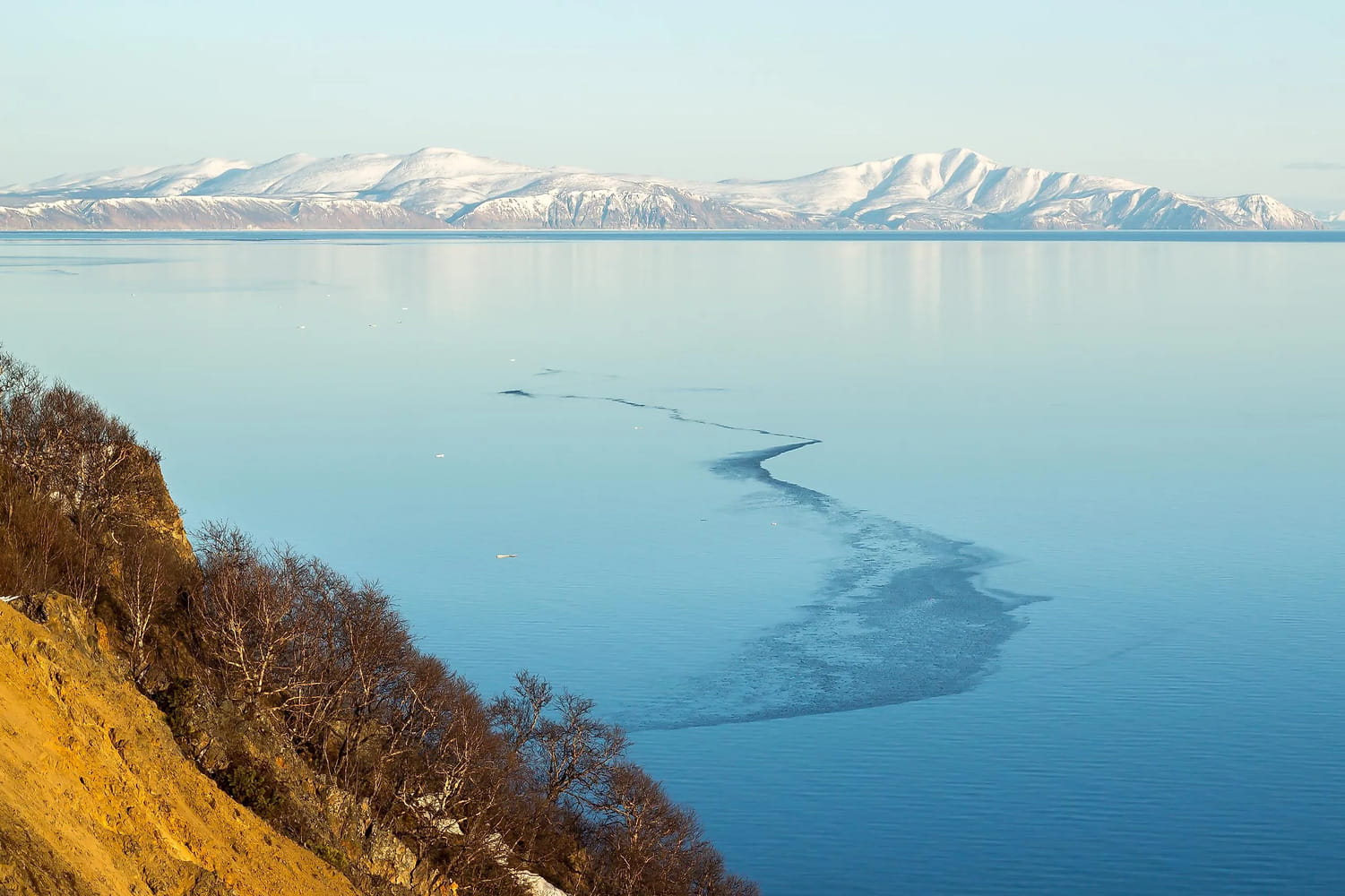
The Sea of Okhotsk is one of the most biologically productive and ecologically significant bodies of water in the Pacific Ocean, nestled between Russia’s eastern coastline, northern Japan, and the island of Sakhalin. It captivates not only with its natural abundance but also with its unique climatic, geological, and biological characteristics. The sea is renowned for its exceptionally rich wildlife, including rare whales, seals, and millions of seabirds that nest on its remote islands. In this article, you’ll discover fascinating facts about its depths, currents, exploration history, and its vital role in the global marine ecosystem. You might not have known just how complex and essential this distant corner of the planet truly is.
- The Sea of Okhotsk takes its name from the Okhota River, near whose mouth Russian Cossacks established the first coastal settlement in the 17th century. From there, regular maritime expeditions began, initially focused on hunting marine mammals. The name quickly became fixed on maps, though indigenous peoples had long used different names for the sea. This region was among the first parts of the Russian Far East to be explored and settled by Russians.
- Covering an area of approximately 1.58 million square kilometers, the Sea of Okhotsk is one of the largest marginal seas in the world. It belongs almost entirely to Russia, except for its southern waters near Japan’s Hokkaido Island. Nearly enclosed by land, it is considered a semi-enclosed inland sea. It connects to the Pacific Ocean only through straits such as La Pérouse (Sōya), Krusenstern, and others.
- The average depth of the Sea of Okhotsk is about 839 meters, with its deepest point reaching 3,372 meters in the northeastern part. Its seabed features numerous underwater canyons, mountains, and even active submarine volcanoes. The Chersky Ridge, stretching across the central basin, is particularly prominent. These geological formations influence ocean currents, the distribution of marine life, and even ice formation patterns.
- The Sea of Okhotsk is famous for its extensive seasonal ice cover, which blankets nearly the entire sea each winter. Ice thickness can exceed one meter, and by January–February, its area often surpasses one million square kilometers. This makes it one of the very few regions in the world where such massive sea ice forms annually at relatively moderate latitudes. Remarkably, the sea remains biologically vibrant even during the harsh winter months.
- The Sea of Okhotsk hosts one of the world’s largest salmon spawning grounds. Every year, millions of chum, pink, sockeye, and other salmon species return from the Pacific Ocean to spawn in rivers across Sakhalin, Kamchatka, and Khabarovsk Krai. This annual spawning event sustains the entire regional ecosystem—from brown bears to seabirds. Without this natural phenomenon, many species would struggle to survive.
- The sea is home to rare and iconic marine mammals, including the endangered bowhead whale, humpback whale, and the world’s smallest baleen whale—the minke whale. Steller sea lions, walruses, and northern fur seals are also commonly observed here. Many of these species are listed in conservation red lists. The Sea of Okhotsk is widely recognized as a critical habitat for marine mammal preservation in the North Pacific.
- One of the sea’s most notable natural landmarks is the Commander Islands, where a nature reserve was established during the Soviet era. These islands are the only place in the world where the red-legged kittiwake breeds, alongside hundreds of thousands of other seabirds. The islands also preserve remnants of an Aleut settlement, reflecting the unique culture of Indigenous peoples. The reserve is designated a UNESCO World Heritage Site.
- A unique phenomenon occurs here each winter: the formation of vast “ice fields” or shelf ice, driven by the sea’s high salinity and frigid continental air masses. This rapid and widespread freezing creates stable platforms where seals give birth to their pups. In spring, the ice breaks apart into enormous drifting floes that travel far into the Pacific Ocean—a spectacle rarely seen elsewhere.
- The Sea of Okhotsk is among the most productive fishing regions on Earth. It yields huge quantities of pollock, cod, crab, shrimp, salmon, and other commercially valuable species. Fisheries form the economic backbone of many coastal communities in the Russian Far East. However, overfishing poses a serious threat, prompting strict quotas and seasonal bans to protect stocks.
- The powerful Okhotsk Current circulates clockwise, shaped by wind patterns and temperature differences between the north and south. It transports cold, nutrient-rich waters from the north toward the south. This current plays a crucial role in distributing plankton—the foundation of the marine food web—making the sea exceptionally fertile. Without it, the region’s extraordinary productivity would not exist.
- Significant hydrocarbon reserves lie beneath the sea floor, especially on the Sakhalin Shelf. Major oil and gas fields like Chayvo and Odoptu are located here. Their development follows stringent environmental regulations due to the fragility of the marine ecosystem. Nevertheless, any major spill could have devastating consequences for local wildlife and habitats.
- The Sea of Okhotsk played a pivotal role in the exploration of the North Pacific. Vitus Bering and Alexei Chirikov led the first scientific expeditions here in the 18th century. Later, Russian, Japanese, and American scientists conducted extensive research in the region. Many marine species now known worldwide were first described based on specimens collected in these waters.
- The coastline has long been inhabited by Indigenous peoples—including the Itelmen, Nivkh, Evenki, and Aleuts—who traditionally relied on fishing, marine mammal hunting, and gathering seafood. Their languages, customs, and spiritual beliefs are deeply intertwined with the sea. Today, these communities continue to advocate for cultural preservation and sustainable use of ancestral resources.
- The sea lies within the Pacific “Ring of Fire,” making it prone to earthquakes and underwater volcanic activity. A powerful magnitude 7.1 earthquake struck near the Commander Islands in 1995. Such events continuously reshape the seafloor and influence ocean circulation. They can also trigger tsunamis, posing risks to coastal settlements.
- Despite its remoteness, the Sea of Okhotsk is vital for climate research. Its interaction with atmospheric systems affects weather patterns across Northeast Asia. Data from buoys and meteorological stations help predict monsoons and winter cold spells. Scientists also monitor how changing sea temperatures impact fish migrations and marine mammal behavior.
These interesting facts about the Sea of Okhotsk reveal it as far more than a remote stretch of water—it is a dynamic, interconnected system that shapes climate, sustains biodiversity, and supports human livelihoods. The astonishing details about its ecology and geology highlight it as a true natural treasure. Captivating insights into Indigenous heritage and scientific significance underscore its global relevance. You might not have known that the Sea of Okhotsk is not merely a resource reservoir, but a cornerstone of planetary ecological balance.


