
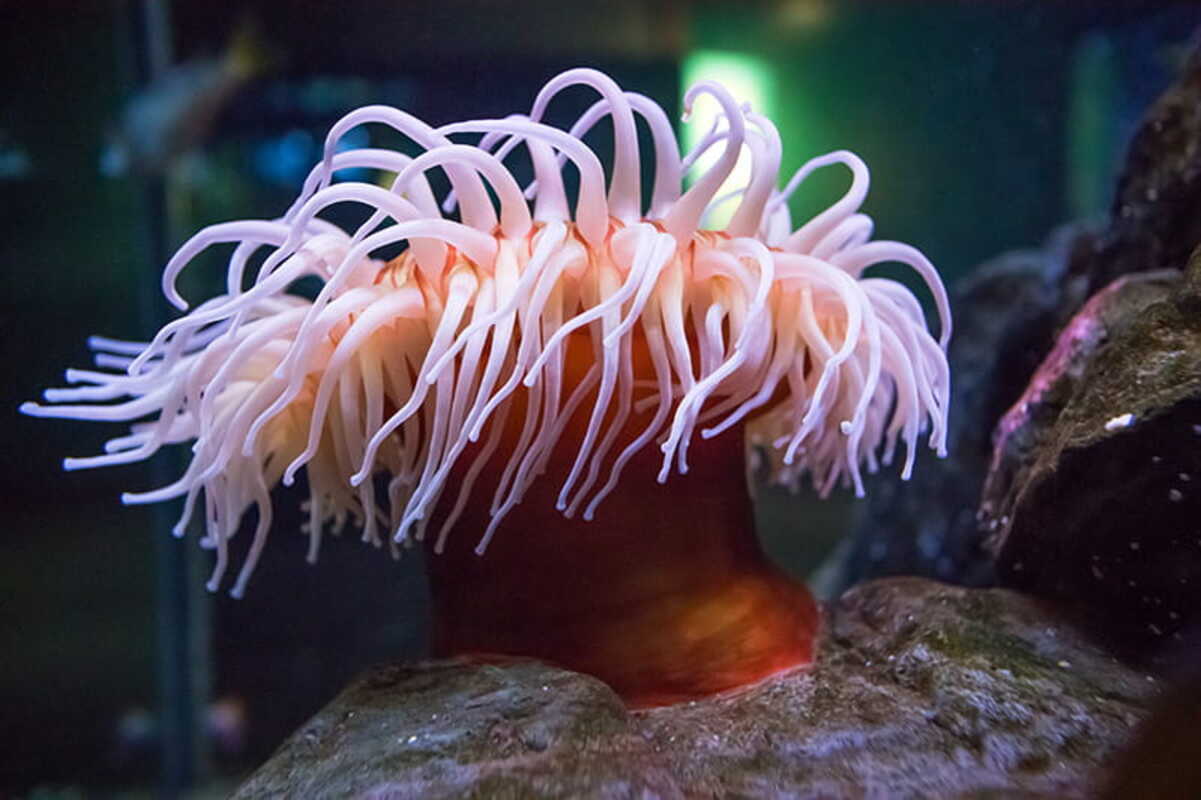
Sea anemones are among the most mysterious and beautiful inhabitants of the underwater world, which at first glance resemble exotic flowers far more than animals. Their vivid tentacles, gracefully swaying in the depths of the water, conceal an extraordinarily complex and sophisticated organism with millions of years of evolutionary history behind it. Fascinating facts about these remarkable creatures are capable of changing your understanding of just how diverse and unpredictable life in the ocean can be. Sea anemones have colonised virtually every corner of the World Ocean and have developed a multitude of unique adaptations that allow them to survive in the most unexpected conditions. We present a collection of interesting facts about sea anemones that you may never have known.
- Sea anemones belong to the phylum Cnidaria and are close relatives of jellyfish and corals. Despite their flower-like appearance, they are genuine predators that actively hunt small fish, crustaceans, and plankton. Their name derives from the terrestrial anemone flower on account of the striking external similarity between these two entirely different organisms.
- The body of a sea anemone is entirely devoid of bones, a hard shell, or any rigid skeleton — it is completely soft and consists predominantly of water. Its shape is maintained by a hydrostatic skeleton — a system of cavities filled with fluid, the pressure of which supports the structure of the animal. Thanks to this, an anemone can radically alter its shape, contracting into a tiny lump or spreading out into a wide and lavish floral display.
- The tentacles of a sea anemone are covered with millions of microscopic stinging cells known as nematocysts, which represent one of the most sophisticated hunting tools found in nature. Each nematocyst contains a coiled harpoon-like sting that fires with incredible speed — in less than three milliseconds — at the slightest touch. The venom injected through this sting paralyses or kills the prey, after which the tentacles draw it towards the mouth opening.
- The majority of sea anemones are sedentary animals that attach themselves to hard surfaces by means of a pedal disc — a sticky base at the bottom of the body. However, when necessary they are capable of moving slowly, gliding across the substrate or even swimming by bending their body and pushing off with their tentacles. Some species are able to detach from the substrate and drift with the current to a more suitable location.
- Sea anemones are capable of reproducing both sexually and asexually. In asexual reproduction, a single individual simply divides into two — a process known as binary fission — or daughter individuals bud off from it. Sexual reproduction occurs through the release of reproductive cells into the water, where fertilisation takes place and larvae develop.
- One of the best-known phenomena in marine biology is the symbiosis between sea anemones and clownfish. The fish live among the stinging tentacles of the anemone without sustaining any harm, thanks to a special protective layer of mucus on their surface. In return, the fish protect the anemone from its predators, drive away parasites, and provide additional aeration of the surrounding water through their movements.
- The protective mucus of clownfish is the result of a gradual process of adaptation — young fish initially touch the tentacles of the anemone cautiously, gradually accumulating microparticles of the anemone’s own mucus on their bodies. This process can last several hours and constitutes a kind of introduction, after which the anemone ceases to perceive the fish as potential prey. Without an anemone, clownfish are extremely vulnerable and rarely survive in open water.
- Some species of sea anemones form symbiotic relationships with algae known as zooxanthellae, which live directly within the tissues of the animal. These microscopic algae carry out photosynthesis and supply the anemone with additional nutrients in exchange for protection and access to sunlight. It is precisely thanks to zooxanthellae that many species of anemones display a vivid green or brown colouration.
- Sea anemones are among the longest-lived animals on Earth — some individuals are capable of living for hundreds of years. Scientists have discovered anemones whose age exceeded 60 to 70 years under laboratory conditions, and they believe that in the wild certain species may live for several hundred years. The secret of their longevity lies in their capacity for regeneration and the absence of signs of biological ageing in some species.
- Sea anemones possess extraordinary powers of regeneration — they can restore lost tentacles, damaged parts of the body, and even rebuild entire organs. In some species, even a small fragment of the body is capable of regenerating into a fully formed individual. This ability makes them practically invulnerable to most predators that attempt to bite off a portion of their body.
- Some sea anemones are capable of what is known as biological immortality — they show no signs of ageing at the cellular level and die predominantly from external causes rather than from the natural wear and tear of the organism. This phenomenon is being studied by scientists in the context of research into the mechanisms of ageing and potentially holds significance for medicine. The anemone of the species Actinia equina, widespread in the Mediterranean Sea, is one of the most well-known examples of such biological longevity.
- The size of sea anemones varies across an extraordinarily wide range — from a few millimetres to more than a metre in diameter. The largest species is considered to be the giant carpet anemone Stichodactyla gigantea, whose tentacles can cover an area of more than a metre across. Smaller species, by contrast, are so microscopic that they are difficult to spot with the naked eye.
- The venom of certain species of sea anemones is extraordinarily potent and can be dangerous even to humans. The species Actinodendron plumosum, known as the hell’s fire anemone, causes severe burns, intense pain, and even systemic reactions in humans upon contact. However, scientists are actively investigating the components of sea anemone venom as a potential basis for new medicinal preparations, in particular anti-tumour and analgesic agents.
- Sea anemones are distributed across all the world’s oceans — from shallow tropical reefs to depths exceeding 10,000 metres in the deepest oceanic trenches. Some Arctic and Antarctic species are perfectly adapted to existence in icy water at temperatures close to zero degrees. This exceptional ecological plasticity has made anemones one of the most successful marine organisms on the planet.
- More than 1,000 known species of sea anemones exist in nature, and scientists regularly discover new ones. They belong to the order Actiniaria and display a remarkable diversity of forms, sizes, and colours — from snow-white and vivid orange to violet and almost black. Such diversity is testament to millions of years of adaptation to the most varied habitats.
- Some species of sea anemones form a remarkable symbiosis with hermit crabs. The crab attaches an anemone to its shell, and the anemone protects the crab from predators with its stinging tentacles, while the crab carries the anemone to new locations with better food resources. When the crab moves into a new and larger shell, it carefully transfers its guardian anemone there as well.
- Sea anemones possess no brain, central nervous system, or any specialised sense organs in the traditional understanding of these terms. Instead, they have a diffuse nerve net — nerve cells dispersed throughout the entire body — which allows them to respond to touch, changes in light levels, and the chemical composition of the water. Despite such a primitive nervous system, anemones display surprisingly complex behaviour, including the recognition of symbiotic partners.
- Sea anemones are capable of recognising genetically foreign individuals of their own species and reacting aggressively to their approach. Upon contact with a foreign anemone, they discharge specialised acrorhagi — structures charged with nematocysts located at the tips of special tentacles — which inflict chemical burns upon the rival. Two genetically identical anemones, by contrast, display no aggression towards one another whatsoever, which is indicative of a distinctive system for distinguishing friend from foe.
- The mouth opening of a sea anemone serves simultaneously as both mouth and anus — it is the single opening through which both the ingestion of food and the expulsion of undigested remains take place. This opening is surrounded by tentacles and in a resting state appears as a simple slit or a small mound at the centre of the body. Despite such a primitive digestive system, anemones are capable of digesting prey several times larger than their own mouth opening, stretching their body to incredible dimensions.
Sea anemones are a living reminder that evolution is capable of creating organisms that combine beauty and lethality, simplicity and remarkable efficiency in equal measure. Every incredible fact about these creatures reveals new dimensions of the complexity of the underwater world, which to this day we have only partially explored. These flowers of the ocean have existed on Earth for more than 500 million years and will undoubtedly continue to astonish researchers with their unexplored secrets for a very long time to come.


