
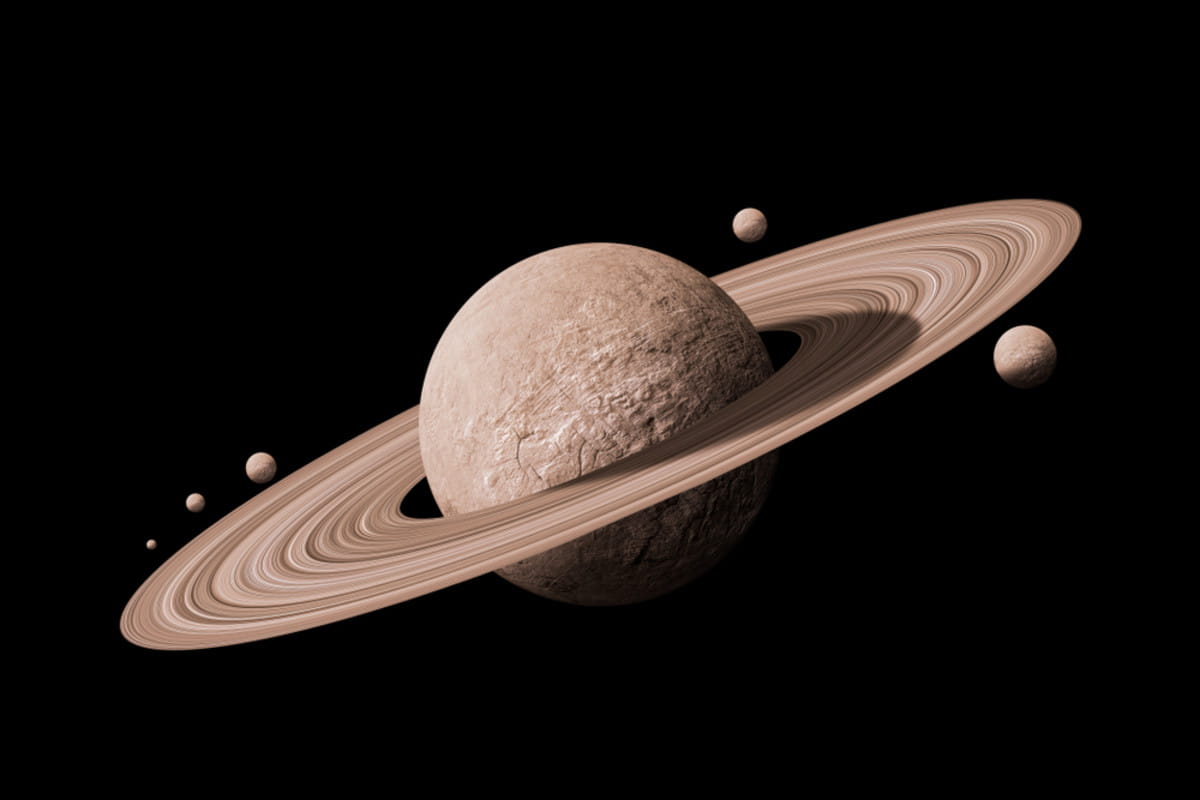
In the frigid expanses of the outer Solar System orbits a true celestial court of numerous moons surrounding the majestic gas giant with their hidden mysteries. Saturn famous for its breathtaking rings reigns as the planet with the most extensive family of natural satellites in our cosmic neighborhood each telling a unique story of planetary formation and evolution. Today we invite you to discover incredible facts about these celestial bodies where ice meets organic compounds and frozen deserts conceal entire oceans beneath their surfaces. You might not have known how remarkably diverse and unexpected these worlds truly are continuing to astonish astronomers with new revelations.
- Saturn possesses the greatest number of confirmed moons among all planets in the Solar System with over one hundred forty six natural satellites identified to date. This number continues to grow as powerful telescopes detect increasingly smaller objects on distant orbits far from the planet itself. The majority of these moons are tiny bodies less than ten kilometers in diameter orbiting at tremendous distances from Saturn often captured from the surrounding space rather than forming alongside the planet.
- Titan stands as the only moon in the Solar System with a dense atmosphere significantly thicker than Earth’s featuring surface pressure one and a half times greater than our planet’s. Its atmosphere consists primarily of nitrogen with traces of methane and ethane creating a thick orange haze that obscures direct observation of the surface. Titan hosts rivers lakes and seas but not of water rather of liquid methane and ethane circulating through a complex methane cycle analogous to Earth’s water cycle with evaporation precipitation and surface flow.
- Enceladus astonishes scientists with its geological activity despite its modest size of merely five hundred kilometers in diameter. From its south polar region powerful ice geysers erupt shooting water vapor ice particles and organic compounds high into space forming one of Saturn’s diffuse rings. Beneath its icy shell lies a global subsurface ocean of salty liquid water making Enceladus one of the most promising locations in our Solar System for the potential discovery of extraterrestrial life.
- Mimas earned the nickname Death Star due to its enormous Herschel Crater spanning one hundred thirty kilometers and occupying nearly one third of the moon’s surface. This crater formed from a colossal impact that should have shattered the moon entirely yet Mimas miraculously maintained its structural integrity. Despite its icy exterior Mimas exhibits an irregular shape suggesting internal inhomogeneity and possibly harboring a subsurface ocean beneath its frozen crust.
- Iapetus is renowned for its striking two-toned appearance with one hemisphere dark as coal while the other gleams bright as snow. This dramatic contrast developed through accumulation of dark material originating from the moon Phoebe coating Iapetus’s leading side during its orbital journey around Saturn. Additionally the moon features a gigantic equatorial ridge reaching twenty kilometers in height giving it a distinctive walnut-like or spacecraft-like profile unlike any other body in our Solar System.
- Rhea ranks as Saturn’s second largest moon with a diameter of approximately fifteen hundred kilometers and possesses an extremely tenuous atmosphere composed of oxygen and carbon dioxide. This fragile envelope formed through radiolytic decomposition of water ice on the moon’s surface under bombardment by solar radiation and charged particles. Rhea also hosts a faint ring system composed of ice particles making it the first moon ever discovered with its own circumplanetary rings.
- Dione displays a complex geological history evident in networks of bright lines crossing its darker terrain representing tectonic fractures and ice cliffs. The moon exhibits faint signs of an exosphere containing molecular oxygen generated when radiation interacts with surface ice molecules. Some scientific investigations suggest the possible existence of a subsurface ocean though direct confirmation of liquid water beneath Dione’s crust remains elusive to current observations.
- Tethys features two enormous impact craters Odysseus and Ithaca providing evidence of violent collision events throughout its ancient history. This moon ranks among the most ice-rich objects in the Solar System with a surface composed almost entirely of water ice reflecting abundant sunlight. Tethys also possesses two Trojan moons Calypso and Telesto residing in stable Lagrange points ahead of and behind it along its orbital path.
- Hyperion distinguishes itself with a unique sponge-like surface structure filled with deep craters giving it the appearance of a cosmic sea sponge or bread crust. This moon exhibits chaotic rotation meaning its axis of spin constantly shifts unpredictably due to gravitational interactions primarily with the massive moon Titan. Hyperion’s low density indicates it consists of loosely packed material containing numerous internal voids making it more porous than most other moons.
- Phoebe represents one of the few Saturnian moons orbiting in a retrograde direction meaning opposite to the planet’s rotation and opposite to most other satellites. This orbital characteristic strongly suggests Phoebe did not form alongside Saturn but was instead captured by the planet’s gravity from the distant Kuiper Belt region. The moon’s dark surface covered in organic compounds serves as the primary source of dark material that gradually coats Iapetus’s leading hemisphere.
- Pan functions as an inner moon of Saturn orbiting within the Encke Gap inside the A Ring and displays a distinctive flying saucer shape caused by accumulation of ring particles along its equatorial region. This moon acts as a shepherd satellite clearing space around its orbit and maintaining sharp boundaries within Saturn’s complex ring structures. Despite Pan’s small diameter of only thirty five kilometers its gravitational influence creates visible waves and structures within the surrounding ring material.
- Atlas similarly features a prominent equatorial ridge giving it the appearance of a tiny spacecraft or airplane with a bulging midsection. This moon orbits near the outer edge of the A Ring serving as a shepherd that prevents the ring from spreading outward into space. Atlas’s diminutive size with a diameter of merely thirty kilometers contrasts dramatically with its significant gravitational impact on Saturn’s magnificent ring system.
- Janus and Epimetheus form a unique pair as the only co orbital moons in the Solar System that periodically exchange positions along their shared orbital path. Every four years these moons approach each other closely and through gravitational energy exchange swap orbits with the inner moon moving outward and the outer moon moving inward. This orbital dance stabilizes their trajectories preventing collision and maintaining their unusual configuration for millions of years.
- Prometheus and Pandora are known as the shepherding moons of the F Ring with their gravity confining this narrow ring to precise boundaries. Prometheus orbits just inside the F Ring while Pandora travels just outside creating gravitational barriers that prevent ring particles from dispersing into space. These irregularly shaped moons continuously interact with ring material generating complex braided structures and kinks along the ring’s edges.
- Helene serves as a Trojan moon of Dione positioned at the stable Lagrange point sixty degrees ahead of Dione along its orbital path. This small moon measuring only thirty six kilometers in diameter possesses a remarkably smooth surface with few impact craters suggesting possible geological resurfacing in its distant past. Helene represents one of the few confirmed Trojan satellites in the Solar System demonstrating the stability of such orbital configurations over astronomical timescales.
- Pallene belongs to the Alkyonides group of moons orbiting between the paths of Mimas and Enceladus within Saturn’s inner satellite system. This moon exhibits an exceptionally bright surface indicating a fresh icy coating possibly renewed through impacts or material ejected from neighboring moons. Pallene’s tiny diameter of merely five kilometers makes it one of the smallest regular satellites orbiting Saturn yet it maintains a stable nearly circular orbit.
- Polydeuces displays an irregular elongated shape suggesting formation through accretion of multiple smaller bodies during the early history of Saturn’s satellite system. This moon travels approximately two million kilometers from Saturn completing an orbital revolution roughly every thirteen days. Polydeuces’s surface bears numerous impact craters testifying to intense bombardment throughout billions of years of existence within the dynamic Saturnian environment.
- Methone and Anthe are exceptionally small moons with diameters under three kilometers orbiting between the paths of Mimas and Enceladus. These tiny bodies possess remarkably smooth surfaces lacking visible craters possibly due to electrostatic accumulation of fine ring particles that gradually fill in impact features. Their shapes resemble potatoes or irregular root vegetables typical of small celestial bodies with insufficient gravity to pull themselves into spherical forms.
- Aegaeon ranks as Saturn’s smallest known moon with a diameter of only half a kilometer orbiting entirely within the G Ring’s confines. This minuscule satellite represents one of just three moons confirmed to travel completely inside Saturn’s ring system rather than outside or between major rings. Aegaeon’s existence confirms the dynamic nature of Saturn’s rings where small moonlets continuously form and disintegrate through collisions and gravitational interactions.
- Bergalia and other recently discovered moons identified during the twenty first century belong to groups of irregular satellites featuring highly inclined and often eccentric orbits. These moons likely represent fragments of larger bodies shattered during catastrophic collisions in the distant past of the Solar System. Studying these distant irregular moons provides valuable insights into the formation history of the outer Solar System and the capture mechanisms employed by gas giant planets.
These fascinating facts about Saturn’s moons only partially reveal the complexity and diversity of this extraordinary planetary system. Each satellite orbiting Saturn reminds us how rich and unpredictable the universe can be even within the boundaries of a single planetary family. Incredible facts about these distant worlds inspire humanity toward further exploration and remind us that the cosmos always remains ready to present us with new wonders and mysteries waiting to be uncovered.


