
Rome is one of the oldest cities in the world, which for millennia has remained the center of civilization, culture, and art. The Eternal City amazes with its multilayered history, where each era has left an unforgettable mark. From ancient ruins to baroque fountains, from pagan temples to Christian basilicas – Rome is a living museum under the open sky. This city conceals incredible facts that tell about the greatness of the ancient empire and its heritage. Get acquainted with fascinating details about the capital of Italy that you may not have known about.
- According to legend, Rome was founded on April 21, 753 BC by the twins Romulus and Remus, who were nursed by a she-wolf. Romulus became the first king of Rome after he killed his brother in a dispute about where exactly to build the city. The symbol of the she-wolf with twins remains one of the most famous emblems of Rome to this day. This date of the city’s founding is celebrated annually as the Birthday of Rome with grandiose historical reenactments.
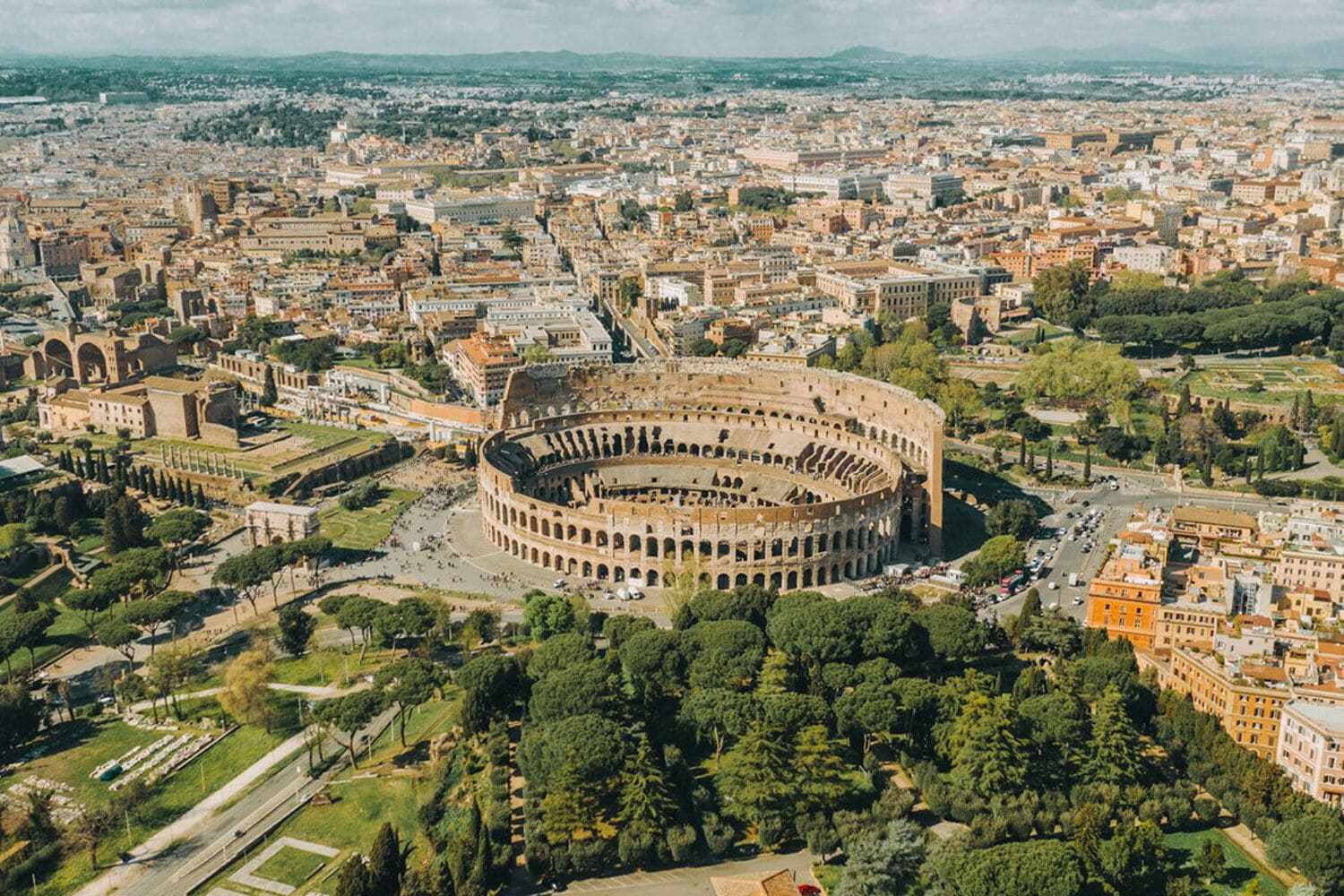
- The Colosseum is the largest amphitheater ever built in the Roman Empire, its construction was completed in 80 AD. The arena could accommodate from 50 to 80 thousand spectators who came to watch gladiatorial battles and other spectacles. A complex system of underground tunnels and lifts allowed for the spectacular release of wild animals and scenery onto the arena. The Colosseum is visited by more than 7 million tourists annually, making it the most popular landmark in Italy.
- The Pantheon is the best-preserved building of Ancient Rome, constructed in 126 AD by order of Emperor Hadrian. The dome of the Pantheon remains the largest unreinforced concrete dome in the world with a diameter of 43.3 meters. In the center of the dome is a circular opening with a diameter of 9 meters, which is the only source of natural lighting. Outstanding Italians are buried in the Pantheon, including the artist Raphael and the kings of united Italy.
- The Trevi Fountain is the largest baroque fountain in Rome and one of the most famous fountains in the world, completed in 1762. According to tradition, a coin tossed over the left shoulder into the fountain guarantees a return to Rome. Approximately 3,000 euros in coins are collected from the fountain daily, which are donated to charity. The fountain is fed by the waters of the ancient Roman aqueduct Aqua Virgo, built as early as 19 BC.
- Vatican City is the smallest independent state in the world with an area of only 44 hectares, completely surrounded by the territory of Rome. The Vatican houses the residence of the Pope and the center of the Roman Catholic Church. The Sistine Chapel with frescoes by Michelangelo, including the famous Last Judgment, attracts millions of visitors annually. The Vatican Museums contain one of the richest art collections in the world.
- The ancient Romans built more than 400 kilometers of aqueducts to supply the city with water from distant sources. Some of these aqueducts still function today and supply water to Roman fountains. The longest aqueduct, Aqua Marcia, stretched 91 kilometers from the source to the city. The Roman water supply system was so perfect that no other European city achieved such a level until the 19th century.
- The Roman Forum was the center of political, religious, and commercial life of Ancient Rome for over a thousand years. The most important government buildings, temples, and basilicas of the empire were located here. During the heyday of Rome, the Forum was decorated with marble columns, statues, and triumphal arches. Today, the ruins of the Forum give an idea of the greatness and complexity of Roman civilization.
- Rome has more than 900 churches, making it the city with the highest concentration of Christian temples in the world. Four of them have the status of papal basilicas and are the most important temples of the Catholic world. St. Peter’s Basilica in the Vatican is the largest church in the world with an area of 15,160 square meters. Many Roman churches are built on the sites of ancient pagan temples.
- The Spanish Steps with the famous Spanish Staircase is one of the most popular tourist locations in Rome. The staircase has 135 steps and leads to the church of Trinità dei Monti at the top of the Pincian Hill. The square received its name from the nearby palace of the Spanish embassy to the Holy See. In spring, the steps are decorated with thousands of blooming azaleas, creating an incredible spectacle.
- Rome is built on seven hills, which were of great importance for the defense and development of the city in ancient times. These hills are called the Palatine, Capitoline, Quirinal, Viminal, Esquiline, Caelian, and Aventine. On the Palatine, according to legend, Romulus founded the first settlement, and it was here that the palaces of Roman emperors were located. Today, wonderful panoramic views of the Eternal City open from each hill.
- The Roman road network during the heyday of the empire covered more than 400 thousand kilometers of roads throughout Europe, North Africa, and the Middle East. The expression all roads lead to Rome arose precisely because the city was the center of this huge network. The ancient Roman Appian Way, built in 312 BC, has been partially preserved and is used to this day. Roman roads were so well designed that some of them serve as the basis for modern highways.
- The Mouth of Truth is an ancient marble disc with a diameter of 1.75 meters, located in the church of Santa Maria in Cosmedin. According to medieval legend, the disc will bite off the hand of anyone who tells a lie while placing it in the mouth of the image. Probably, initially this disc was the cover of an ancient sewer manhole or part of a fountain. Today there is always a queue of tourists at the Mouth of Truth who want to take a photo with this mysterious relic.
- The Roman Pantheon maintained the status of the largest dome in the world for almost 1,300 years, until the 15th century when the construction of the Cathedral of Santa Maria del Fiore in Florence was completed. The thickness of the concrete dome of the Pantheon decreases from the base to the top, which allowed achieving its incredible strength. The Romans used a special recipe for concrete that contained volcanic dust and was stronger than modern concrete. The secret of this concrete was lost after the fall of the Roman Empire and was rediscovered only in our time.
- Piazza Navona is built on the site of the ancient Roman Stadium of Domitian, which could accommodate 30 thousand spectators. The characteristic elongated shape of the square exactly repeats the contours of the ancient stadium. The square features three fountains, the most famous of which is the Fountain of the Four Rivers by Bernini. Piazza Navona remains one of the liveliest places in Rome with numerous cafes, street artists, and musicians.
- Every day in Rome approximately 280 tons of food are thrown away, and the city produces about 1.8 million tons of garbage annually. The ancient Romans were pioneers in creating the complex sewage system Cloaca Maxima, which partially functions to this day. This sewage system was built as early as the 6th century BC and is considered one of the oldest engineering structures in the world. Modern Rome continues to struggle with waste disposal problems inherited from the huge tourism industry.
Rome continues to captivate millions of visitors with incredible facts from its centuries-old history. Every stone of the Eternal City has its own unique story that interweaves antiquity, the Middle Ages, and modernity. Interesting facts about Rome testify that this city remains a living witness to the greatness of human civilization. Visiting the capital of Italy offers an opportunity to touch the heritage that shaped European culture and influenced the entire world.


