
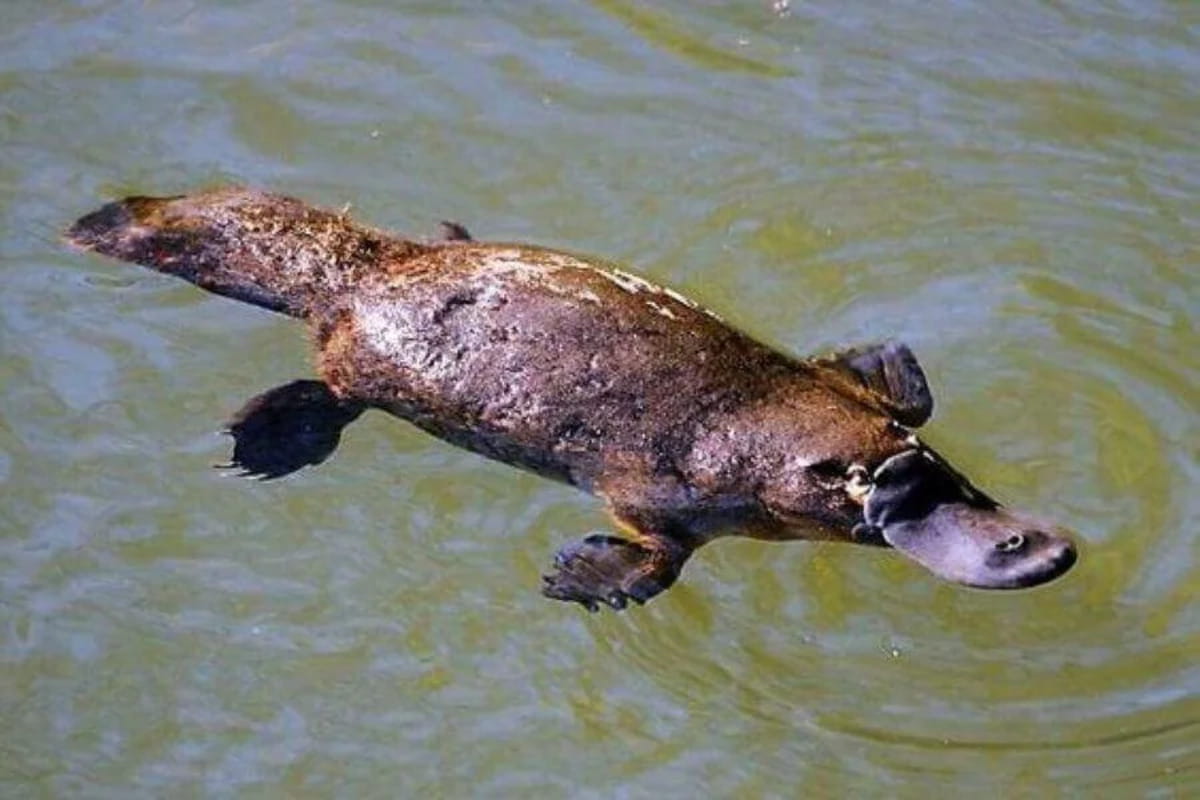
The platypus is one of the most extraordinary creatures on our planet, which at first glance appears to be a product of fantasy rather than a real animal. When European scientists first saw its stuffed specimen in the eighteenth century, they concluded that someone was playing a trick on them by sewing a duck’s bill onto the body of a beaver. However, nature turned out to be far more inventive than any human imagination, and the platypus genuinely exists — with its incredible abilities and unique characteristics. Fascinating facts about this animal are capable of changing your understanding of what mammals can actually be. We present a collection of interesting facts about platypuses that you may never have known.
- The platypus is one of the rarest egg-laying mammals on Earth. Together with the echidna, it belongs to the group of monotremes — the oldest surviving order of mammals, which appeared more than 166 million years ago. This group is a genuine living witness to ancient evolution, as most of the creatures related to it died out long ago.
- The bill of the platypus does not actually resemble a duck’s bill at all — it is soft and leathery rather than hard and horny. Inside it contains thousands of specialised receptors that detect the electric fields generated by the muscles of prey beneath the water. Thanks to this, the platypus is capable of hunting with its eyes, ears, and nostrils all closed, navigating exclusively by means of electrical signals.
- The electroreception of the platypus is one of the most sophisticated among all mammals. The animal possesses around 40,000 electroreceptors and 60,000 mechanoreceptors in its bill, which allows it to detect the faintest electrical impulses in the water. By comparison, the hammerhead shark, renowned for its electrosensitivity, possesses only around 1,500 such receptors.
- The platypus is one of the very few venomous mammals in the world. Males have sharp spurs on their hind legs connected to glands that produce venom. Although this venom is not lethal to humans, it causes extraordinarily intense and long-lasting pain that cannot be relieved even by morphine.
- Despite being a mammal, the platypus has no nipples. Milk is secreted directly through the pores of the female’s skin and collects in specialised grooves on her abdomen, from where the young lick it up. This method of feeding is unique among all mammals and testifies to the extraordinarily ancient origins of this animal.
- The tail of the platypus resembles that of a beaver and serves several functions simultaneously. In males it acts as a reservoir for storing fat, which is used as an energy reserve. In addition, the tail helps the animal to manoeuvre while swimming and to maintain its balance on land.
- Platypuses are nocturnal animals and lead a predominantly solitary lifestyle. They interact with one another extremely rarely outside the breeding season, avoiding any form of social contact. Each individual guards its own stretch of riverbank and will not tolerate neighbours in its immediate vicinity.
- The female platypus lays between one and three eggs resembling those of reptiles — small, leathery, and soft. She incubates them by tucking them between her tail and abdomen rather than sitting on them as birds do. The incubation period lasts only around ten days, which is an exceptionally short time for a mammal.
- Platypuses do not have a stomach in the conventional sense of the word. Their oesophagus connects directly to the intestine, bypassing the gastric sac, so food does not undergo the usual acid processing. Instead, the animal grinds its prey using keratinised pads in its mouth, since adult individuals have no teeth.
- Baby platypuses are born with teeth, but lose them before reaching adulthood. These temporary teeth help the young to break free from the eggshell during hatching. After losing them, the animal switches to grinding food with horny pads that perform the same function.
- Platypuses are extraordinarily efficient hunters and in a single dive are capable of consuming an amount of food equivalent to up to 20 percent of their own body weight. Their diet consists of insect larvae, worms, molluscs, small crustaceans, and fish. Since the animal has no pockets or pouch for storing food, it temporarily stashes its catch in its cheek pouches while hunting.
- Underwater, the platypus can hold its breath for up to 40 seconds, although most dives last between 20 and 30 seconds. Over the course of one hour of hunting, the animal performs hundreds of such dives in succession. Between dives it surfaces for only a brief moment to take in air, then immediately submerges again.
- The platypus is one of the few mammals in which fluorescence has been detected. Under ultraviolet light its fur glows with a greenish-blue colour, which is a wholly unusual phenomenon for warm-blooded animals. Scientists have not yet definitively established what biological function this property serves.
- The genome of the platypus is one of the most remarkable among all mammals that have been studied. It contains elements characteristic simultaneously of mammals, birds, and reptiles, reflecting its evolutionary antiquity and unique place in the animal kingdom. The decoding of the platypus genome in 2008 became a genuine sensation in the scientific world.
- Platypuses have a very low body temperature compared to other mammals — approximately 32 degrees Celsius instead of the standard 37. This is an indication of their primitive metabolism, which has been preserved from ancient times. Despite this, the animal copes remarkably well with the cold water of mountain streams, where it frequently hunts.
- The platypus has ten sex chromosomes instead of the two found in most mammals. In the male, the set of chromosomes resembles the chromosomal system of birds, whereas in most mammals sex chromosomes are determined in an entirely different manner. This discovery confirmed that platypuses occupy a special evolutionary position between reptiles, birds, and mammals.
- The natural habitat of the platypus is exclusively the eastern and south-eastern parts of Australia, including the island of Tasmania. The animal lives only near freshwater bodies — rivers, lakes, and streams with clean water. The pollution of waterways and the destruction of riparian ecosystems represent the principal threats to the survival of this species.
- Platypuses dig burrows directly into riverbanks, and these burrows can reach ten metres in length. The female digs a separate nesting burrow for raising her young and seals it from the inside with plugs of earth to protect against predators. The entrance to the burrow is usually positioned below the waterline, which makes access difficult for unwelcome visitors.
- The platypus is the only mammal in which gastric acid is entirely absent. Most vertebrates use the acidic environment of the stomach to digest food and destroy harmful bacteria, but the platypus manages without this mechanism. Scientists believe that this type of digestion was characteristic of the ancestors of all modern mammals.
- The lifespan of the platypus in the wild ranges from 10 to 15 years, while in captivity certain individuals have been known to live to the age of 17. Young animals are particularly vulnerable and perish in the first years of life due to predators and disease. Adult platypuses have relatively few natural enemies thanks to their venom and their nocturnal way of life.
The platypus is a living illustration of just how boundless and unpredictable nature can be. Every incredible fact about this animal reminds us that evolution is capable of producing solutions that fit within no generally accepted framework. This astonishing creature has lived on Earth for tens of millions of years — and by its very existence alone proves that reality is always more interesting than any fiction.


