
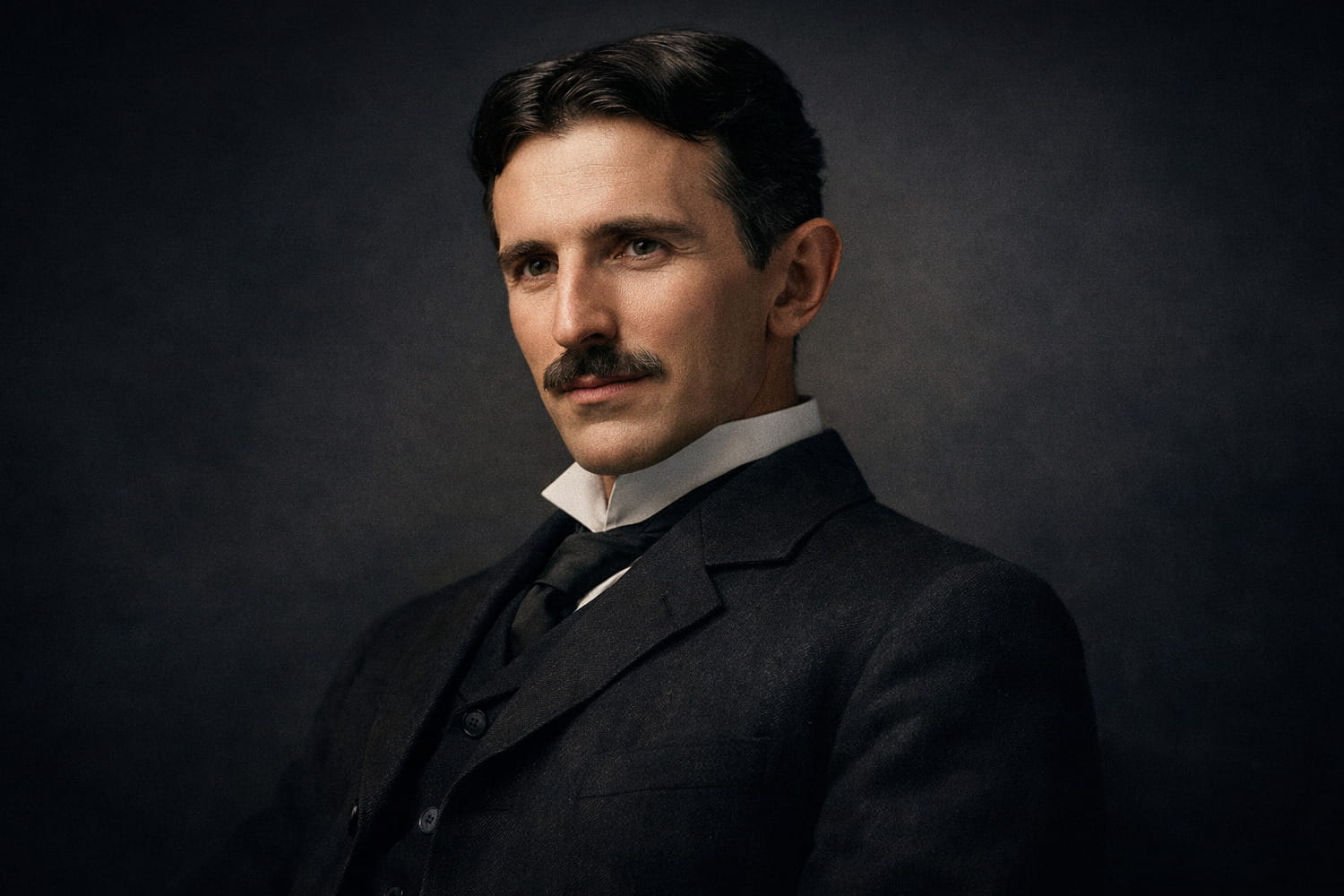
Imagine a genius whose inventions changed the course of history and gave humanity electric light, radio and many other technologies that we use every day. Nikola Tesla remains one of the most mysterious figures in the world of science because his life was full of incredible discoveries and personal tragedies. Many have heard about this outstanding inventor but far from everyone knows about the amazing details of his biography and unique habits. We have gathered for you the most interesting facts and fascinating information that will reveal the true essence of this legendary personality. You might not know how far ahead of his time Tesla was and what secrets lie behind his brilliant ideas.
- Nikola Tesla was born in 1856 in a small village called Smiljan in the territory of modern Croatia which was then part of the Austrian Empire. His father was an Orthodox priest while his mother although she had no formal education possessed a remarkable talent for creating household tools. It was from his mother that Tesla inherited the amazing ability to visualize complex mechanisms in his imagination without having to draw them on paper. This unique feature allowed him to create inventions in the future that were decades ahead of their time.
- Tesla possessed a phenomenal memory and could quote entire books from memory including complete works by Goethe and other classical literary works. He claimed that his brain worked like a powerful computer capable of instantly processing huge amounts of information and performing complex calculations. This ability allowed him to conduct experiments in his mind checking the operation of mechanisms even before their physical creation. Many contemporaries considered such memory a gift however Tesla himself viewed it as a tool for scientific work.
- The inventor freely spoke eight languages including Serbian English German French Italian Latin Czech and Hungarian. Such polyglotism allowed him to communicate freely with scientists and investors from different corners of the world and read specialized literature in the original. Knowledge of languages also helped Tesla publish his works in leading scientific publications and protect patents at the international level. This contributed to the rapid spread of his ideas and technologies on a global scale.
- Tesla was known for his obsession with the number three and often performed actions exactly three times before entering a room or starting important work. He could walk around the house three times before going inside or count his steps to make them divisible by three. Psychologists later suggested that such behavior might have been a manifestation of obsessive-compulsive disorder that accompanied the genius throughout his life. Despite these quirks Tesla remained extremely productive and focused on his scientific goals.
- The outstanding inventor had a unique ability to see bright flashes of light and geometric figures when he heard certain words or thought about complex concepts. This phenomenon known as synesthesia allowed him to perceive abstract ideas in the form of visual images which greatly facilitated the invention process. Tesla often used these inner visions to develop new schemes and constructions that were later embodied in real devices. Such unconventional thinking became the key to many of his revolutionary discoveries.
- Tesla slept only two to three hours a day believing that long sleep takes away time that could be devoted to scientific work and experiments. He often worked all night in his laboratory taking breaks only for short rest or a walk. Such a regime allowed him to achieve incredible productivity however it could negatively affect his physical and emotional health over time. Many researchers believe that such an intensive schedule accelerated the exhaustion of the inventor’s body in old age.
- Tesla was known for his pedantic cleanliness and could refuse to shake hands with a person if they had dirty hands or a sloppy appearance. He often wore white gloves at public events to avoid direct contact with objects and people he considered unclean. This character trait sometimes complicated his social relationships however it helped him maintain focus on work and avoid unnecessary distractions. Some believe that such behavior was part of his general tendency toward control and order in all areas of life.
- Despite his brilliant mind Tesla had rather controversial views on the role of women in society and believed that women should gradually be displaced from many spheres of activity. He never married explaining that marriage and family life could interfere with his scientific career and focus on inventions. However later in life he had a deep emotional connection with a white pigeon which he considered his only true friend and inspiration. This story demonstrates the complexity of Tesla’s personality and his search for spiritual closeness beyond science.
- Tesla developed the concept of transmitting electrical energy without wires and even built the Wardenclyffe Tower for experiments in this area which was never completed due to lack of funding. He dreamed of creating a global system of free energy available to every resident of the planet regardless of place of residence. Although this project remained unrealized Tesla’s ideas about wireless transmission of data and energy are today embodied in wireless charging and internet technologies. His vision of the future turned out to be surprisingly accurate and relevant even a century later.
- Tesla claimed that he received signals from space during his experiments with radio waves and believed that this might be an attempt to establish contact with other civilizations. He recorded strange repeating impulses that he could not explain by earthly sources and seriously considered the possibility of interstellar communication. Modern scientists suggest that these signals could have been radiation from pulsars or other astrophysical objects that were not yet known to science at that time. This episode emphasizes the openness of Tesla’s mind to the boldest hypotheses and his desire to expand the boundaries of human knowledge.
- Tesla invented the first remote control device which he demonstrated in 1898 at an exhibition in Madison Square Garden amazing the audience with a controlled boat without visible mechanisms. He called this invention teleautomatics and predicted its wide use in military affairs industry and everyday life. Many viewers at that time considered this a trick or magic however in reality it was an early example of radio control which became the basis for modern drones and robots. This demonstration became an important step in the development of automated systems and unmanned technologies.
- Tesla developed the principle of operation of a bladeless turbine which used the boundary layer effect to rotate disks and achieved an extremely high efficiency coefficient. This design was significantly simpler and more reliable than traditional turbines however it did not receive widespread use due to difficulties with the production of materials at that time. Modern engineers are again paying attention to Tesla’s ideas in this area trying to implement them in the newest energy systems. His engineering solutions often turned out to be too advanced for the industry of his era.
- Tesla experimented with X-rays even before the official discovery by Röntgen and made the first images of the human body using his own developments in this field. He lost many of his records and equipment during a fire in the laboratory which prevented him from receiving recognition as the discoverer of this phenomenon. Tesla also warned about the potential danger of radiation to health when most scientists were not yet aware of these risks. His contribution to the development of medical diagnostics remains little known however it is an extremely important aspect of his legacy.
- Tesla had a unique habit of squeezing his toes one hundred times each foot before sleep believing that this stimulates brain cells and improves mental activity. He also avoided round objects and pearls in jewelry preferring geometric shapes and clear lines in everything that surrounded him. These personal rituals and preferences reflected his desire for order and control over his own body and mind. Many of these habits seem strange however they helped Tesla maintain psychological balance in intense work.
- The unit of measurement of magnetic induction in the International System of Units SI is named tesla in honor of the outstanding inventor which emphasizes his fundamental contribution to the development of electromagnetism. This recognition by the world scientific community fixed Tesla’s name alongside other great physicists such as Newton Einstein and Maxwell. Today the name Tesla is also borne by a famous company producing electric cars which testifies to the relevance of his ideas in the modern technological world. The legacy of this genius continues to inspire new generations of engineers and inventors around the planet.
These fascinating facts demonstrate how versatile and deep the personality of Nikola Tesla was and his influence on the development of science. Every detail of his life from childhood dreams to his last experiments testifies to the tireless search for truth and the desire to change the world for the better. Incredible facts about this inventor remind us that genius often borders on extravagance and requires great sacrifices for a higher purpose. Only by studying the lives of such people can we understand the true price of progress and the importance of preserving intellectual heritage for the future.


