
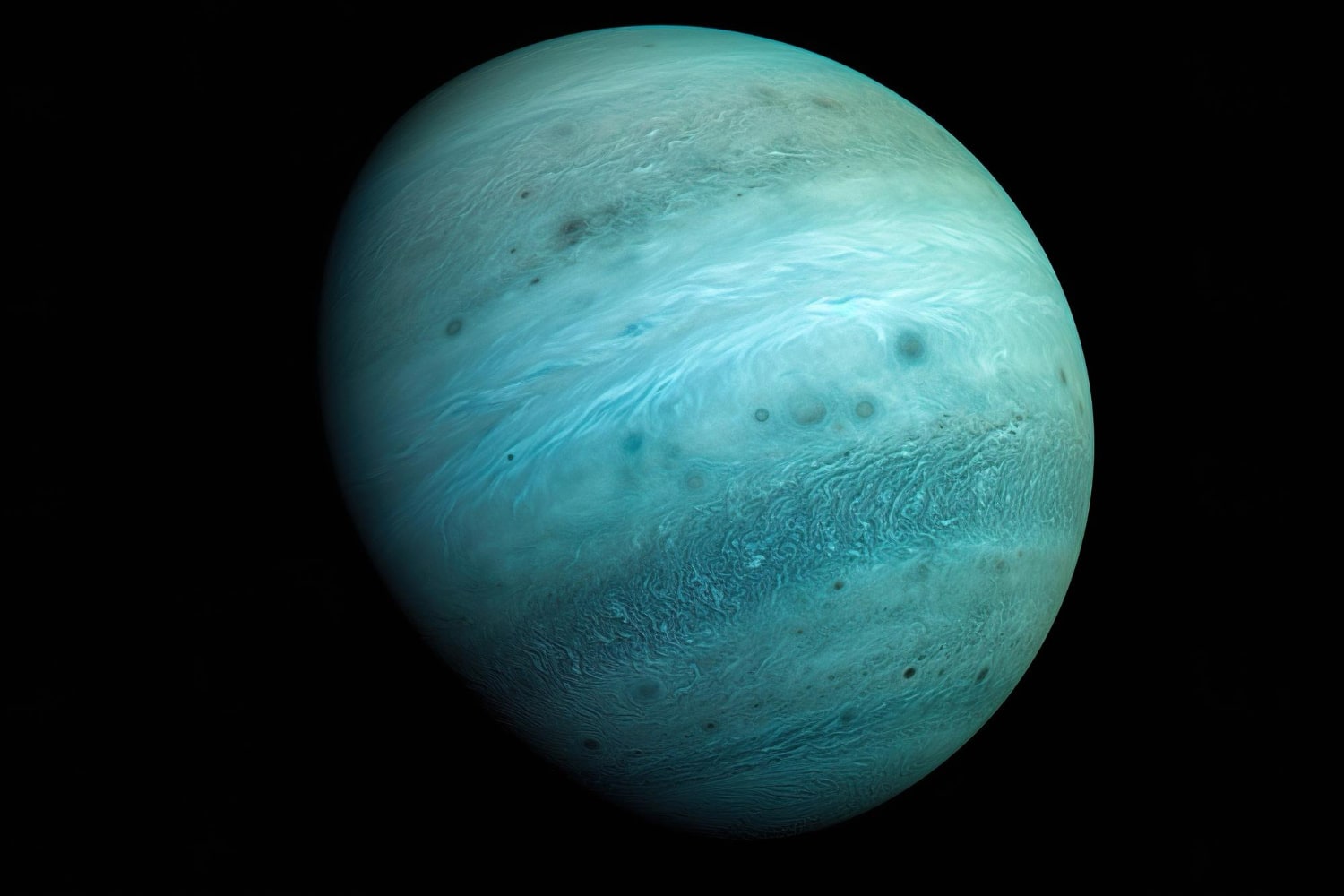
Neptune is one of the most mysterious planets in the Solar System, concealed behind thick layers of atmosphere, extreme distance and harsh conditions. Although humanity has approached it only once through a single spacecraft, research continues to reveal new and fascinating insights. You might not know that this distant world contains unique atmospheric phenomena, unusual moon orbits and features not found anywhere else in the Solar System. Scientists are still studying its nature, as many aspects of Neptune remain hidden. That is why these interesting facts about Neptune help us better understand the characteristics of this icy giant and its place in the cosmos.
- Neptune lies so far from the Sun that sunlight needs more than fourteen hours to reach its atmosphere. The distance exceeds four billion kilometres, so the planet receives very little heat. Temperatures in the upper atmosphere drop to nearly minus two hundred twenty degrees. This makes Neptune one of the coldest planets in the Solar System.
- The planet was discovered not through observation but through mathematical predictions, which is a rare case in the history of astronomy. Scientists noticed that Uranus deviated from its expected orbit and concluded that an unknown planet was influencing it. Calculations indicated where this object should be located. Later observations confirmed that the prediction was correct.
- Neptune’s atmosphere is composed mostly of hydrogen, helium and methane, with methane giving the planet its deep blue colour. Methane absorbs red light, causing the reflected colour to appear vivid blue. Deeper layers may contain other gases and various types of ice. These elements create complex atmospheric circulation patterns.
- The strongest winds in the Solar System blow on Neptune, reaching speeds of more than two thousand kilometres per hour. Such winds move massive volumes of gas at speeds unimaginable on Earth. Scientists attribute this to extreme cold and low atmospheric density. These conditions make Neptune’s atmosphere exceptionally active.
- Large dark spots seen on the planet are enormous storms that can persist for many years. Some of these storms are bigger than Earth. They form in the upper atmosphere and drift with prevailing winds. Their behaviour helps scientists understand the deeper layers of the planet.
- One of Neptune’s most notable atmospheric formations is the Great Dark Spot, which changes in size and shape over time. Unlike Jupiter’s storms, these features often disappear and reappear. Their formation mechanisms are still not fully understood. Studying them provides insight into wind behaviour under extremely cold conditions.
- Neptune’s interior consists of layers of water ice, ammonia ice and methane ice under immense pressure. In the deepest regions these substances can transition into unusual forms, including superheated ice. This state occurs at temperatures of thousands of degrees and pressures hundreds of thousands of times greater than those on Earth. These layers contribute to the creation of the planet’s magnetic field.
- Neptune’s magnetic field does not align with the planet’s geometric centre and is significantly tilted. It is shifted sideways and rotated relative to the axis of rotation. This creates an extremely complex and unpredictable magnetosphere. Because of this, Neptune is often compared to a magnetic maze.
- Neptune has many moons, and the most famous among them is Triton, which orbits in the opposite direction to the planet’s rotation. This retrograde orbit suggests that Triton was most likely captured from the Kuiper Belt. It is one of the coldest known objects in the Solar System. Nitrogen geysers have been observed on its surface.
- Triton’s surface is covered with frozen nitrogen, and beneath it may lie an ocean of liquid water. The surface temperature reaches about minus two hundred thirty degrees. Despite these extreme conditions, internal heating caused by tidal forces may persist. This makes Triton a promising target for future exploration.
- Neptune is surrounded by a system of thin rings composed mainly of ice and dust particles. In some regions the rings form arcs, which are sections with significantly higher concentrations of material. This rare phenomenon remains only partially explained. It may be linked to the gravitational influence of nearby moons.
- Voyager 2 is the only spacecraft that has ever approached Neptune, completing a flyby in the mid-1980s. It sent back unique images and scientific data that remain the foundation of our current knowledge about the planet. The spacecraft observed storms, ring structures and atmospheric details. This historic mission marked a breakthrough in the study of distant giants.
- Neptune rotates very quickly, with a day lasting about sixteen hours. However, one full orbit around the Sun takes nearly one hundred sixty-five Earth years. This combination leads to unusual seasonal cycles that stretch across decades. The planet experiences slow and long-lasting climate changes.
- Even though Neptune receives minimal solar energy, its atmosphere remains surprisingly active. Scientists believe that its energy comes from internal heat. This heat is a remnant from the planet’s formation. It drives atmospheric motion even at the far edge of the Solar System.
These interesting facts about Neptune show just how complex and extraordinary this distant planet truly is. Many of its phenomena are still not fully understood, and new research continues to deepen interest in this icy world. You might not have known about the numerous hidden processes that shape Neptune’s nature. That is why studying this planet is an essential step toward understanding distant cosmic environments.


