
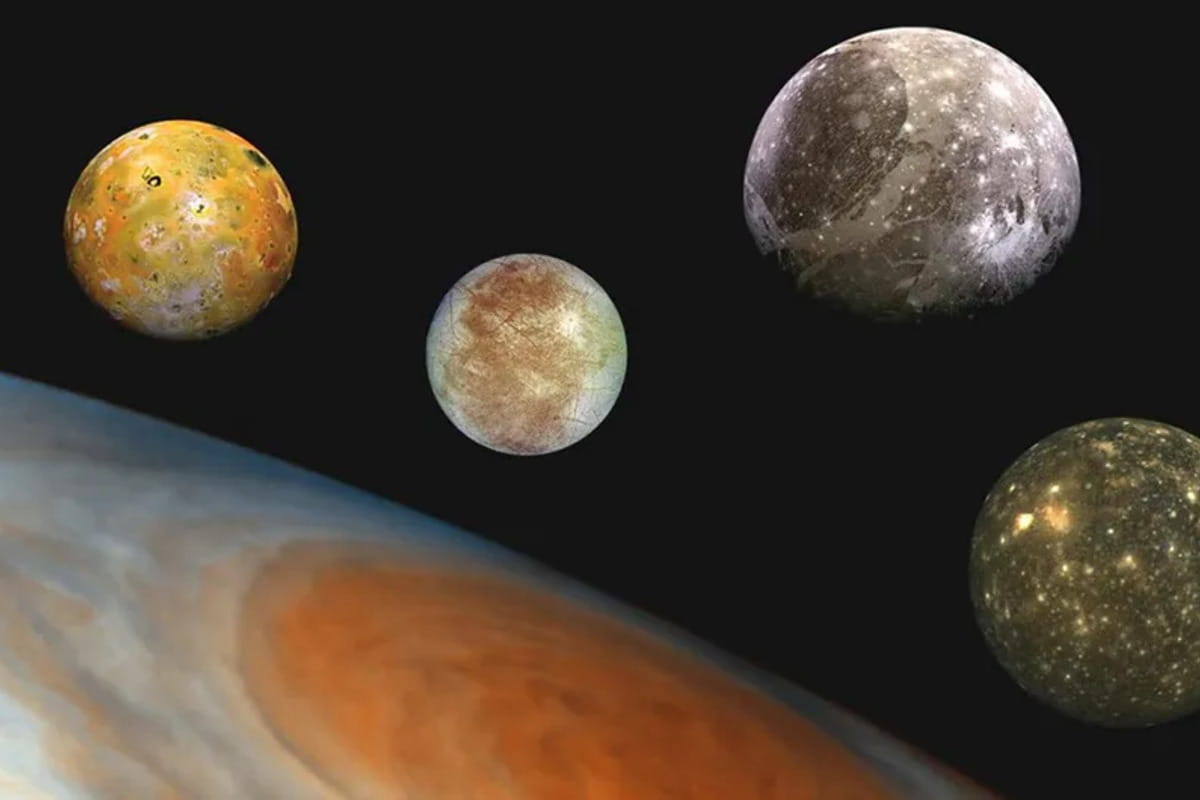
Jupiter, the colossal gas giant, reigns over a magnificent realm of dozens of natural satellites, each harboring unique cosmic secrets waiting to be uncovered. Incredible facts about Jupiter’s moons reveal a universe of extreme volcanoes, subsurface oceans hidden beneath icy shells, and intricate gravitational dances within the planet’s powerful sphere of influence. You might not know that several of these moons actually surpass terrestrial planets in size, challenging our conventional understanding of planetary bodies. Fascinating facts about this complex system transform our perspective on geological activity and the potential for life in the far reaches of our solar system.
- Jupiter possesses the most extensive moon system of any planet in our solar system with respect to confirmed objects. As of 2024 astronomers have officially verified the existence of ninety-five natural satellites orbiting the gas giant. The majority of these are small bodies measuring less than ten kilometers in diameter discovered through advanced modern telescopes. This number continues to grow steadily as observational technologies for deep space exploration advance further.
- The four largest Jovian moons were discovered by Galileo Galilei in 1610 using the first telescope in history. These moons earned the designation Galilean satellites and became the first known objects observed orbiting a planet other than Earth. This groundbreaking discovery delivered a powerful blow to the geocentric model of the universe and provided crucial support for Copernicus’s heliocentric theory. Today these moons bear the names Io Europa Ganymede and Callisto.
- Ganymede stands as the largest moon not only of Jupiter but of our entire solar system with a diameter exceeding five thousand kilometers. This satellite surpasses even the planet Mercury in size though its mass remains considerably smaller due to lower density. Ganymede holds the distinction of being the only moon in the solar system known to generate its own magnetic field produced by the motion of its liquid iron core. A thin oxygen-rich atmosphere envelops this remarkable world.
- Io ranks as the most volcanically active body in our solar system with more than four hundred active volcanoes dotting its surface. This extraordinary activity stems from tidal heating caused by gravitational interactions with Jupiter and the other Galilean moons. Eruptions on Io can propel material upward five hundred kilometers into space creating spectacular plumes visible from orbit. The moon’s surface undergoes constant renewal which explains the near absence of impact craters.
- Europa captures scientists’ special attention due to a deep subsurface ocean of liquid water concealed beneath an icy shell dozens of kilometers thick. This hidden ocean contains more water than all of Earth’s oceans combined and potentially offers a habitat suitable for microbial life. Europa’s surface displays distinctive cracks and streaks indicating active tectonic movement within its frozen crust. Spacecraft have detected plumes of water vapor erupting through fractures in the ice.
- Callisto features the most heavily cratered surface among all large moons in the solar system providing clear evidence of its ancient geological age. Unlike other Galilean moons Callisto experiences minimal tidal heating because of its considerable distance from Jupiter. This moon might also harbor a subsurface ocean though likely buried much deeper beneath a thicker ice layer. Callisto represents the most promising location for a future human base due to significantly lower radiation levels compared with Jupiter’s other large moons.
- The three inner Galilean moons Io Europa and Ganymede exist in a precise orbital resonance pattern of 1:2:4. This means that for every two orbits Europa completes around Jupiter Io makes four orbits while Ganymede completes just one. Such resonance generates periodic gravitational tugs that sustain Io’s volcanic fury and likely help maintain Europa’s ocean in a liquid state. This stands as one of the most stable orbital resonances observed anywhere in our solar system.
- The moon Amalthea ranks as the largest of Jupiter’s inner irregular satellites and displays an unusual reddish surface coloration. This small potato-shaped moon orbits extremely close to Jupiter and maintains one of the shortest orbital periods among all the planet’s satellites. Amalthea serves as a source of material for Jupiter’s faint ring system as particles continuously eject from its surface into space. Its landscape features enormous craters some reaching one third of the moon’s entire diameter.
- Most of Jupiter’s smaller moons belong to the category of irregular satellites characterized by highly inclined and often retrograde orbits. Scientists believe these moons did not form alongside Jupiter but were captured by its gravitational field during the solar system’s early formation period. They cluster into several families based on similar orbital characteristics including the Himalia Ananke Carme and Pasiphae groups. Many measure less than five kilometers across and resemble asteroids in both composition and appearance.
- The moon Himalia serves as the largest representative of its namesake group of irregular satellites and possesses an irregular non-spherical shape. This satellite was discovered back in 1904 though detailed study only became possible with modern spacecraft technology. Himalia exhibits a dark surface with low albedo indicating the presence of organic compounds on its terrain. Researchers consider it likely a fragment of a shattered asteroid captured by Jupiter long ago.
- Certain Jovian moons such as Elara and Leda follow such elongated orbital paths that their distance from the planet changes dramatically during a single revolution. These moons belong to the Carme group and travel around Jupiter in a direction opposite to the planet’s rotation. Such retrograde orbits serve as characteristic signatures of captured objects rather than bodies that formed within the planet’s original accretion disk. Their orbital paths constantly experience gravitational disturbances from the Sun and other planets.
- The moon Themisto represents one of Jupiter’s smallest known satellites with a diameter of merely a few kilometers. It belongs to the Ananke group and maintains one of the most steeply inclined orbits among all solar system moons. Themisto was not discovered until the year 2000 thanks to digital image processing technologies applied to observations from powerful ground-based telescopes. Such tiny moons remain perpetually vulnerable to collisions with other small bodies or loss through gravitational perturbations.
- Jupiter’s moon system significantly influences the formation of the planet’s delicate ring structures composed of fine dust particles. This dust undergoes continuous replenishment through meteoroid impacts on the surfaces of inner moons such as Metis and Adrastea. Jupiter’s rings appear substantially fainter and darker than Saturn’s famous rings and were first detected only in 1979 by the Voyager 1 spacecraft. They exhibit complex multi-component structures reflecting the gravitational influence of various moons.
- The moon Carme stands as the largest object within the Carme group with a diameter of approximately forty-six kilometers. This satellite orbits Jupiter in a retrograde direction with an orbital inclination exceeding one hundred seventy degrees. Carme displays a dark surface with an albedo of only about four percent typical of primitive carbonaceous asteroids. Scientists believe the entire Carme group originated from the fragmentation of a single large captured asteroid.
- The most distant known Jovian moons such as S/2003 J2 travel in orbits more than twenty million kilometers from the planet. Orbital periods for such distant satellites can exceed two Earth years. These objects reside at the very edge of Jupiter’s gravitational dominance and can easily be lost due to perturbations from the Sun or neighboring planets. Their discovery became possible only through automated sky surveys utilizing the most advanced telescopes available today.
- Several Jovian moons particularly the Galilean satellites possess thin atmospheres composed of various gases. Io for instance maintains a sulfur dioxide atmosphere constantly replenished by ongoing volcanic activity. Europa features an extremely tenuous oxygen atmosphere created when radiation interacts with surface ice. Ganymede also possesses a faint oxygen atmosphere detected through ultraviolet observations. These atmospheres remain exceptionally thin compared with Earth’s and provide no meaningful protection against cosmic radiation.
- The moon Leda follows one of the most elongated orbits among Jupiter’s regular satellites with an eccentricity exceeding zero point zero three. This satellite belongs to the Himalia group and displays an irregular shape measuring approximately twenty-four by sixteen kilometers. Leda was discovered in 1938 and for many years remained the sole known representative of its orbital family. Its surface appears very dark suggesting the presence of organic materials or silicate minerals.
- The Juno spacecraft operating in Jovian orbit since 2016 has captured unprecedented detailed images of the planet’s inner moons. These observations revealed new surface features including fresh fractures on Europa and complex volcanic structures on Io. Juno also investigates the gravitational influence of moons on Jupiter’s extensive magnetosphere. Future missions such as JUICE and Europa Clipper will focus intensively on comprehensive exploration of the Galilean satellites.
- The moon Ananke serves as the largest object in the Ananke group and follows a retrograde orbit with significant inclination. This satellite was discovered as early as 1951 though its physical characteristics remained unknown until modern telescopes emerged. Ananke measures approximately twenty-eight kilometers in diameter and displays a dark surface similar to typical C-type asteroids. The entire Ananke group likely formed when a single large captured body fragmented after Jupiter’s gravitational capture.
- Some Jovian moons including Pasiphae follow orbits with such extreme eccentricity that they actually cross the orbital paths of other moons within their group. Pasiphae ranks as the largest moon in the Pasiphae group with a diameter of approximately sixty kilometers. This satellite orbits Jupiter at distances exceeding twenty million kilometers and possesses one of the longest orbital periods among all Jovian moons. Its surface appears exceptionally dark indicating a primitive composition similar to carbonaceous chondrite meteorites.
These captivating facts about Jupiter’s moons unveil a cosmic system of extraordinary diversity and complexity. Incredible insights into their geology orbital mechanics and potential habitability establish this system as one of the most promising frontiers for future exploration. You might not have realized how multifaceted Jupiter’s lunar family truly is but now understand these bodies represent entire worlds with distinctive characteristics and histories. Upcoming space missions promise to reveal even more secrets of this remarkable system possibly even uncovering evidence of extraterrestrial life thriving in hidden oceanic realms.


