
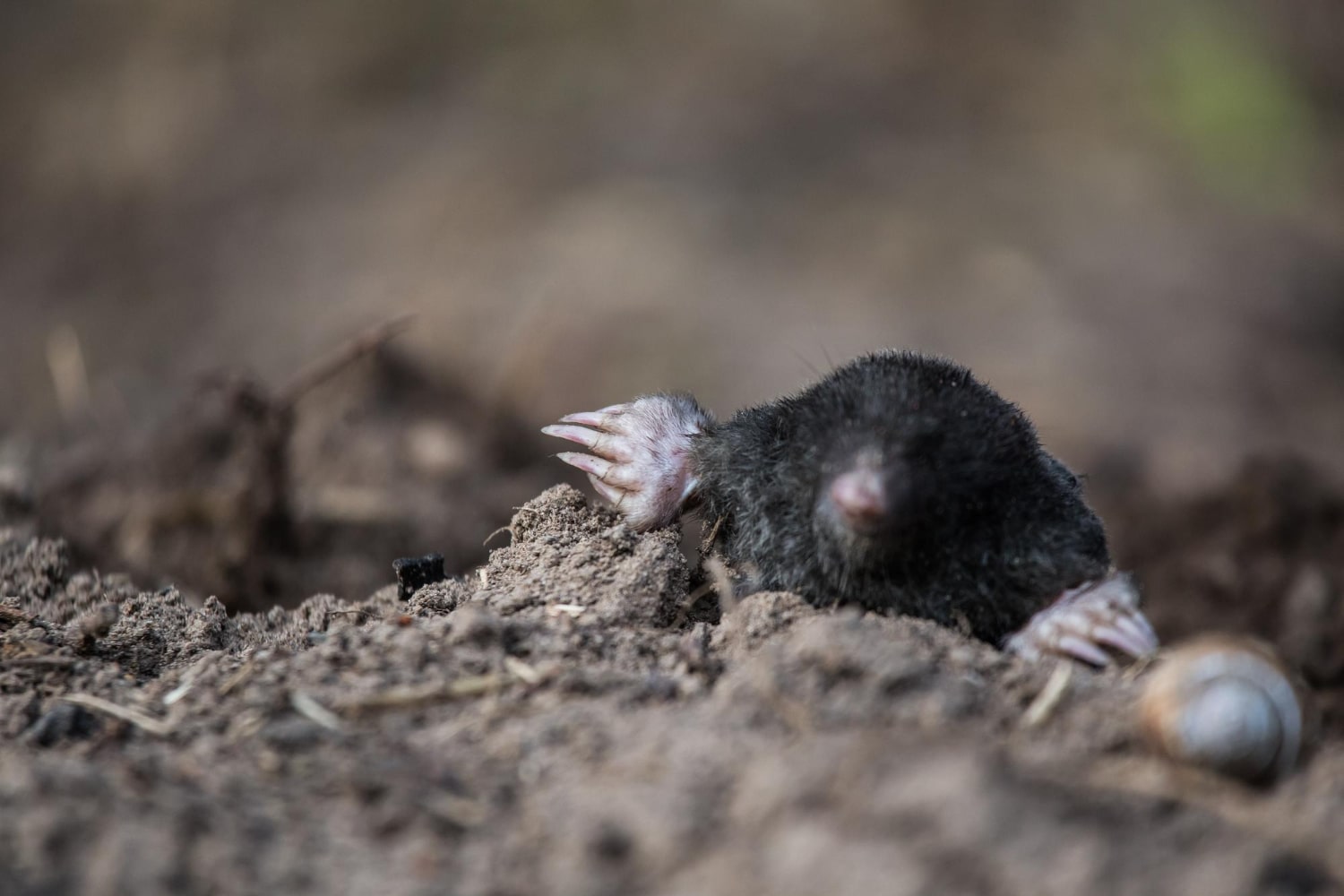
Moles are small mammals that are rarely seen but play an important role in nature. They live underground, creating complex tunnel systems, and possess unique anatomical and behavioral traits that demonstrate impressive adaptability. Despite their unremarkable appearance, these creatures can surprise both scientists and gardeners around the world. Below are some interesting facts about moles that will give you a deeper look into the hidden lives of these mysterious soil dwellers.
- Moles can dig up to 20 meters of tunnels in a single day. Their forelimbs are specially adapted for digging, with strong muscles and an outward-facing orientation that makes it easier to move soil. This allows them to disappear underground almost instantly. Over the course of a year, a mole can create a tunnel network more than a kilometer long.
- These animals are nearly blind, although they have not completely lost their vision. They can distinguish only light from darkness, which helps them navigate their surroundings. Their main senses are touch and smell. As a result, they are highly efficient at moving through the total darkness of their underground world.
- Moles have extremely sensitive noses that allow them to detect even the smallest movements in the soil. Some species, like the star-nosed mole, have special tentacle-like structures around their nose that detect microscopic vibrations. This helps them locate prey instantly. Their sense of smell is even more precise than that of many dogs.
- Although moles are often associated with damaging plant roots, they are actually carnivorous. Their diet consists mainly of earthworms, larvae, insects, and other invertebrates. They do not eat plants, and only damage them accidentally while tunneling. Therefore, they can be seen both as pests and as beneficial helpers in pest control.
- Moles have a very high metabolic rate, which means they must eat constantly. They can consume an amount of food equal to their own body weight in a single day. Without food, a mole can survive only about 12 hours. This is why they remain active even during the winter.
- In winter, moles do not hibernate but continue digging beneath the snow and frozen ground. They move deeper into the soil where temperatures are more stable. There, they store food supplies, especially immobilized earthworms. They bite the worms’ nerve centers to keep them alive but paralyzed.
- A mole’s body is covered with short, velvety fur that lacks a defined direction of growth. This allows them to move forward and backward in tight tunnels without resistance. This type of fur structure is unique among mammals. It also helps reduce friction while moving underground.
- A mole’s heart beats very rapidly—up to 200 times per minute during activity. This supports their high energy demands while digging. When resting, their heart rate slows to nearly half. This adaptation helps them conserve energy during periods of inactivity.
- Moles have elbow joints that are rotated outward, enabling more effective manipulation of soil while digging. This anatomical feature is not found in any other mammals. Thanks to this, moles can efficiently create complex tunnel systems. Their forelimbs function almost like shovels.
- Some species of moles can move underwater. They are able to hold their breath for several minutes and use submerged tunnels. For example, the American water mole is an excellent swimmer and hunts in ponds and streams. This makes it a rare example of a semi-aquatic mole.
- Moles are highly territorial animals and usually live alone. If another mole enters their burrow, a fierce fight can occur. The only exception is the mating season. During this time, males travel long distances in search of females.
- Mole tunnels often consist of multiple levels—shallow ones for hunting and deeper ones for resting and nesting. Moles frequently build central chambers lined with dry leaves and grass. These are the places where females give birth and raise their young. Under favorable conditions, a female may have up to seven offspring at once.
- Even though their eyesight is poor, moles have an excellent sense of hearing. They can detect ground vibrations caused by insect movements. This allows them to accurately locate their prey. Their ears are covered with fur, which protects them from soil particles.
- A mole’s tunnel system is useful not only for hunting but also for ventilation. Air circulates through the passages, helping to exchange oxygen. Moles even create vertical shafts to improve airflow. This keeps their living space comfortable.
- Despite being well adapted to life underground, moles are vulnerable above ground. They are hunted by predators such as foxes, owls, and snakes. For this reason, they rarely come to the surface. Even when foraging, they try to stay just beneath the soil.
- In various cultures, moles hold symbolic meanings. In some parts of Europe, they are seen as omens of change. Folklore often highlights their ability to sense underground movements as a metaphor for intuition. However, gardeners usually view them less favorably.
- There are over 40 species of moles, and some of them live in mountainous regions. For instance, the Tibetan mole inhabits elevations above 4000 meters. Its body is adapted to low-oxygen environments. This shows just how versatile and resilient these animals can be.
These fascinating facts about moles reveal how complex and diverse the world of even the most overlooked creatures can be. The underground lives of moles are filled with unique adaptations that help them survive and play a vital ecological role. Their behavior, anatomy, and lifestyle deserve attention from both scientists and curious readers. You might not have known just how interesting life beneath our feet can be.


