
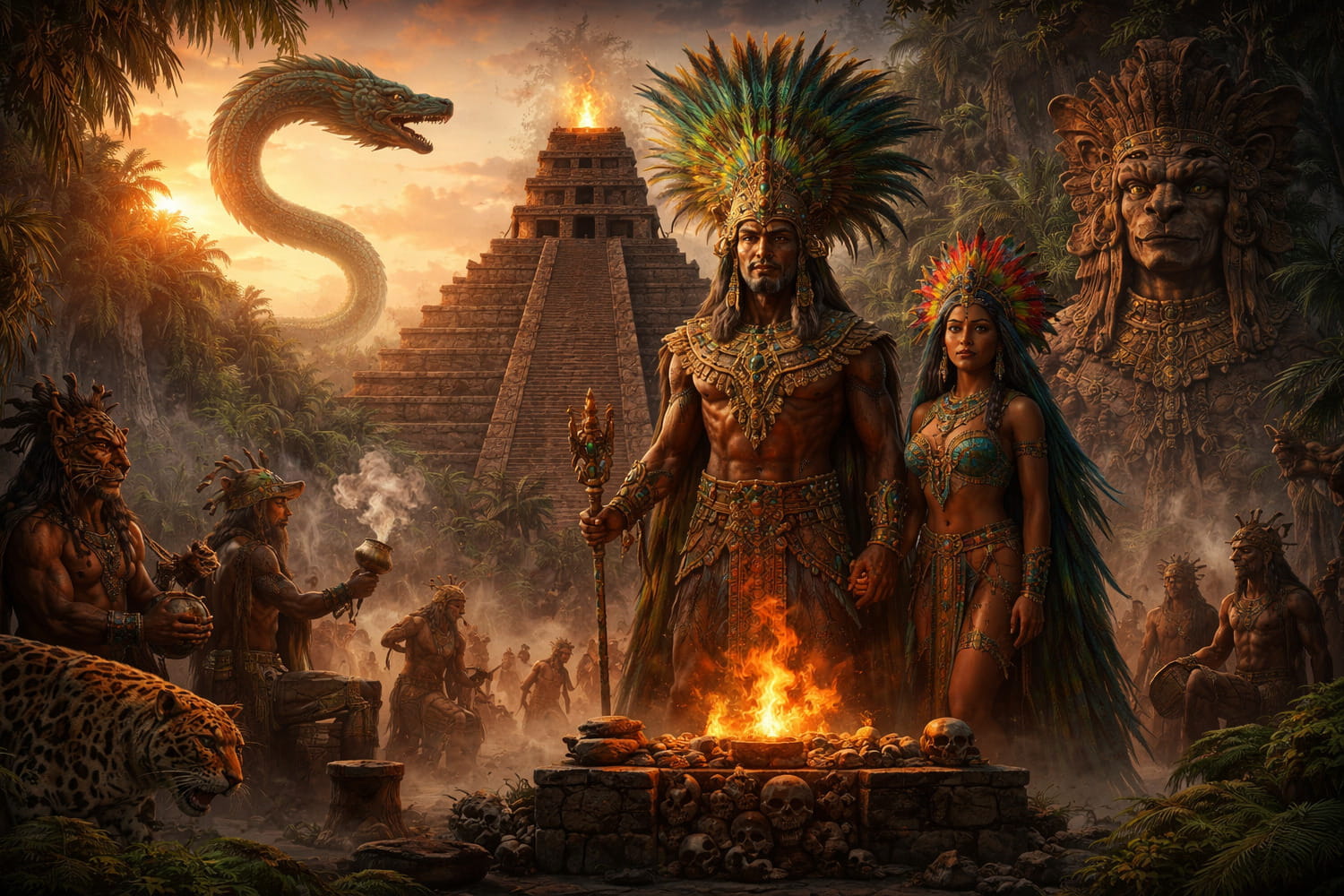
Maya mythology represents an extraordinarily complex and multifaceted belief system that developed over millennia deep within the tropical forests of Central America. Incredible facts about this mythology reveal a world where time flows in cycles, and each day is governed by a distinct deity. You might not know that the Maya believed in the simultaneous existence of three interconnected worlds—the celestial realm, the earthly plane, and the subterranean kingdom of the dead. Fascinating facts about Maya mythology transform it into one of the most profound spiritual systems of the ancient world.
- The Maya believed the universe passed through successive creations and destructions, with each cycle called a sun or age. According to their traditions, we currently inhabit the fifth age, which began on August thirteenth in the year three thousand one hundred fourteen before the common era. The previous four worlds were destroyed by various catastrophes, including floods, fire, and a rain of resin. This concept of cyclical time formed the foundation of their sophisticated calendar systems and prophetic traditions.
- The sacred Maya book Popol Vuh contains a complete creation myth that differs significantly from many other cultural traditions. Initial attempts at creation included humans fashioned from mud, who simply dissolved, and beings made of wood, who lacked intelligence and emotion. Only when the gods crafted humans from white and yellow maize did their creation prove successful and enduring. Maize became far more than sustenance—it transformed into the sacred substance from which human essence itself was formed.
- The underworld realm of the dead, known as Xibalba, existed as an intricate labyrinth containing numerous houses, each presenting unique dangers to visitors. Among these perilous structures were the House of Darkness, the House of Cold, the House of Jaguars, and the House of Knives. Souls of the deceased had to navigate these trials successfully to reach their final resting place. Only those who died violent deaths, or women who perished during childbirth, gained direct passage to celestial paradise.
- The Hero Twins, Hunahpu and Xbalanque, occupy a central position in Maya mythology, comparable to major deities in Greek or Norse traditions. They defeated the lords of Xibalba through a series of intellectual challenges and athletic competitions, most notably the sacred ballgame. Following their victory, they resurrected their father, who became the Maize God, while they themselves transformed into the Sun and Moon. Their legendary exploits symbolized the eternal triumph of life over death.
- The rain god Chaac appeared with a distinctive long curved nose resembling an elephant’s trunk and carried a stone axe that created thunder when struck. He manifested in four aspects, each governing one cardinal direction and associated with a specific color: red, white, black, and yellow. During droughts, the Maya performed elaborate rituals, including bloodletting ceremonies where even children’s blood was offered to appease Chaac’s anger. This deity held paramount importance in the daily lives of agricultural communities.
- The supreme god Itzamna served as creator of writing, the calendar system, and medicine, while also regarded as the first priest and ruler of the Maya people. He appeared as an elderly man with an elongated nose and large eyes, yet possessed the ability to transform into a crocodile or bird. Itzamna maintained strong associations with celestial bodies, particularly the North Star, which the Maya considered the cosmic axis and center of the universe. His worship became especially prominent during the later periods of Maya civilization.
- The Feathered Serpent Kukulkan, equivalent to the Aztec Quetzalcoatl, emerged as one of the most significant deities during the late classical period of Maya civilization. He embodied the connection between heaven and earth, with feathers representing the celestial realm and the serpent’s body symbolizing the terrestrial world. During the spring and autumn equinoxes, sunlight casts a shadow resembling a serpent slithering down the staircase of the Kukulkan pyramid at Chichen Itza. This deity became associated with wind, knowledge, science, and artistic expression.
- The Maya believed each day fell under the influence of a specific deity drawn from both a thirteen-day cycle and a twenty-day month in their sacred calendar. These day lords possessed unique names, symbols, and influences affecting the destiny of individuals born under their patronage. Priests meticulously studied these celestial influences to forecast future events and determine auspicious dates for important activities. This system proved considerably more complex than the modern zodiac, requiring sophisticated mathematical understanding.
- The sacred Ceiba tree functioned as the cosmic axis connecting three levels of existence: the celestial realm, the earthly plane, and the underworld. Its roots penetrated deep into Xibalba, its trunk passed through the human world, and its branches reached toward the heavens. Many ancient Maya cities featured enormous Ceiba trees, considered places of exceptional spiritual power and divine presence. Contemporary Maya communities continue to honor these trees, conducting religious ceremonies in their vicinity.
- The goddess Ixchel served as patroness of medicine, weaving, childbirth, and fertility, yet was also associated with destructive floods and storms. She appeared in dual forms, either as an aged woman with pendulous breasts or as a youthful deity cradling a rabbit symbolizing the Moon. Her principal shrine stood on the island of Cozumel, where women traveled from across Mesoamerica on pilgrimages seeking her blessings. Ixchel was considered the wife of Itzamna and mother of the rain god Chaac.
- The Maya conceived of time not as linear progression but as an endless cycle, where each era repeated previous events with subtle variations. This philosophical framework underpinned their Long Count calendar, which tracked periods exceeding five thousand years with remarkable precision. They predicted the recurrence of cosmic events through mathematical cycles rather than viewing history as a straight line of unique occurrences. This temporal philosophy stood in stark contrast to the linear time concept later introduced by European colonizers.
- Maya mythology included the death god Ah Puch, depicted with a bloated corpse-like body, exposed ribs, and an extraordinarily long protruding tongue. He ruled the underworld alongside twelve other death lords, each presiding over a specific form of suffering or torment. Ah Puch delighted in the anguish of the deceased and frequently appeared in artwork surrounded by decapitated heads or decomposing bodies. His worship involved rituals incorporating sounds mimicking the rattling cough of the terminally ill.
- The jaguar held sacred status as an animal connected to the underworld, darkness, nocturnal power, and royal authority. Maya rulers frequently adopted jaguar titles and imagery to emphasize their supernatural power and connection to the spirit realm. Shamans believed they could transform into jaguars during trance states, enabling them to travel between cosmic levels. Jaguar imagery with human characteristics appears frequently in Maya art, especially within temples associated with underworld deities.
- The Maya believed the first humans created from maize possessed extraordinary abilities, including vision across vast distances and comprehension of all animal languages. However, the gods, fearing humans would become too powerful, deliberately diminished their sight and limited their knowledge. This myth explained why humans cannot perceive universal truth completely and must seek wisdom through ritual practices and spiritual discipline. Maize remained the central symbol of human nature throughout Maya cosmological thought.
- Each of the three cosmic realms required a supporting deity who literally held up that world upon his shoulders to maintain its existence. These cosmic bearers needed regular replacement through ritual means; otherwise, they would exhaust their strength, causing cosmic collapse. This belief explained the necessity of frequent ceremonies and sacrificial offerings to sustain universal order. The Maya understood their religious practices as essential maintenance for cosmic stability rather than merely symbolic acts.
- Maya mythology described a complex nine-level structure within the underworld, with each tier governed by a distinct pair of deities. A soul’s journey through these levels required fourteen days and involved numerous challenges, testing the deceased’s spiritual preparation. The lowest level housed the throne of the death lords, where the final judgment of each soul occurred. This multi-tiered conception of the afterlife influenced religious beliefs throughout Mesoamerica.
- The sun god Kinich Ahau appeared with distinctive square eyes, an aquiline nose, and often a diamond-shaped symbol on his forehead. He served as divine protector of Maya kings and maintained associations with fire, time, and cosmic order. Each evening, Kinich Ahau traveled through the dangerous underworld to emerge reborn at dawn, reuniting with the celestial realm. This daily journey symbolized the perpetual cycle of death and resurrection central to Maya cosmic understanding.
- The Maya believed that after death each soul needed to cross the river Pushtun, which separated the realm of the living from the domain of the dead. Successful crossing required possession of special flowers placed within the burial wrappings during funeral rites. Without these sacred blossoms, the soul remained trapped forever, wandering the riverbank, unable to proceed. This belief underscored the critical importance of proper burial ceremonies and spiritual preparation for the afterlife journey.
- Maya mythology recognized Bolon Yokte as the god of writing, knowledge, war, and world creation. He manifested nine distinct aspects, corresponding to the nine levels of the underworld. Bolon Yokte played a crucial role in the myth of the fifth creation and served as guardian of the Long Count calendar system. His worship held particular significance during the completion of major calendar cycles, when cosmic renewal was anticipated.
- The Maya believed every person possessed an animal spirit companion, called a nahual, that was born simultaneously with the individual. This spirit animal influenced the person’s character, destiny, and innate abilities throughout their entire lifetime. Shamans developed the capacity to perceive others’ nahual and utilized this knowledge for healing purposes or divination. The most powerful nahual were considered to be jaguars, pumas, and various species of birds, particularly owls and eagles.
These fascinating facts about Maya mythology unveil a world of extraordinary depth and sophistication, where cosmology, philosophy, and daily existence intertwined seamlessly. Incredible insights into their understanding of time, death, and the interconnectedness of all reality levels testify to a highly developed spiritual tradition refined over centuries. You might not have realized how remarkably contemporary certain Maya concepts appear regarding cyclical existence and cosmic interdependence. The legacy of Maya mythology continues inspiring modern thought while reminding us of humanity’s rich and diverse spiritual heritage across cultures and epochs.


