
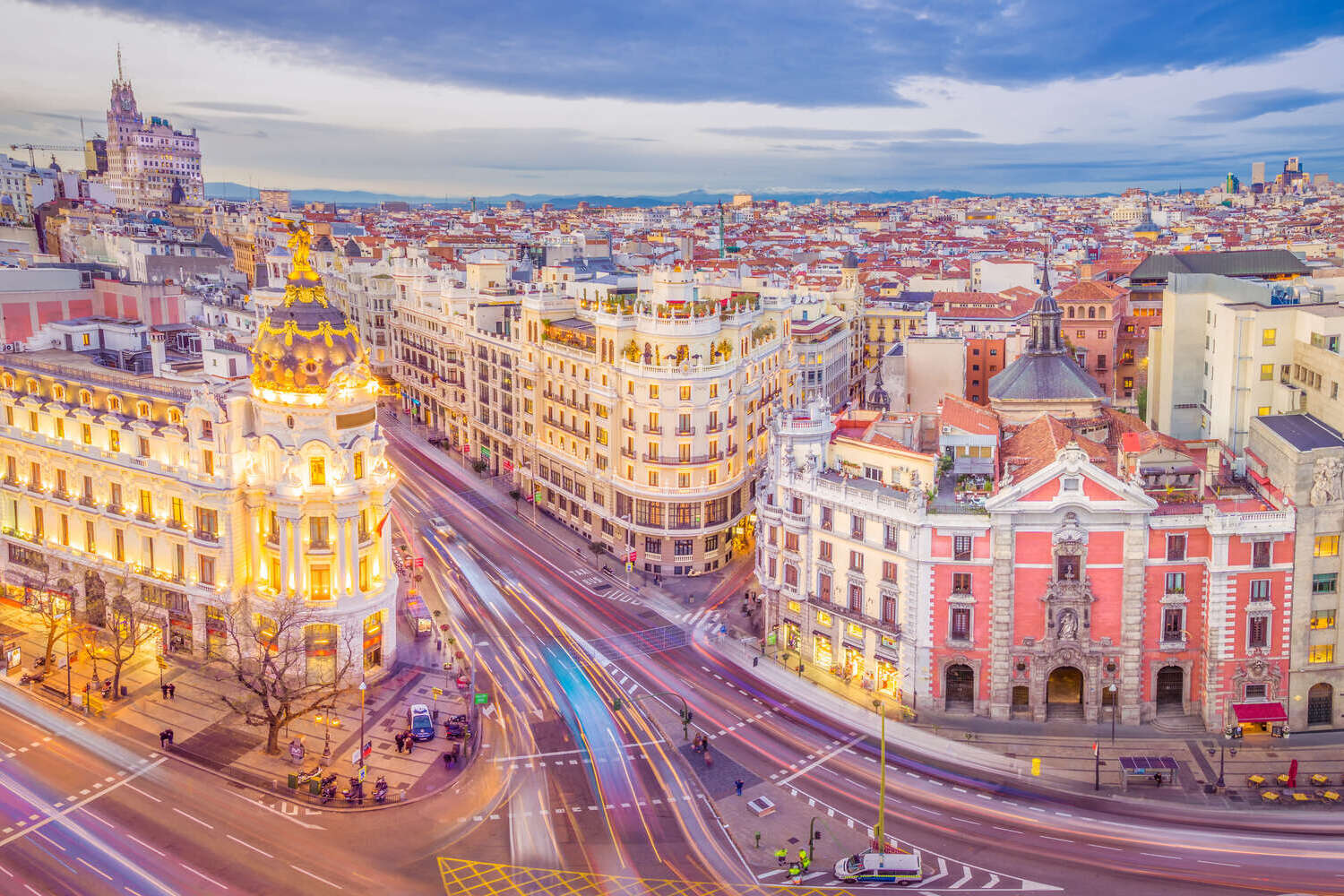
Madrid is a city that can surprise even the most experienced traveller, as behind its grand facade lie thousands of years of fascinating history and culture. It is a city of contrasts, where ancient traditions coexist with contemporary art, and royal grandeur blends with a genuine folk spirit. Incredible facts about the Spanish capital can be discovered literally at every turn — in street names, the architecture of buildings, and the customs of its residents. Every year millions of tourists rediscover Madrid, because even those who have visited before always find something new. We present a collection of interesting facts about this unique capital that you may never have known.
- Madrid is the highest-altitude capital city in the European Union, situated at approximately 667 metres above sea level. As a result, the climate here is harsher than in other Iberian cities: hot, dry summers give way to cold winters, sometimes accompanied by wet snow. This geographical position has shaped the development of the city over the centuries and continues to influence the daily lives of its residents to this day.
- The city became the capital of Spain only in 1561, when King Philip II relocated the royal court here. Before that, Madrid was a modest town surrounded by forests well suited to hunting — and it was precisely this that attracted the monarch. In a relatively short period of time, Madrid transformed from a provincial settlement into the heart of a great empire.
- The Prado Museum — one of the richest art museums on the planet — holds more than 8,000 paintings, although only around 1,500 of them are accessible to the public at any one time. It houses masterpieces by Velázquez, Goya, El Greco, and Rubens. The collection was assembled over several centuries through royal acquisitions and has become a true treasury of world art.
- Madrid is home to two football clubs of worldwide renown — Real Madrid and Atlético Madrid. The rivalry between them, known as the Madrid Derby, is considered one of the most passionate in the world. The Santiago Bernabéu stadium, where Real Madrid plays, recently underwent a major reconstruction and has become one of the most modern arenas in Europe.
- The symbol of the city is a bear rising up on its hind legs against a strawberry tree, depicted on the coat of arms of Madrid. This bronze sculpture near the Puerta del Sol metro station is one of the most popular spots for tourist photographs. Legend has it that bears once genuinely roamed the surrounding forests, and the madroño tree, also known as the strawberry tree, gave its name to the entire region.
- Puerta del Sol — the central square of Madrid — is considered kilometre zero of all Spanish roads. It is from this point that distances to every corner of the country are measured, and a special marker inscribed with Km 0 is embedded in the cobblestones of the square. Every year on New Year’s Eve, thousands of madrileños gather here to eat twelve grapes to the chimes of the clock — one grape per chime — symbolising good fortune in each month of the coming year.
- The Madrid Metro is one of the oldest in the world, having opened in 1919 as the fourth underground railway in Europe after London, Budapest, and Paris. Today the network comprises 13 lines and more than 300 stations, serving millions of passengers every day. Several stations have been transformed into genuine galleries of contemporary art thanks to their vibrant and imaginatively designed interiors.
- Madrid is renowned for its nightlife — the city is officially considered one of the latest in Europe when it comes to dinner times and entertainment. Restaurants here begin to fill only after nine o’clock in the evening, and clubs do not reach full swing until after midnight. The expression as lively as Madrid aptly captures the rhythm of a city where nocturnal activity sometimes surpasses that of the daytime.
- The Retiro Park — the lungs of Madrid, with more than 15,000 trees — was once the private garden of the royal family and did not open to the general public until 1868. The central lake of the park, overlooked by a monument to King Alfonso XII, is now a beloved spot for boat trips. At weekends, exhibitions, street performers, and book fairs regularly take place throughout the park.
- Madrid is home to the Liria Palace — one of the few private palaces in Spain — which houses an art collection that rivals those of state museums. It belongs to the Dukes of Alba, one of the oldest aristocratic families in the country. The collection includes works by Raphael, Titian, and Goya, as well as letters written by Christopher Columbus.
- Madrid is the birthplace of a unique musical genre known as zarzuela, which combines opera, operetta, and drama. This genre was born in Madrid in the seventeenth century and became an integral part of the national cultural identity. The Teatro de la Zarzuela, where this genre is performed, continues to welcome large audiences every year.
- The Complutense University of Madrid is one of the largest universities in Europe, with more than 80,000 students enrolled. Founded as far back as the thirteenth century in the city of Alcalá de Henares, it later relocated to Madrid and now occupies a vast campus in the western part of the city. It is within the walls of this university that numerous Nobel laureates and prominent Spanish public figures received their education.
- Madrid is home to the oldest restaurant in the world according to the Guinness Book of Records — Sobrino de Botín, which opened in 1725. The establishment’s signature dish is roast suckling pig prepared in a wood-fired oven that has been in continuous operation for nearly three centuries. Ernest Hemingway and Francisco Goya both dined here, and the restaurant itself is mentioned in the novel The Sun Also Rises.
- Madrid is one of the few cities in the world where an authentic ancient Egyptian monument has been preserved within the city boundaries. The Temple of Debod — a genuine Egyptian temple dating from the fourth century BC — was gifted to Spain by the Egyptian government in 1968 as a token of gratitude for Spain’s assistance in rescuing ancient monuments during the construction of the Aswan Dam. The temple now stands in the Montaña Park and has become one of the most extraordinary landmarks in Madrid.
- The Gran Vía, constructed in the early twentieth century, is regarded as the Spanish Broadway, with numerous theatres, cinemas, and hotels concentrated along its length. In order to lay out this boulevard, hundreds of buildings had to be demolished and thousands of residents relocated. Construction lasted more than twenty years and came to symbolise the modernisation of Madrid in a new era.
- The Adolfo Suárez Madrid-Barajas Airport is one of the largest in Europe. Its fourth terminal, Terminal 4, designed by the architect Richard Rogers, received the prestigious Pritzker Architecture Prize in 2006. The terminal’s undulating bamboo ceiling is a genuine work of art in its own right. The airport serves more than 50 million passengers annually.
- Madrid is a city of fountains, boasting more than 300 public fountains within its boundaries. The most celebrated of these is the Cibeles Fountain on the square of the same name, where the goddess Cybele rides a chariot drawn by lions. It is beside this very fountain that Real Madrid traditionally celebrates its championship victories together with supporters.
- On the outskirts of Madrid — in El Escorial — stands the monastery-palace of El Escorial, built in the sixteenth century on the orders of Philip II. It is one of the largest Renaissance buildings in the world, with the complex covering an area of more than 33,000 square metres. The monastery served simultaneously as the residence of Spanish kings, a royal pantheon, and a library.
- Madrid is the home of the National Library of Spain, which holds millions of books, manuscripts, and documents, including the first editions of Don Quixote by Miguel de Cervantes. Founded in 1711 by order of Philip V, it is one of the oldest national libraries in Europe. The library also preserves unique maps, engravings, and photographs that bring to life the centuries-long history of Spain.
- Madrid is celebrated for its traditional markets, the most famous of which is El Rastro — the largest flea market in Spain. Every Sunday and on public holidays, thousands of vendors and buyers fill the streets of the La Latina neighbourhood in search of antiques, clothing, and unexpected finds. El Rastro has been in existence for more than five hundred years and remains a vibrant part of the city’s culture.
- The climate of Madrid is described by a local saying: nine months of winter and three months of hell — an expression that highlights the sharpness of the temperature contrasts. In summer, temperatures regularly exceed 40 degrees Celsius, while winters frequently bring frost. Despite this, madrileños have adapted remarkably well to their climate and enjoy an active street life throughout the entire year.
- The city officially bears the full name Villa y Corte Madrid — the Town and Court of Madrid — reflecting its dual role as a municipality and the capital of the kingdom. This official designation has survived from the era when Madrid served as the residence of Spanish monarchs. Today the city’s population exceeds 3.3 million residents, and together with its suburbs the greater metropolitan area numbers more than 6 million people.
Madrid is a city that cannot be exhausted in a single visit, as every corner conceals new captivating facts and unexpected discoveries. Its uniqueness lies in the fact that art lovers, food enthusiasts, sports fans, and dreamers who simply enjoy wandering through its streets without any particular purpose all feel equally at home here. The Spanish capital never ceases to amaze — and that, perhaps, is the most remarkable fact of all.


