
Liguria is far more than just an Italian region along the Ligurian Sea—it is a true jewel of the Mediterranean, where mountainous landscapes, ancient fishing villages, and rich cultural heritage converge. You may not have known that Christopher Columbus was born here, or that the world’s first pesto sauce was created in a small town near Genoa. The astonishing facts about Liguria reveal it as the cradle of seafarers, chefs, and artists whose influence is still felt today. These captivating insights show how nature, history, and human ingenuity have shaped a uniquely enchanting corner of Italy. Below is a collection of fascinating details, each illuminating a different facet of this remarkable region.
- Liguria is one of Italy’s smallest regions by area, covering only 5,421 square kilometers, yet it boasts an exceptionally dense network of settlements. Much of its territory is mountainous, so towns and villages are often perched on steep slopes or cling directly to the coastline. This rugged terrain has fostered a distinctive architectural style featuring terraces, narrow alleyways, and stone-built houses. Despite its compact size, Liguria comprises four provinces: Genoa, Savona, La Spezia, and Imperia.
- Genoa, the capital of Liguria, was for centuries a powerful maritime republic that rivaled Venice and Pisa. During the Middle Ages, it controlled vital trade routes across the Mediterranean and maintained its own colonial empire. The city gave birth to legendary navigators such as Christopher Columbus, John Cabot, and Andrea Doria. Genoa’s historic center is among the largest in Europe and is inscribed on UNESCO’s World Heritage List.
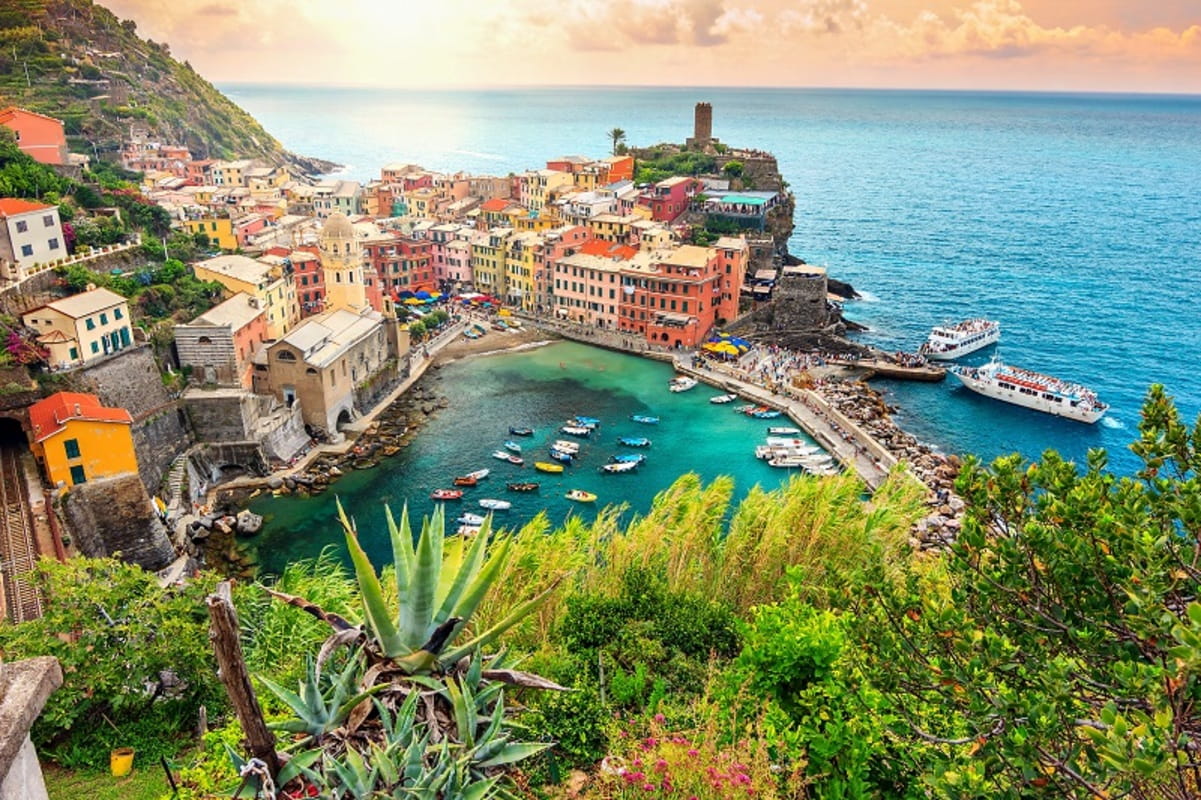
- The Ligurian coast is famed for the Cinque Terre—“Five Lands”—a string of five picturesque villages: Riomaggiore, Manarola, Corniglia, Vernazza, and Monterosso. Nestled on dramatic cliffs, these villages are connected by scenic footpaths winding through vineyards and olive groves. Cinque Terre is both a national park and a UNESCO World Heritage Site. Travelers from around the globe come to admire the vibrantly painted houses that seem to grow organically from the rock face.
- Liguria is the birthplace of pesto, the iconic green sauce made from basil, garlic, Parmesan cheese, pine nuts, and olive oil. Authentic Ligurian basil, grown especially in the Prà district near Genoa, has a delicate flavor and aroma that cannot be replicated elsewhere. True pesto is always prepared in a marble mortar with a wooden pestle to preserve its texture and volatile essential oils. This sauce has become a symbol of Ligurian cuisine and is now beloved worldwide.
- Liguria is home to one of the oldest continuously operating lighthouses in the world—the Lanterna of Genoa, built in the 13th century. It served not only as a navigational aid for sailors but also as a defensive fortress. Today, the Lanterna functions as a museum and stands as a proud symbol of the city, even appearing on Genoa’s coat of arms. At 77 meters tall, it remains the tallest lighthouse in the Mediterranean.
- Liguria enjoys a mild Mediterranean climate, with gentle winters and warm—but not scorching—summers. Sheltered by the Apennine Mountains from cold northern winds, the region supports palm trees, olive groves, citrus orchards, and even cacti. This makes it a popular destination year-round, especially in winter for tourists from northern Europe. Towns like Portofino and Sanremo are renowned for their charming seafront promenades and luxurious villas.
- Liguria is the birthplace not only of Columbus but also of other luminaries, including the virtuoso violinist Niccolò Paganini, who was born in Genoa. His extraordinary technique and musical genius captivated 19th-century Europe. A theater and museum in his honor stand in the city today. Antonio Vivaldi, though more associated with Venice, was also born in this region, and his music echoes the lightness and luminosity of the Mediterranean.
- Liguria features an extensive system of terraced agriculture, allowing grapes and olives to be cultivated on steep hillsides. These terraces, supported by dry-stone walls, were painstakingly built by hand over centuries and represent a model of sustainable farming. UNESCO has recognized several of these agricultural landscapes as cultural heritage sites. Without these terraces, many coastal villages would have lacked both food security and economic independence.
- Sanremo, located near the French border, is famous not only for its casino and flower farms but also for hosting the annual Festival della Canzone Italiana (Sanremo Music Festival). Since 1951, this competition has launched the careers of stars like Andrea Bocelli, Eros Ramazzotti, and Laura Pausini. Broadcast nationwide, it is considered the most important event in Italian pop music. It was in Sanremo that the global hit “Volare” was first performed.
- Ligurian cuisine emphasizes simplicity and fresh, local ingredients—fish, seafood, vegetables, olive oil, and herbs. Beyond pesto, regional specialties include focaccia (especially the Genoese version with olive oil and rosemary), trofie pasta with beans, and stuffed zucchini blossoms. Fish is typically grilled or baked rather than boiled to preserve its natural flavor. Due to the scarcity of flat land, grains are rarely grown here, so bread is often made from corn or rye.
- Liguria harbors unique natural caves, including the Grotta Artaлина near Bordighera, where Paleolithic-era archaeological remains have been discovered. These findings prove that humans inhabited this region over 30,000 years ago. Additionally, numerous sea caves dot the coastline, accessible only by boat, attracting divers and adventure seekers alike. Liguria’s natural beauty blends the softness of the sea with the ruggedness of the mountains.
- The Ligurian language, though lacking official status, is still spoken in some rural communities, particularly among older generations. It is a Romance language with distinct phonetic and lexical features that set it apart from standard Italian. Regional authorities support efforts to preserve it through schools and cultural initiatives. For linguists, Ligurian offers valuable insights into the evolution of Romance languages.
These captivating facts about Liguria reveal how this compact region encapsulates the essence of Italian history, culture, and natural splendor. You may not have realized that behind its modest size lies a profound spiritual and material legacy that has shaped global exploration, cuisine, and art. The incredible truths about Liguria remind us that the greatest treasures often lie not in scale, but in detail—in the scent of basil, the resonance of Paganini’s violin, the colors of Cinque Terre. Interesting facts about this region inspire us to travel not just with our eyes, but with our hearts, discovering Italy at its most authentic and soulful.


