
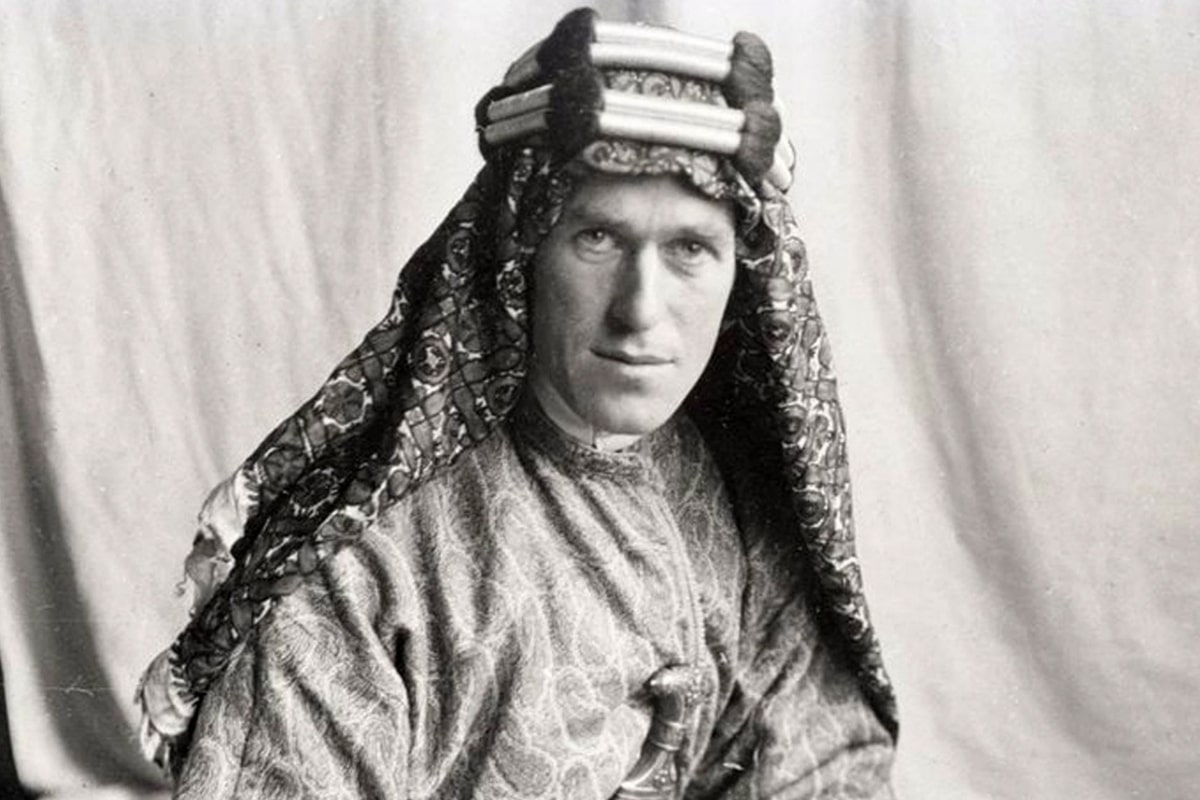
Thomas Edward Lawrence, known to the entire world as Lawrence of Arabia, is one of the most enigmatic and legendary figures of the 20th century. This British officer, archaeologist, and writer became the symbol of the Arab Revolt against the Ottoman Empire during the First World War. You may not have known that during his short life he managed to become a military commander, diplomat, author of a literary masterpiece, and even an ordinary soldier under a fictitious name. Fascinating facts about this extraordinary personality will reveal to you the history of a man who changed the course of history in the Middle East and forever left his mark on world culture.
- Thomas Edward Lawrence was born on 16 August 1888 in Wales as the illegitimate child of English aristocrat Sir Thomas Chapman and governess Sarah Junner. His father left his wife and four daughters for his lover, with whom he had five sons. The family lived under the surname Lawrence, concealing their true origins. Thomas learned about the circumstances of his birth only in his youth, which profoundly affected his self-perception.
- Lawrence was exceptionally short for a British officer of his time, standing at only 165 centimetres tall. He compensated for this physical shortcoming with incredible endurance and willpower. During his journeys through the desert, he could cover enormous distances on camelback, withstanding extreme heat and lack of water. His physical resilience amazed even hardened Bedouins.
- Before the outbreak of the First World War, Lawrence worked as an archaeologist at the excavations of the ancient city of Carchemish in what is now Syria. This work allowed him to master the Arabic language and the culture of the local population perfectly. The archaeological expedition also served as cover for British intelligence, which was monitoring the construction of the German Baghdad Railway. Knowledge of the region and language proved invaluable during his military career.
- Lawrence participated in the famous capture of the port of Aqaba in July 1917, which is considered one of the most audacious military manoeuvres in history. Instead of attacking from the sea, where the Turks had strong defences, he led Arab forces through the impassable Nefud Desert. The march lasted approximately two months in unbearable heat. The unexpected attack from the rear caught the Turkish garrison off guard, and the city fell with almost no resistance.
- During the war, Lawrence was captured multiple times and subjected to torture by Turkish soldiers. The most tragic episode occurred in the town of Deraa in November 1917, where he was seized by the Turks. According to Lawrence’s own testimony, he was subjected to brutal beatings and sexual assault. This trauma haunted him for the rest of his life and found reflection in his autobiographical book.
- Lawrence wrote one of the most outstanding war memoirs of the 20th century entitled Seven Pillars of Wisdom. The book describes in detail his experiences during the Arab Revolt and contains profound reflections on war, culture, and human nature. The first manuscript was lost at a railway station, and Lawrence had to rewrite the book from memory. The work became a literary classic and is considered one of the finest examples of war prose.
- After the war, Lawrence felt profound guilt that the British government had broken the promises made to the Arabs regarding their independence. The secret Sykes-Picot Agreement of 1916 envisaged the division of Arab lands between Britain and France contrary to agreements with Arab leaders. Lawrence considered himself complicit in this betrayal and suffered morally because of it. He publicly advocated for Arab interests but without much success.
- Lawrence maintained close relations with Emir Faisal, son of Sharif Hussein of Mecca, who led the Arab Revolt. Their partnership became the foundation of the revolt’s success against the Turks. After the war, Lawrence accompanied Faisal to the Paris Peace Conference, where he served as his interpreter and adviser. Faisal later became King of Iraq, partly thanks to Lawrence’s efforts.
- After the war, Lawrence refused the high honours and positions offered to him, including the Order of the Bath and the position of Viceroy of India. He sought to escape the fame and publicity that pursued him. In 1922, he enlisted in the Royal Air Force under the fictitious surname Ross, and later in the Tank Corps as Private Shaw. This flight from fame continued until the end of his life.
- Lawrence was a passionate motorcyclist and owned several powerful Brough Superior motorcycles. He called these machines the Rolls-Royces of motorcycles and acquired seven such vehicles during his lifetime. Riding at high speed gave him a sense of freedom and helped him combat depression. It was a motorcycle that ultimately caused his tragic death.
- Lawrence died on 19 May 1935 as a result of a motorcycle accident near his home in Dorset. He was travelling at high speed and attempted to avoid a collision with two boys on bicycles. After the accident, he remained in a coma for six days, never regaining consciousness. He was only 46 years old and left behind a legend that continues to live to this day.
- One of the doctors who treated Lawrence after the accident, Hugh Cairns, was so shaken by the consequences of the head injury that he devoted his life to research on motorcycle helmets. His work led to the mandatory use of helmets by motorcyclists in many countries. Thus, Lawrence’s death indirectly saved thousands of lives in the future. This is one of the most unexpected aspects of his legacy.
- Lawrence was a personal friend of many prominent figures of his time, including Winston Churchill, George Bernard Shaw, and poet Robert Graves. Churchill called him one of the greatest men of his time and used his experience in shaping Britain’s Middle Eastern policy. Bernard Shaw and his wife Charlotte became close friends of Lawrence in the final years of his life. These connections testify to Lawrence’s intellectual depth and personal magnetism.
- Lawrence was a talented translator and translated Homer’s Odyssey into English, which was published in 1932. The translation received high praise from critics and remains popular to this day. He worked on the translation for several years, using this work as a way to distract himself from his demons. The work demonstrates his deep knowledge of classical literature and mastery of language.
- The 1962 film Lawrence of Arabia directed by David Lean became one of the greatest cinematic works of all time. The picture received seven Academy Awards, including Best Picture and Best Director. Peter O’Toole in the leading role created an unforgettable portrayal of the legendary hero. The film significantly enhanced the mythology surrounding Lawrence’s figure and made him known to new generations.
- Lawrence developed a unique tactic of guerrilla warfare in the desert that was decades ahead of its time. He emphasised mobility, surprise, and avoiding direct confrontation with superior enemy forces. His strategy envisaged attacks on enemy communications, especially the railway, rather than capturing territory. These principles were later studied by military strategists and influenced the development of guerrilla warfare theory.
- Despite his fame as a warrior and adventurer, Lawrence was a deeply educated man with a degree in history from Oxford University. His thesis was devoted to Crusader architecture and required an extensive journey through the Middle East. This academic preparation shaped his analytical mind and ability to understand complex political situations. The combination of intellect with courage made him a unique figure of his era.
- Lawrence adopted the Arab way of life and wore traditional white Arab robes during his campaigns in the desert. This was not merely a practical decision but also a symbol of his respect for Arab culture. He spoke Arabic fluently and observed local customs. Such cultural sensitivity helped him win the trust and respect of Arab leaders.
Incredible facts about Lawrence of Arabia demonstrate how complex and multifaceted this legendary figure was, combining in himself the qualities of a warrior, scholar, writer, and philosopher. From archaeological excavations to audacious military operations, from literary masterpieces to voluntary exile into anonymity, his life was filled with incredible contrasts and dramatic turns. These fascinating details remind us of a man who left an indelible mark on the history of the Middle East and world culture, becoming a symbol of an entire era.


