
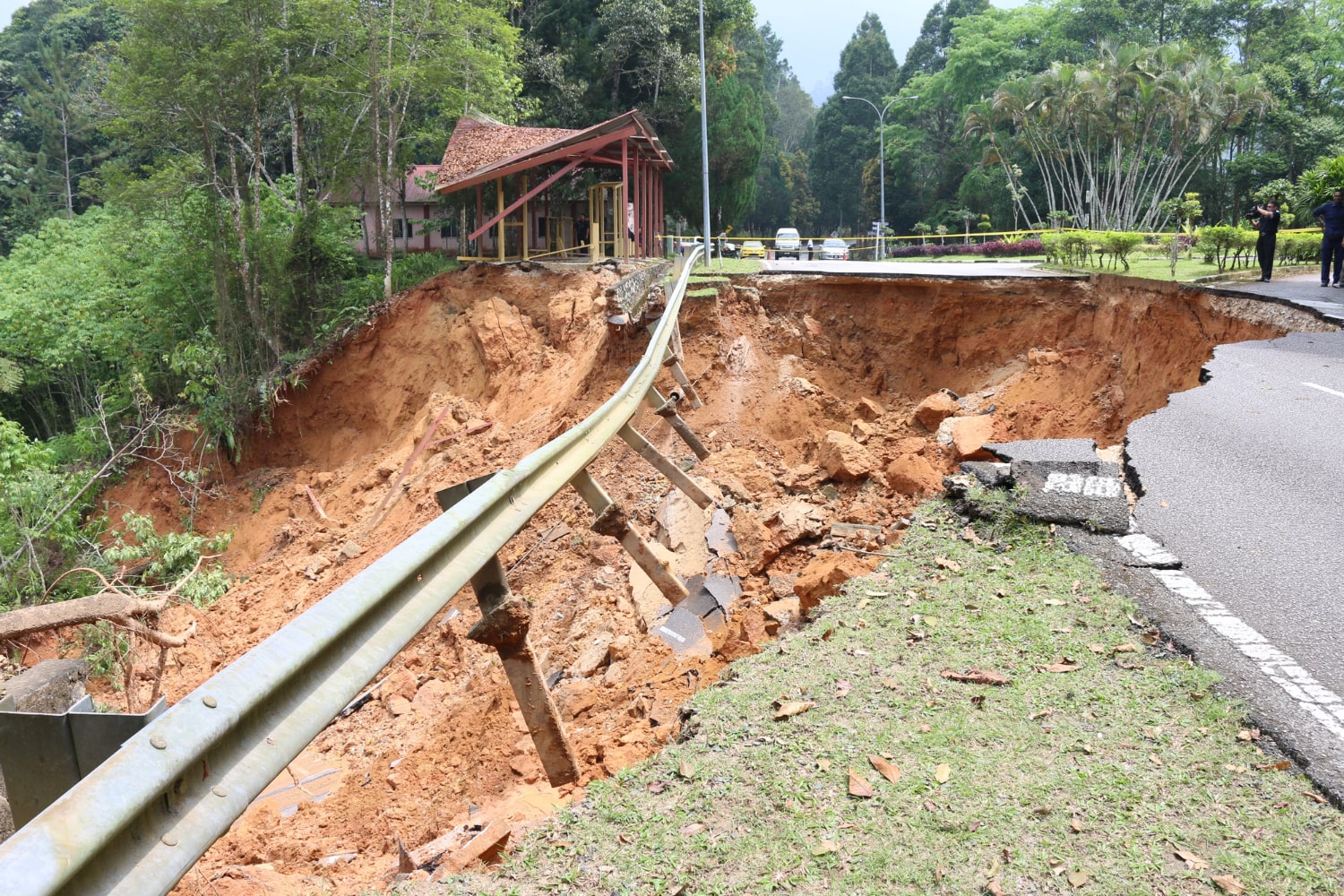
Landslides are among the most destructive and impressive natural phenomena on our planet, which for millions of years have shaped landscapes and changed the face of the Earth. These sudden and often catastrophic events, when enormous masses of rock, soil or snow collapse downward under the force of gravity, can transform entire valleys and destroy everything in their path within minutes. Incredible facts about landslides reveal to us a world of geological processes that demonstrate the enormous power of nature and its ability to instantly change the environment. From ancient megalandslides that shaped modern terrain to contemporary disasters that claim human lives and destroy infrastructure, landslides remain the subject of intensive scientific study and a constant threat to human settlements in mountainous regions. Get ready to learn fascinating details about these powerful natural phenomena, as you might not have known most of these striking features that make landslides one of the most dangerous and mysterious geological processes on the planet.
- Landslides can move at incredible speeds reaching 100-200 kilometers per hour, transforming them into one of the fastest natural phenomena on Earth. Such high speed is explained by the air cushion effect that forms under the falling mass and reduces friction. Some catastrophic landslides moved so fast that the air in front of them compressed and heated to high temperatures. This speed makes landslides practically impossible to avoid if a person finds themselves in their path.
- The largest recorded landslide in history occurred about 56 million years ago in the Sevier region of Utah, USA. The volume of collapsed mass was approximately 1000 cubic kilometers, which exceeds the volume of Lake Geneva five hundred times. This megalandslide left behind a huge debris field that extends for tens of kilometers. The study of such prehistoric landslides helps geologists understand the scale of past geological processes.
- The landslide in the Vajont Valley in Italy in 1963 became one of the largest man-made disasters of the twentieth century. About 260 million cubic meters of rock collapsed into an artificial reservoir, creating a giant wave 250 meters high. This wave overflowed the dam and destroyed several settlements in the valley, claiming the lives of nearly 2000 people. The tragedy occurred despite warnings from geologists about the danger of building a dam in this location.
- Landslides play an important role in shaping mountain landscapes and creating new geological structures. Large landslides can block river valleys, forming natural dams and lakes. Some of the most beautiful mountain lakes in the world were formed precisely as a result of landslides that blocked river channels. These natural dams can exist for thousands of years or suddenly break through, creating catastrophic floods downstream.
- Seismic landslides can generate powerful shock waves that are registered by seismic stations around the world. The energy released during a large landslide is equivalent to an earthquake of magnitude 4-5. Scientists use seismic records to study landslide mechanisms and assess their power. Some landslides create such strong vibrations that they can be felt at distances of tens of kilometers from the event site.
- Climate change significantly increases the risk of landslides in high mountain regions due to the melting of permafrost and glaciers. Ice that has held rocks together for thousands of years is melting, making slopes unstable. In the Alps and other mountain ranges, a sharp increase in the number of landslides is observed compared to the last century. It is predicted that in the coming decades, the frequency and scale of landslides in mountainous regions will continue to grow.
- Submarine landslides can be significantly larger than terrestrial ones and are capable of generating devastating tsunamis. One of the largest known submarine landslides occurred off the coast of Norway about 8000 years ago and created a tsunami that affected the entire North Atlantic coast. The volume of displaced rock was approximately 3500 cubic kilometers. The study of submarine landslides is important for assessing tsunami risks in coastal regions.
- Lunar landslides have been recorded by spacecraft on the Moon’s surface, where they occur due to meteorite impacts and moonquakes. Unlike Earth, the Moon has no atmosphere or water that affect destruction processes, so lunar landslides have a different character. Some lunar slopes show traces of large-scale landslides that occurred millions of years ago. The study of extraterrestrial landslides expands our understanding of these processes in the Solar System.
- Sudden landslides can create powerful air blasts that destroy buildings and trees at considerable distances from the landslide zone. During the movement of a large mass of rock, the air in front of it compresses and explodes outward with tremendous force. Such air blasts can sweep away forests and buildings hundreds of meters from the direct path of the landslide. This effect makes landslides dangerous even for objects that seem distant from the zone of direct impact.
- Early warning systems for landslides use various technologies, including seismic sensors, radars and satellite observations. Some systems can detect preliminary signs of landslides hours or even days before the event. Israeli scientists have developed a system that uses acoustic sensors to register characteristic sounds of cracks in rocks. However, predicting the exact time of a landslide remains an extremely difficult task.
- Landslides on Mars are among the largest in the Solar System, with some slides extending over 100 kilometers. Martian gravity, which is only 38 percent of Earth’s, allows collapsed masses to travel much greater distances. Spacecraft have recorded fresh traces of landslides, indicating the continuation of geological activity on the Red Planet. The study of Martian landslides helps plan safe locations for future crewed missions.
- Rockfall differs from landslides in scale and character of movement, usually involving smaller volumes of rock and more chaotic trajectories of individual stones. Rockfalls are a constant threat on mountain roads and railways, requiring special protective structures. The falling speed of individual rocks can exceed 100 kilometers per hour, making them deadly dangerous. Engineers develop special nets and barriers to protect infrastructure from rockfalls.
- Some landslides can last for hours, when the mass of rock gradually shifts downward in a series of successive collapses. Such slow landslides give people more time to evacuate but remain extremely destructive. A slow landslide in the Swiss village of Bregaglia lasted several days, allowing all residents to be evacuated before the final collapse. Monitoring such slow landslides requires constant observation and precise measurements of ground movement.
- Glacial landslides are becoming increasingly frequent in conditions of global warming and create special risk for mountaineers. Large blocks of ice break off from glaciers and collapse downward, breaking into thousands of fragments. Some glacial landslides can initiate snow avalanches or mixed ice-rock landslides. In the Himalayas and Andes, an increase in the number of glacial landslides by 50 percent over the last 20 years has been recorded.
- Landslides on volcanoes have particular danger due to high temperature and toxic gases that can accompany the collapsed mass. The collapse of part of Mount St. Helens volcano in the USA in 1980 was the largest recorded terrestrial landslide in modern American history. About 2.5 cubic kilometers of rock collapsed and triggered a catastrophic eruption. Volcanic landslides can create pyroclastic flows that move at speeds exceeding 700 kilometers per hour.
- Micro-landslides and cracks in rocks generate characteristic acoustic signals that can be detected with special equipment. Scientists use these signals to monitor slope stability and predict large landslides. The frequency and intensity of micro-landslides usually increases before a major catastrophe. Some researchers are training artificial intelligence to recognize patterns of acoustic signals preceding landslides.
- Landslides play an important role in the evolution of mountain ecosystems, creating new habitats and changing flows of water and nutrients. Zones of old landslides are often characterized by unique flora and fauna adapted to specific conditions. Some rare plant species are found exclusively in areas of former landslides. Ecologists study how living organisms colonize fresh landslide deposits and what ecological sequences occur in the process.
- Ancient civilizations often interpreted landslides as manifestations of divine wrath or punishment. Many legends and myths of various peoples are associated with catastrophic landslides that changed the landscape. Archaeologists have discovered evidence that some ancient settlements were abandoned or destroyed due to landslides. In some cultures, there were taboos on building in zones where landslides had previously occurred.
- Remote sensing of Earth from space allows detection of potentially dangerous landslide zones before they occur. Satellites can measure microscopic displacements of the Earth’s surface that indicate slope instability. Interferometric radars are capable of detecting ground movement of just a few millimeters per year. These technologies are especially valuable for monitoring remote mountainous regions where it is impossible to install ground sensors.
- Reconstruction of mountain slopes after landslides is a complex engineering task that can take years and cost millions of dollars. Engineers use anchor systems, retaining walls and drainage systems to stabilize slopes. In some cases, entire mountains are covered with steel nets or concrete panels to prevent landslides. However, in many cases, the safest solution is relocating people from dangerous zones.
These fascinating facts about landslides demonstrate the extraordinary power and diversity of this natural phenomenon, which continues to shape our planet and pose a serious threat to human civilization. Each aspect of landslides reflects the complex interaction of geological, climatic and gravitational forces that operate in mountainous regions around the world. The incredible destructive force of landslides reminds us of the importance of scientific monitoring of dangerous slopes, developing effective early warning systems and responsible planning of human settlements taking into account geological risks to ensure the safety of future generations.


