
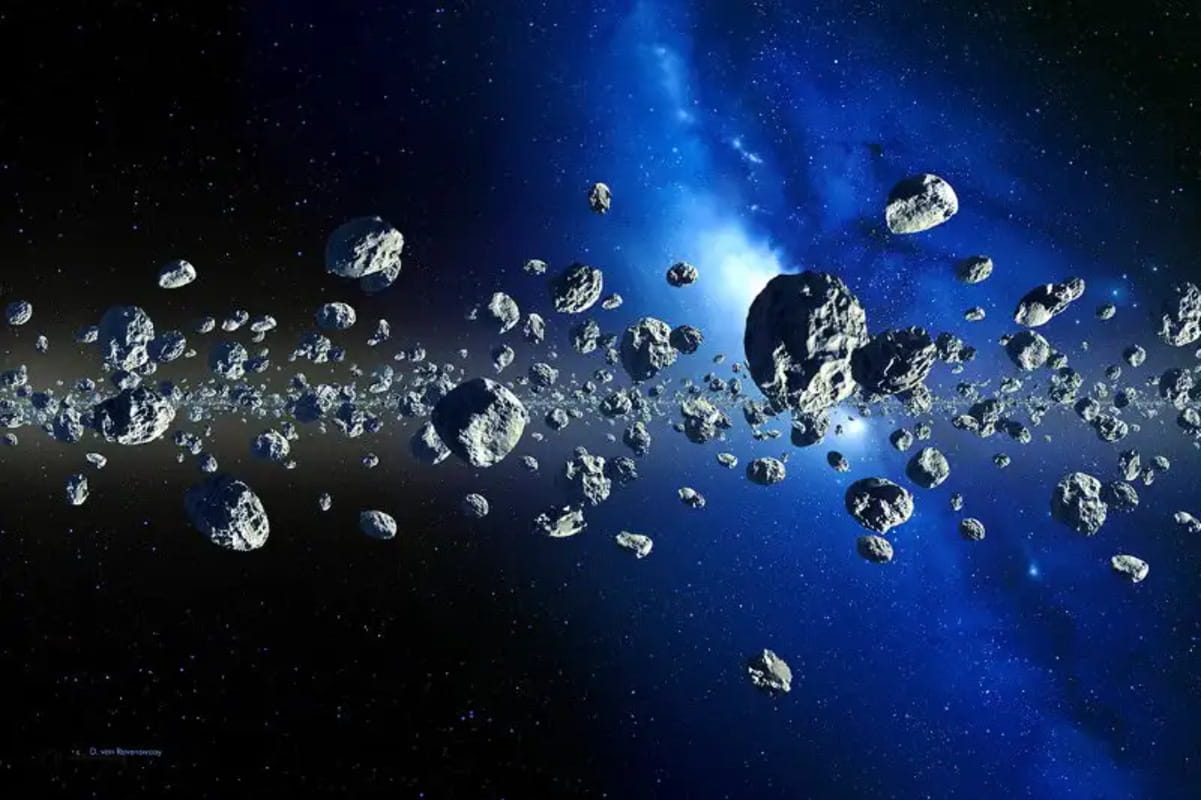
Beyond Neptune’s orbit in the frigid depths of our Solar System lies a mysterious realm filled with icy bodies preserving evidence of our cosmic neighborhood’s earliest formation stages. The Kuiper Belt this distant zone of planetesimals has become a genuine window into the Solar System’s past where each object tells a story of chaotic processes unfolding billions of years ago. Today we invite you to discover incredible facts about this remote world where temperatures plunge below minus two hundred degrees Celsius and frozen bodies safeguard primordial material from which our planetary system was born. You might not have known how remarkably rich and dynamic this region truly is having long been dismissed as merely the barren periphery of our Solar System.
- The Kuiper Belt was theoretically predicted by Dutch astronomer Gerard Kuiper in 1951 though its actual existence remained unconfirmed until 1992 when astronomers David Jewitt and Jane Luu discovered the first object beyond Pluto. This object designated 1992 QB1 became the first confirmation of a belt of icy bodies existing beyond Neptune’s orbit. Today more than three thousand Kuiper Belt objects have been identified with astronomers estimating their total population could reach hundreds of thousands when accounting for smaller undetected bodies.
- The Kuiper Belt extends from approximately thirty to fifty astronomical units from the Sun making it dozens of times more distant than Earth’s orbit. For perspective sunlight reaches Earth in eight minutes but requires over seven hours to travel to the outer boundaries of the Kuiper Belt. Temperatures throughout this region range between minus two hundred twenty and minus two hundred four degrees Celsius rendering it one of the coldest environments in our entire Solar System.
- Pluto long considered the ninth planet is actually the largest known resident of the Kuiper Belt though certainly not the only dwarf planet inhabiting this realm. In 2006 the International Astronomical Union reclassified Pluto as a dwarf planet specifically because of numerous similar-sized discoveries within the Kuiper Belt. Other notable dwarf planets in this region include Eris Makemake and Haumea each possessing unique physical characteristics and orbital behaviors that distinguish them from one another.
- Kuiper Belt objects consist primarily of frozen volatile compounds including methane nitrogen and water ice making them resemble comet nuclei but on significantly larger scales. These icy bodies represent remnants of the original protoplanetary disk from which Solar System planets formed over four billion years ago. Unlike main asteroid belt objects composed of rock and metal Kuiper Belt objects have preserved their primordial chemical composition thanks to the region’s extraordinarily low temperatures.
- The Kuiper Belt possesses a complex structure comprising the classical belt resonant objects and the scattered disc each exhibiting distinct orbital characteristics. Classical Kuiper Belt objects maintain nearly circular orbits with minimal inclination to the ecliptic plane while resonant objects exist in gravitational resonance with Neptune most commonly in a two to three orbital ratio. The scattered disc contains objects with highly elongated orbits likely ejected to distant paths by Neptune’s gravitational influence during the Solar System’s early history.
- The dwarf planet Eris discovered in 2005 proved slightly more massive than Pluto directly triggering Pluto’s status reevaluation and the establishment of the dwarf planet classification category. Eris orbits at an average distance of ninety six astronomical units from the Sun making it one of the most distant known large objects in our Solar System. This planet possesses a moon named Dysnomia and its surface is coated with frozen methane ice giving it exceptionally high reflectivity.
- NASA’s New Horizons mission which flew past Pluto in 2015 later encountered the Kuiper Belt object Arrokoth in 2019 becoming the first spacecraft to explore such a remote region directly. Arrokoth displays an unusual double-lobed shape resembling a snowman providing evidence it formed through gentle merger of two separate bodies in the calm conditions of the early Solar System. Data returned from Arrokoth delivered invaluable insights into accretion processes that occurred during planetary formation.
- Kuiper Belt objects exhibit extraordinarily slow orbital periods around the Sun with Pluto requiring two hundred forty eight Earth years to complete a single revolution. The most distant known Kuiper Belt objects may possess orbital periods exceeding one thousand Earth years. Such extended orbital durations mean astronomers observe only minuscule positional changes in these objects over human lifetimes complicating precise orbital determination efforts.
- The Kuiper Belt serves as the primary source of short period comets which complete their orbits in less than two hundred years. Gravitational perturbations from Neptune and other giant planets periodically eject Kuiper Belt objects onto inner Solar System trajectories where they transform into comets upon approaching the Sun. These comets differ from long period comets which originate from the much more distant hypothetical Oort Cloud located up to two light years from the Sun.
- The dwarf planet Haumea rotates with extraordinary speed completing one rotation every three hours which stretches it into an elongated ellipsoidal shape rather than a spherical form. This planet also possesses a narrow ring system making it the first known Kuiper Belt object with such a feature. Haumea has two moons Hi’iaka and Namaka likely formed from a past collision event that also explains its remarkably rapid rotation.
- The Kuiper Belt does not represent uniformly filled space but contains distinct structural features including the so called Kuiper Gap around forty astronomical units from the Sun. This gap formed through gravitational resonance with Neptune which cleared most objects from this region over billions of years. Similar resonant structures appear in the main asteroid belt between Mars and Jupiter where Kirkwood gaps resulted from Jupiter’s gravitational influence.
- Kuiper Belt objects exhibit very low densities indicating porous internal structures containing substantial ice content and void spaces. Pluto’s average density measures only 1.86 grams per cubic centimeter significantly less than terrestrial planets but typical for icy bodies in the outer Solar System. This low density results from ice comprising a greater volume proportion within these bodies compared to rocky materials.
- The Kuiper Belt likely contains remnants of primordial material from which the cores of giant planets particularly Uranus and Neptune originally formed. Some theories propose Neptune formed considerably closer to the Sun before migrating outward gravitationally scattering Kuiper Belt objects during this journey. This migration of giant planets played a crucial role in shaping the Solar System’s current architecture including the distribution of objects within the Kuiper Belt itself.
- The inner Kuiper Belt extending from Neptune’s orbit to approximately forty astronomical units contains most known objects while the outer region remains significantly more sparsely populated. This asymmetry results from Neptune’s gravitational influence which more effectively cleared inner regions of material throughout Solar System history. Nevertheless the largest Kuiper Belt objects including Pluto and Eris reside specifically within the outer portions of this region.
- Some Kuiper Belt objects possess moons enabling astronomers to precisely determine their masses using Kepler’s laws of orbital motion. Binary systems where two objects orbit a common center of mass are also relatively common among Kuiper Belt residents. For instance object 1998 WW31 consists of two nearly equal sized bodies orbiting each other with a period of several months demonstrating the prevalence of such configurations.
- The Kuiper Belt does not mark the Solar System’s ultimate boundary as beyond it lies the even more distant scattered disc and the hypothetical Oort Cloud. The scattered disc extends beyond one hundred astronomical units while the Oort Cloud may reach distances up to two light years from the Sun. Objects within the Oort Cloud are considered the source of long period comets that rarely venture into the inner Solar System.
These fascinating facts about the Kuiper Belt only partially reveal the richness and complexity of this distant region which safeguards keys to understanding our planetary system’s formation. Each newly discovered object within the Kuiper Belt adds another fragment to the mysterious mosaic of our Solar System’s early history. Incredible facts about this icy realm remind us that even in the most remote corners of our cosmic neighborhood treasures of knowledge await discovery by curious explorers.


