
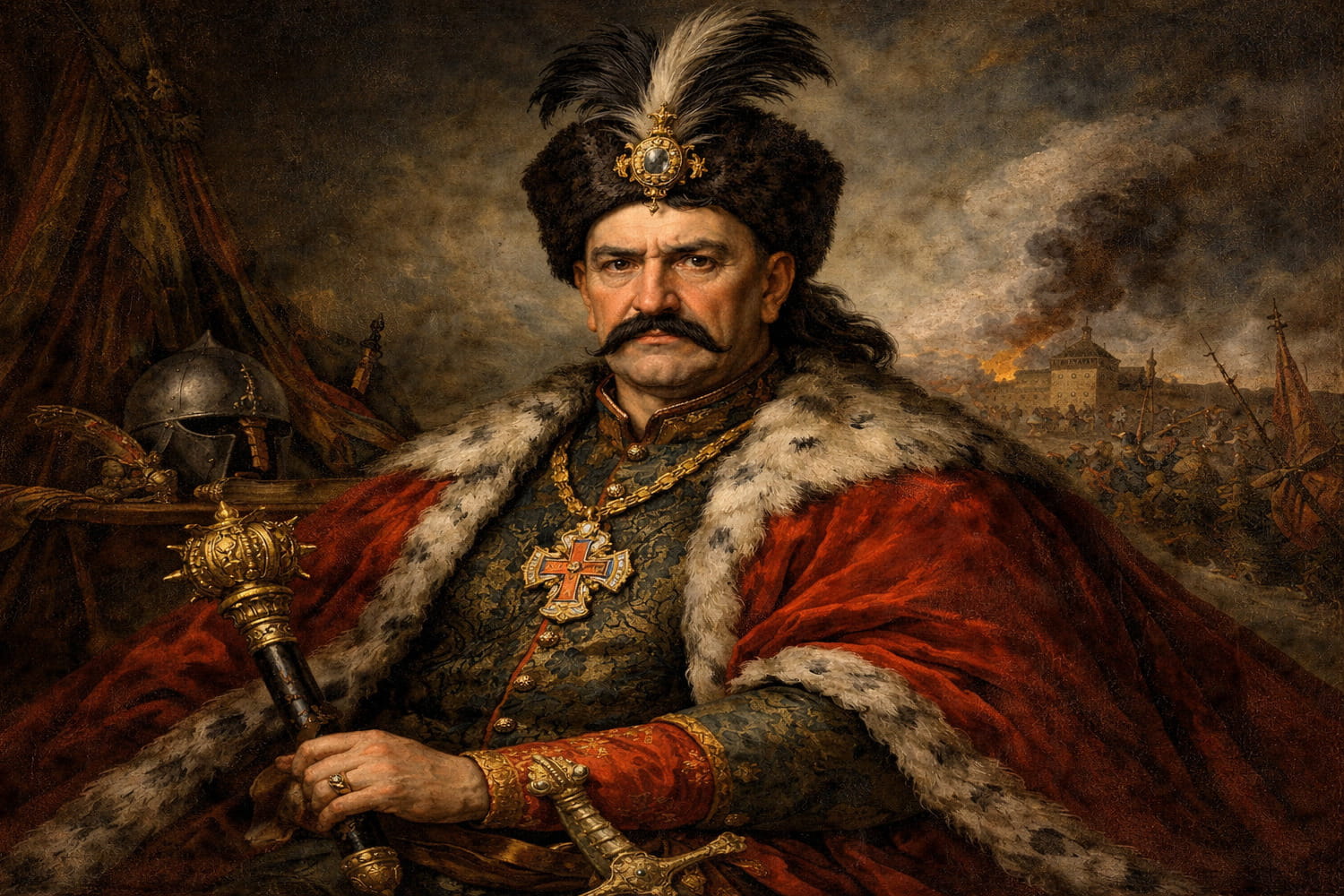
Ivan Mazepa was one of the most prominent and at the same time most controversial figures in Ukrainian history, whose life was filled with dramatic turns of fate. This Hetman of the Zaporozhian Host ruled Ukraine for more than two decades and left an unparalleled mark on the cultural and political life of the nation. His figure inspired some of the greatest European poets, composers, and artists for centuries. Fascinating facts about Ivan Mazepa reveal the complex world of the Cossack era and the struggle for Ukrainian statehood. Many remarkable details from the life of this legendary personality, who forever changed the course of Ukrainian history, remain little known.
- Ivan Mazepa was born on March 20, 1639, in the village of Mazepyntsi in the Kyiv region, into a family of Orthodox nobility. His father, Adam-Stepan Mazepa, was a cupbearer of Chyhyryn and a devoted supporter of Hetman Bohdan Khmelnytsky. His mother, Maryna Mokiiievska, came from an influential Cossack family. The family owned substantial landed estates in Left-Bank Ukraine.
- Mazepa received an excellent European education, which was rare among the Ukrainian nobility of that time. He studied at the Kyiv-Mohyla Academy and later at a Jesuit college in Warsaw. The young Mazepa also pursued studies in Germany, Italy, and the Netherlands. He was fluent in Latin, Polish, German, Italian, and French.
- Mazepa began his career as a page at the court of Polish King John II Casimir. During his service, he carried out diplomatic missions and gained experience in court life. There is a legend about his romantic adventures at the Polish court, which allegedly forced him to leave royal service. This story later inspired many European writers and artists.
- Ivan Mazepa became Hetman of Ukraine in 1687 with the support of the Moscow government. He was elected at a Cossack council in Kolomak after the removal of Hetman Ivan Samoilovych. Mazepa ruled the Hetmanate for a record 22 years, the longest tenure among all Ukrainian hetmans. During this period, he strengthened central authority and contributed to the development of Ukrainian statehood.
- Mazepa was one of the wealthiest people in Europe at the time and the most generous patron of Ukrainian culture. With his support, more than 20 churches and monasteries were built or restored. He financed the construction of the Great Lavra Bell Tower at the Kyiv-Pechersk Lavra. The total value of his donations to churches and education is estimated at millions of gold coins of that era.
- The architectural style that flourished during Mazepa’s time became known as Ukrainian or Mazepa Baroque. It combined European Baroque elements with traditional Ukrainian architecture. The most notable examples include St. Nicholas Cathedral in Nizhyn and the Church of All Saints above the gate of the Kyiv-Pechersk Lavra. Mazepa Baroque became a symbol of Ukraine’s cultural revival.
- Mazepa founded a printing house in Chernihiv and actively supported book publishing. With his assistance, numerous theological, historical, and educational books were published. He financed the Kyiv-Mohyla Academy and provided scholarships for students. The hetman personally collected rare books and manuscripts for his library.
- In 1700, Tsar Peter I awarded Mazepa the Order of Saint Andrew the First-Called. Mazepa became the second person in history to receive this highest honor of the Russian Empire. The first recipient was Peter I himself, honored by his associates. Later, the tsar publicly stripped Mazepa of this award and declared him a traitor.
- In 1708, Mazepa concluded a secret alliance with the Swedish king Charles XII. He sought to free Ukraine from Moscow’s domination and restore its independence. During the Great Northern War, the hetman sided with Sweden along with part of the Cossack forces. This step forever changed his place in history and became the cause of centuries-long debates.
- After Mazepa defected to the Swedes, Peter I ordered the destruction of the hetman capital, Baturyn. Moscow troops under the command of Alexander Menshikov massacred the city’s population in the autumn of 1708. According to various estimates, between several thousand and fifteen thousand inhabitants were killed. The Baturyn tragedy became one of the most horrific pages in Ukrainian history.
- The Russian Orthodox Church anathematized Mazepa in November 1708. This ecclesiastical punishment was unprecedented and was meant to symbolize the complete rejection of the hetman. The anathema was proclaimed annually in Russian churches until 1917. The Ukrainian Greek Catholic Church lifted the anathema from Mazepa in 2007.
- The Battle of Poltava on June 27, 1709, became a turning point in the fate of Mazepa and Ukraine. The Swedish-Ukrainian army suffered a crushing defeat by Russian forces. Mazepa, together with Charles XII, was forced to flee to the territory of the Ottoman Empire. This battle determined Russia’s dominance in Eastern Europe for the centuries that followed.
- Ivan Mazepa died on October 2, 1709, in the Moldavian city of Bendery, then part of the Ottoman Empire. The cause of death was a heart condition aggravated by stress and flight. The hetman was buried in the Monastery of Saint George in Galați, in present-day Romania. The exact location of his grave was lost over time.
- Mazepa’s image inspired numerous European artists to create masterpieces of world art. Lord Byron wrote the poem “Mazeppa” in 1819, which gained enormous popularity. Victor Hugo and Alexander Pushkin also dedicated works to him. Franz Liszt composed the symphonic poem “Mazeppa,” and Pyotr Tchaikovsky wrote an opera of the same name.
- Many European painters depicted Mazepa in their works. The most famous paintings were created by Théodore Géricault, Horace Vernet, and Eugène Delacroix. A popular motif was the legend of the young Mazepa tied to a wild horse. These works made Mazepa one of the most recognizable Ukrainians in 19th-century Europe.
- Mazepa left behind several poetic works written in the Ukrainian language. The most famous is the poem “Duma,” also known as “All Sincerely Desire Peace,” which reflects his philosophical reflections. This poetry testifies to the hetman’s high level of literary education. Mazepa’s works are an important part of Ukraine’s literary heritage.
- Hetman Mazepa created a powerful Cossack army and modernized it according to European standards. He introduced regular payment of wages to the Cossacks and improved their armament. Mazepa also built a number of fortresses to defend Ukrainian lands. His military reforms increased the combat effectiveness of the Cossack forces.
- Mazepa’s personal coat of arms featured images of a cross and a crescent. This emblem combined family symbols with new elements. The hetman used it on official documents, coins, and buildings. Mazepa’s coat of arms can be seen on many churches built with his funds.
- Mazepa’s portrait is depicted on the 10-hryvnia banknote. This note was introduced into circulation in independent Ukraine as a tribute to the great hetman. Mazepa is one of the few historical figures honored on Ukrainian currency. His image symbolizes the struggle for Ukrainian independence.
- Monuments to Ivan Mazepa have been erected in many cities of Ukraine and abroad. The most famous monuments are located in Kyiv, Poltava, Chernihiv, and Galați. In 2009, a monument was unveiled in the Swedish city of Karlskrona. These memorials reflect recognition of Mazepa’s role in Ukrainian history.
Remarkable facts about Ivan Mazepa demonstrate the scale of this outstanding personality, who combined the talents of a statesman, patron of culture, and warrior. His life remains an example of the struggle for Ukrainian independence and cultural identity. Mazepa’s legacy continues to inspire Ukrainians and attract the interest of scholars around the world. The figure of the hetman will forever remain a symbol of the Ukrainian state tradition and the pursuit of freedom.


