
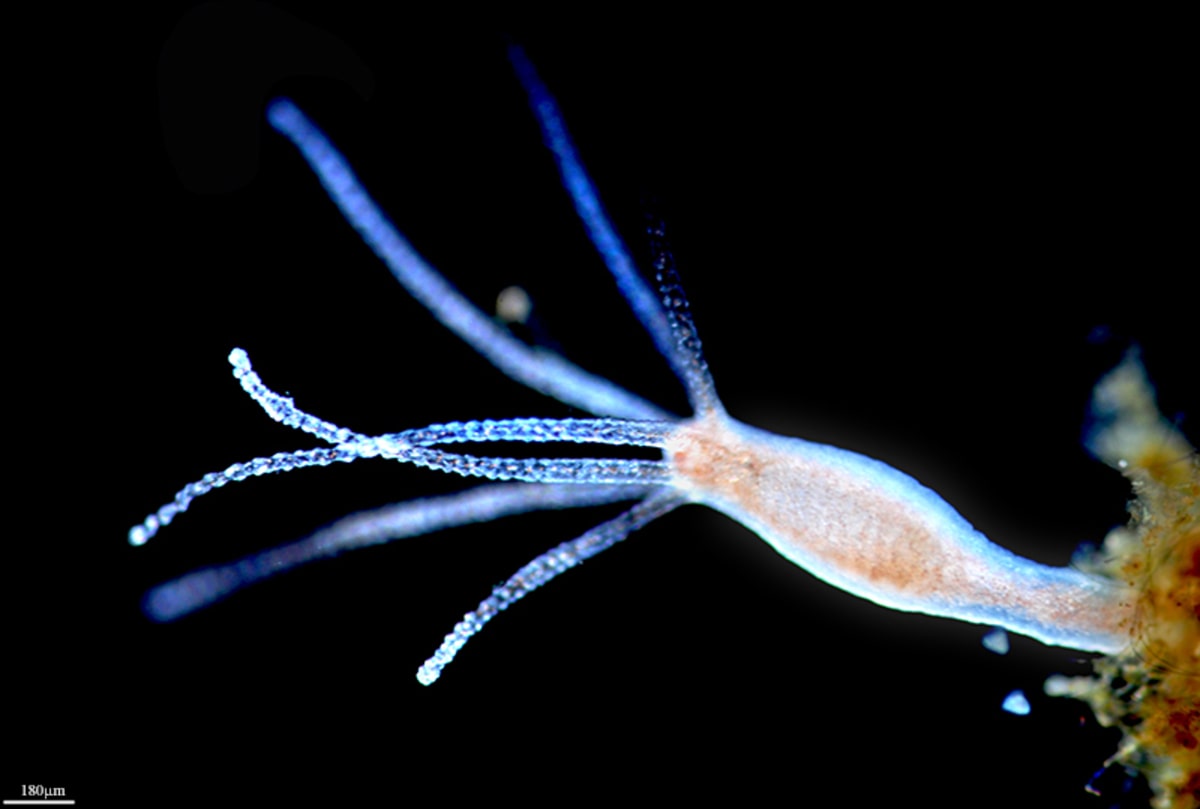
Hydras are among the most extraordinary freshwater organisms you may not know much about. Despite their tiny size, they possess remarkable biological features that challenge traditional assumptions about living creatures. Their simple structure hides abilities that are extremely rare in the animal kingdom, particularly in the areas of regeneration and longevity. Scientific studies on hydras shed light on fundamental mechanisms of evolution, cellular development and adaptation. This collection of fascinating and surprising facts will help you better appreciate the uniqueness of these remarkable organisms.
- Hydras belong to the group of cnidarians and usually measure only a few millimetres in length. Despite their small size, they have a complex body with tentacles used to capture prey. Their transparent bodies allow direct observation of internal processes under a microscope. This makes hydras a common model organism in educational and research laboratories.
- One of the most famous features of hydras is their incredible ability to regenerate. If a hydra is cut into several pieces, each fragment can develop into a complete organism. This regenerative capacity is driven by highly active stem cells distributed throughout their tissues. Such extraordinary regenerative potential attracts great interest in the field of regenerative medicine.
- Hydras do not age in the usual biological sense and are theoretically capable of living indefinitely. Their cells constantly renew themselves, preventing tissue deterioration. In controlled laboratory conditions they can remain fully viable for exceptionally long periods without showing signs of ageing. This potential biological immortality makes them unique among animals.
- The movement of hydras is unusual and easily recognisable. They cannot swim actively, so they move by attaching themselves to a surface with the base of their body and slowly flipping forward. This form of locomotion resembles slow acrobatic motions. At times they may detach and drift freely with the water current.
- Hydras feed on small crustaceans, insect larvae and other microscopic aquatic organisms. Their tentacles are covered with stinging cells that paralyse prey on contact. The immobilised prey is then transported to the mouth opening located at the centre of the tentacle ring. This feeding strategy makes hydras effective micro-predators in freshwater ecosystems.
- Hydras do not possess a brain, but their nervous system consists of a diffuse network spread throughout the entire body. This network coordinates movement, responses to stimuli and basic behaviours. Although simple in structure, it functions with remarkable efficiency. It represents an early evolutionary form of neural organisation.
- Hydras reproduce both sexually and asexually. Under favourable conditions they form buds that develop into new individuals. When environmental conditions become stressful or temperatures change, they can switch to sexual reproduction. This flexibility helps maintain the stability and survival of their populations.
- Hydras can detect light even though they have no eyes. Their cells contain light-sensitive molecules that allow them to sense changes in illumination. This helps them find suitable habitats within their aquatic environment. Light sensitivity also influences their feeding patterns and daily activity.
- Hydras possess specialised toxin-producing cells in their tentacles. These cells activate upon contact with prey, causing immediate paralysis. The toxins are potent against small organisms but pose no danger to humans. This adaptation plays an essential role in both their defence and hunting strategies.
- Hydras exhibit radial symmetry, enabling them to perceive stimuli from all directions equally well. This symmetry allows efficient prey capture since the tentacles surround the mouth opening completely. Radial symmetry is considered one of the earliest structural solutions in animal evolution. It gives simple organisms the advantage of equal responsiveness to their environment.
- Some hydra species can form colonies consisting of many individuals. Each hydra remains a separate organism, yet the colony can function similarly to a coordinated community. This behaviour resembles that of coral colonies and demonstrates that even primitive animals can display early forms of social organisation. Although rare, such formations are of great interest to biologists.
- Hydras are capable of adjusting their body size according to environmental conditions. When food is scarce, they shrink to conserve energy. Once conditions improve, they return to their typical size. This plasticity enhances their chances of survival in unstable ecosystems.
- In biological research hydras serve as an important model organism. They are widely used to study stem cell behaviour, tissue regeneration and genetic regulation. Their biological processes help scientists develop insights into fundamental mechanisms shared by many living organisms. Hydras therefore play a significant role in advancing modern biological science.
- Hydras show high sensitivity to chemical substances dissolved in water. They can detect subtle changes in molecular concentration, which helps them find food and avoid danger. This form of chemical perception is considered one of the earliest sensory systems in animal evolution. It contributes substantially to their survival strategies.
- When environmental conditions become extremely unfavourable, hydras can enter a state of anabiosis. Their metabolism slows drastically, allowing them to withstand cold, drought or lack of food. Once conditions improve, they quickly return to normal activity. This mechanism increases the resilience of hydra populations during ecological instability.
In conclusion, hydras contain many interesting facts that highlight their biological uniqueness. Their remarkable regenerative abilities, unusual behaviours and ecological adaptability reveal how surprising the world of microscopic organisms can be. Despite their simple body plan, hydras greatly influence the development of modern biological research. For these reasons they continue to fascinate scientists and remain a symbol of nature’s hidden complexity.


