
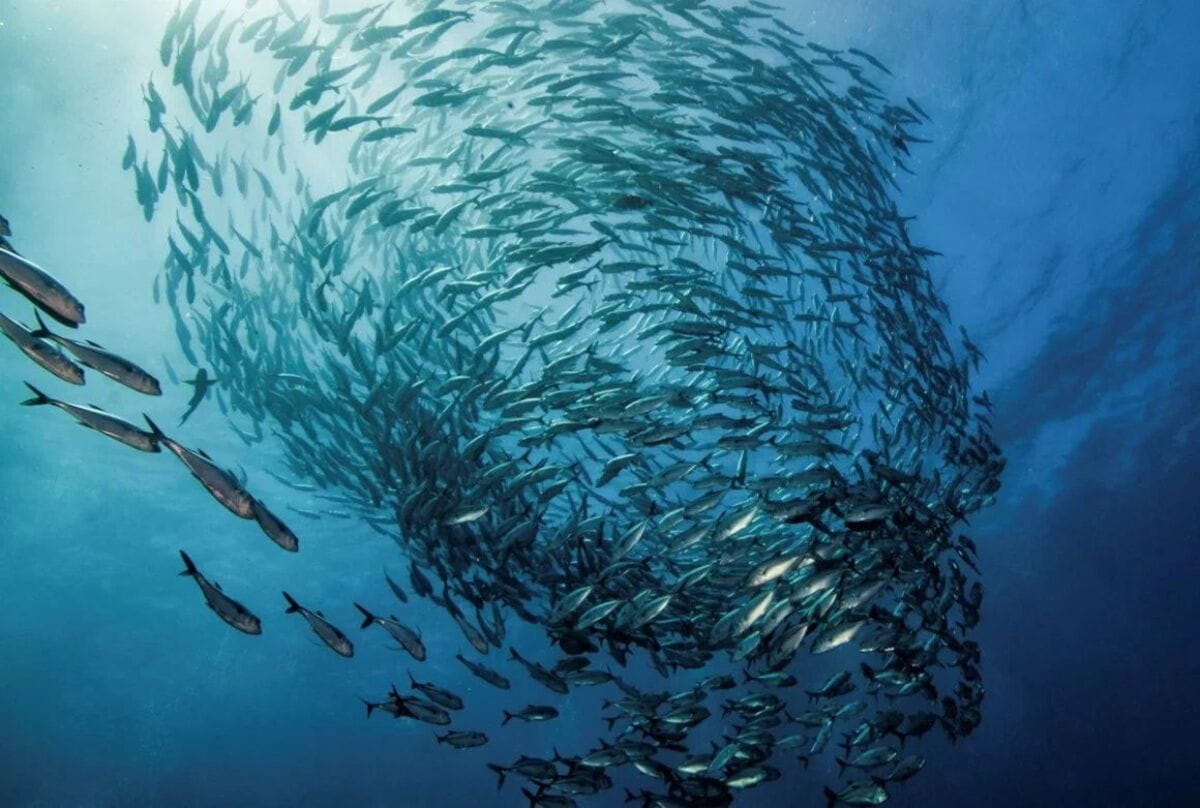
Herring is far more than just a salty delicacy on the holiday table—it is a true marine strategist, playing a pivotal role in the global ecosystem. This small fish forms one of the most crucial links in the ocean’s food chain, feeding everything from whales to humans. You may not have known that herring travel thousands of kilometers, forming immense schools so vast they can be seen from space. The astonishing facts about this fish reveal its uniqueness—from biology to cultural significance. Below is a collection of fascinating insights, each shedding light on the life of this remarkable sea creature.
- Herring belong to the Clupeidae family, and there are over 200 species worldwide, with the most well-known being Atlantic herring (Clupea harengus) and Pacific herring (Clupea pallasii). Both species share a similar body shape—streamlined, silvery, and covered in numerous scales that easily flake off. They inhabit temperate and cold waters of the Northern Hemisphere, where they form massive schools. It was precisely their abundance that made them the foundation of industrial fishing as early as the Middle Ages.
- Atlantic herring can live up to 25 years and reach lengths of 45 centimeters, although most individuals are caught much younger. They reach sexual maturity between 3 and 5 years of age, depending on environmental conditions. During a single spawning season, a female can release up to 30,000 eggs. Herring roe serves as a vital food source for many marine organisms, including crabs and small fish.
- Herring migrate in enormous schools that can number in the millions and stretch for several kilometers. These aggregations form as a defense mechanism against predators—when the fish move in perfect synchrony, it creates a “sensory overload” effect in attacking predators. Herring schools are so large that they are sometimes detected by weather satellites as “atmospheric phenomena.” This phenomenon is even referred to as a “fish rain.”
- Herring possess a unique sound perception system—they have specialized structures called otoliths that help them navigate in the darkness of deep water. Additionally, they are highly sensitive to water vibrations, allowing them to detect approaching predators well in advance. This ability also helps maintain coordination within the school without visual contact. As a result, the school can instantly change shape to evade attacks.
- Herring are a keystone species in marine ecosystems—they convert plankton into biomass that feeds thousands of other animals. Without them, humpback whales, seals, seabirds, and many commercially valuable fish would struggle to survive. When herring populations decline, it triggers a cascading effect throughout the entire ecosystem. For this reason, their population health is considered a key indicator of ocean vitality.
- Humans have been harvesting herring for over a thousand years—Scandinavian Vikings salted them for long sea voyages. In the Middle Ages, herring became the economic backbone of the Netherlands, and its trade helped build maritime empires. Herring preservation through salting was so vital that it earned the nickname “silver of the sea.” Even today, it remains one of the most heavily fished species in the world.
- Herring are rich in omega-3 fatty acids, which support heart health, brain function, and the immune system. Regular consumption of herring reduces the risk of cardiovascular disease and depression. Moreover, it is an excellent source of vitamin D—a nutrient many people lack due to insufficient sunlight exposure. This is why herring has traditionally been valued as a health-sustaining food in northern countries.
- There are numerous ways to prepare herring—from salting and smoking to marinating in vinegar, wine, or even milk. In Sweden, there are over 30 varieties of marinated herring, served on festive tables under the name “surströmming.” In the Netherlands, fresh herring is eaten raw—held by the tail and slid directly into the mouth. This tradition dates back to the 17th century and remains popular at markets and festivals.
- Herring spawn at different times of the year depending on the population—some in spring, others in autumn. During spawning, they move close to shore and deposit their eggs on seaweed or rocks. The eggs adhere to surfaces thanks to a sticky coating that protects them from being washed away. After 10 to 40 days, larvae hatch and initially feed on plankton.
- Despite massive fishing pressure, herring populations can recover quickly due to high fertility and rapid juvenile growth. However, overfishing in the 20th century caused the collapse of certain stocks, particularly in the North Sea. Today, catches are regulated by international quotas to prevent overexploitation. Fortunately, thanks to these measures, many herring populations are now stabilizing once again.
- Herring do not have a stomach—their digestive tract runs straight from mouth to anus without any expansion. This means they must feed almost continuously to obtain enough energy. They filter plankton by passing water through their gill rakers, where specialized plates trap food particles. This efficient system allows them to thrive even in waters with low plankton concentrations.
- In ancient Scandinavian mythology, herring were considered a gift from the gods, ensuring survival through harsh winters. Their silvery bodies were associated with the Moon, while their schools were likened to star clusters. In Slavic traditions, herring often featured in New Year rituals as a symbol of prosperity. Even today, in many cultures, it is served during holidays as a protective charm against hunger.
These captivating facts about herring reveal how this seemingly simple fish is deeply woven into both the fabric of global ecology and human history. You may not have realized that behind its shimmering flank lies a true engine of marine life, maintaining the balance of the ocean. The incredible truths about herring remind us that even the smallest creatures can have the greatest impact. Interesting facts about this fish inspire respect for nature and a deeper understanding of how all living beings on Earth are profoundly interconnected.


