
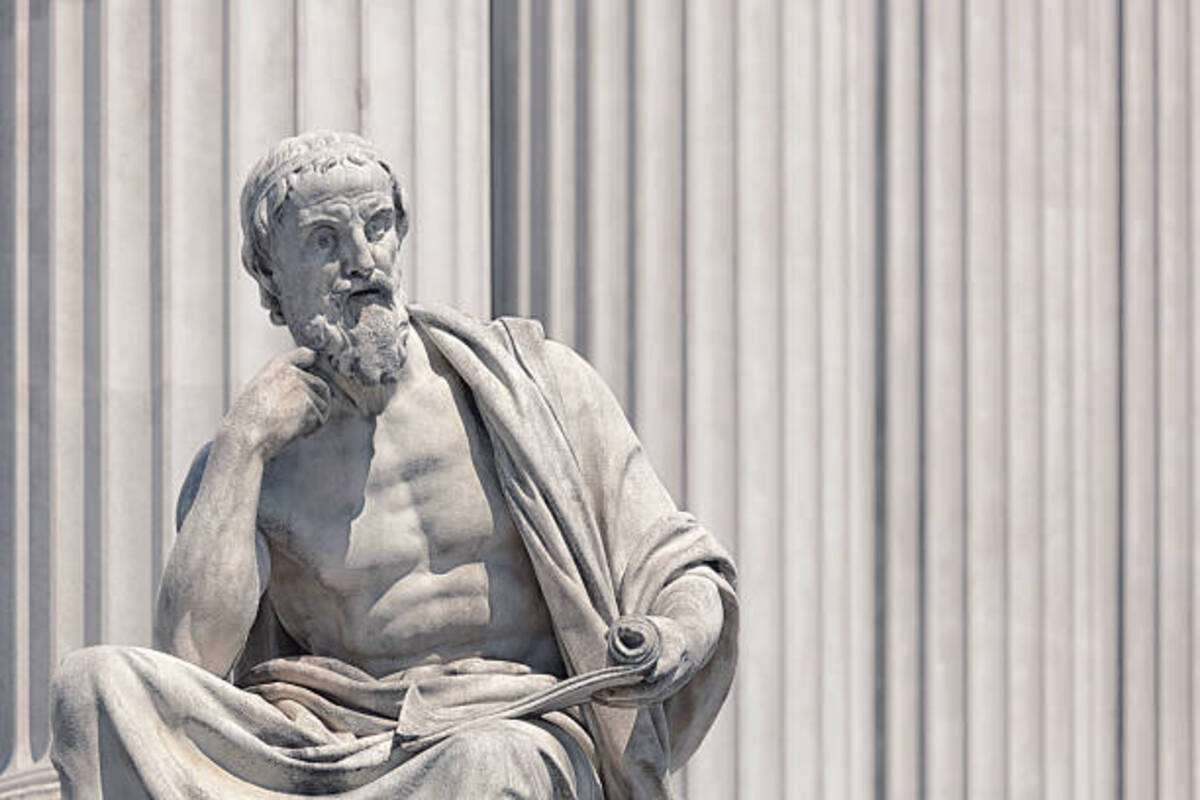
Herodotus is one of the most outstanding figures of the ancient world, whose work laid the foundations of historical science. This ancient Greek thinker is rightfully called the father of history, as he was the first to systematically research and record events of the past. His life was full of travels, discoveries, and tireless pursuit of knowledge about the peoples and cultures of the ancient world. Fascinating facts about Herodotus reveal to us the personality of an extraordinarily curious and bold man of his era. You may not have known many amazing details about the life and work of this legendary historian.
- Herodotus was born approximately in 484 BCE in the city of Halicarnassus, which was located in the territory of modern-day Turkey. This city was a Greek colony with a rich cultural life and trade connections. Halicarnassus was under the influence of the Persian Empire, which allowed the young Herodotus to become acquainted with various cultures early on. It was precisely this cosmopolitan environment that shaped his interest in other peoples.
- Herodotus received the title of father of history from the ancient Roman orator Cicero. This honorable title has remained with him for millennia and is still used today. Cicero recognized the unique contribution of Herodotus to the development of historical thought. Before Herodotus, no one had attempted to systematically describe historical events and their causes.
- The main work of Herodotus is simply called “The Histories” and consists of nine books. Each book was later named by scholars after one of the nine muses of Greek mythology. This work covers the history of the Greco-Persian Wars and describes the peoples with whom the Greeks had contact. The total volume of the work amounts to approximately 600 pages of modern print.
- Herodotus was one of the greatest travelers of the ancient world. He visited Egypt, Babylon, Persia, Scythia, Thrace, and numerous Greek city-states. His travels covered territory from modern-day Ukraine to North Africa. According to researchers’ calculations, he covered tens of thousands of kilometers during his lifetime.
- Herodotus left the oldest detailed description of Egypt that has survived to our times. He described the pyramids, the process of mummification, the customs of the Egyptians, and the floods of the Nile. Many of his observations have been confirmed by modern archaeological research. Egyptian priests told him legends and stories, which he carefully recorded.
- The work of Herodotus contains the first known description of the Scythians and their way of life. He told in detail about the nomadic lifestyle of this people, their military customs, and beliefs. Herodotus described the territory of modern-day Ukraine, which he called Scythia. His information about the Scythians remains an important source for modern historians.
- Herodotus was forced to leave his native Halicarnassus for political reasons. His family participated in an unsuccessful uprising against the tyrant Lygdamis. After his exile, Herodotus settled on the island of Samos, where he continued his education. Later he was able to return to his homeland after the overthrow of the tyranny.
- Herodotus personally visited the site of the Battle of Thermopylae and described this confrontation. He told about the heroic deed of the three hundred Spartans led by King Leonidas. His description of this battle became the basis for all later retellings of this event. Herodotus spoke with participants of the Greco-Persian Wars and their descendants.
- Herodotus participated in the founding of the Greek colony of Thurii in Southern Italy in 444 BCE. This colony was founded on the initiative of the Athenian leader Pericles. Herodotus received citizenship of this city and possibly spent the last years of his life there. Some sources indicate that he was buried precisely in Thurii.
- Herodotus was the first to begin critically analyzing sources of information. He often noted that he was conveying what he heard, but did not necessarily believe everything he heard. Such an approach was revolutionary for its time and laid the foundations of critical thinking in history. He distinguished facts that he saw personally from those he had only heard about.
- The work of Herodotus contains the oldest description of Babylon and its famous wonders. He described the walls of Babylon, the temple of Marduk, and the legendary hanging gardens. Some of his descriptions were long considered exaggerations until archaeology confirmed many details. Herodotus admired the greatness of Mesopotamian civilization.
- Herodotus recorded the first known version of the legend about the ring of Polycrates. This story tells about the tyrant of Samos who tried to avoid the jealousy of the gods. The legend became a classic example of the Greek concept of fate and nemesis. Herodotus used such stories to illustrate moral lessons.
- Herodotus was a contemporary of the most outstanding figures of the Golden Age of Athens. He lived during the times of Pericles, Sophocles, and Socrates. There is evidence of his friendship with the tragedian Sophocles. Athens of that period was the center of intellectual life of the Greek world.
- Herodotus publicly read his work at the Olympic Games before a huge audience. According to legend, among the listeners was the young Thucydides, who later himself became an outstanding historian. Public readings were an important form of disseminating literary works in ancient Greece. These performances brought Herodotus fame throughout the Greek world.
- Herodotus described in detail the political systems of various peoples and compared them. He analyzed the advantages and disadvantages of monarchy, oligarchy, and democracy. His work contains the first known discussion about forms of government. This analysis influenced later political thinkers, including Plato and Aristotle.
- Herodotus recorded numerous details about the customs and traditions of various peoples. He described wedding rituals, funeral traditions, food habits, and religious practices. His ethnographic observations make the work valuable to anthropologists. Herodotus sought to understand other cultures without prejudice.
- Herodotus told about the construction of the Egyptian pyramids based on the accounts of local priests. He described the methods of transporting stones and the organization of labor. Some of his information about the number of workers and the duration of construction is still debated today. His description remains one of the oldest written sources about the pyramids.
- Herodotus was the first to describe the process of mummification in ancient Egypt. He told about three different methods of embalming depending on the wealth of the client. His description proved to be extremely accurate after modern studies of mummies. Egyptologists still cite Herodotus as an important source.
- The work of Herodotus has survived in its entirety, which is a rarity among ancient texts. Many other ancient Greek historical works have come down to us only in fragments. The oldest surviving manuscripts of “The Histories” date to the 10th century CE. The text was passed down through generations of copyists over one and a half millennia.
- Herodotus used the concept of fate and divine intervention to explain historical events. He believed that the gods punish human pride and violation of moral norms. This religious component of his work reflects the worldview of the ancient Greeks. At the same time, he also sought rational explanations for events.
- Herodotus described the famous Battle of Marathon in 490 BCE. He told about the victory of the Athenians over a significantly larger Persian army. It is precisely from his description that the legend of the marathon runner Pheidippides originates. This battle became a symbol of Greek resistance to Persian expansion.
- Herodotus recorded important geographical information about the ancient world. He described the course of rivers, the climate of various regions, and the features of the terrain. His geographical data helped later travelers and merchants. Many of his observations proved to be surprisingly accurate.
- Herodotus died approximately in 425 BCE, having lived about 60 years. The exact circumstances and place of his death remain unknown. According to various versions, he died in Thurii, Athens, or Pella in Macedonia. His work continued to live and influence generations of historians.
Incredible facts about Herodotus demonstrate the scale of his contribution to world culture and science. This ancient Greek thinker not only recorded the history of his era but also created a method for studying it. His tireless curiosity and respect for other cultures make him relevant to modern readers as well. The legacy of Herodotus continues to inspire historians, anthropologists, and travelers around the world for more than two and a half thousand years.


