
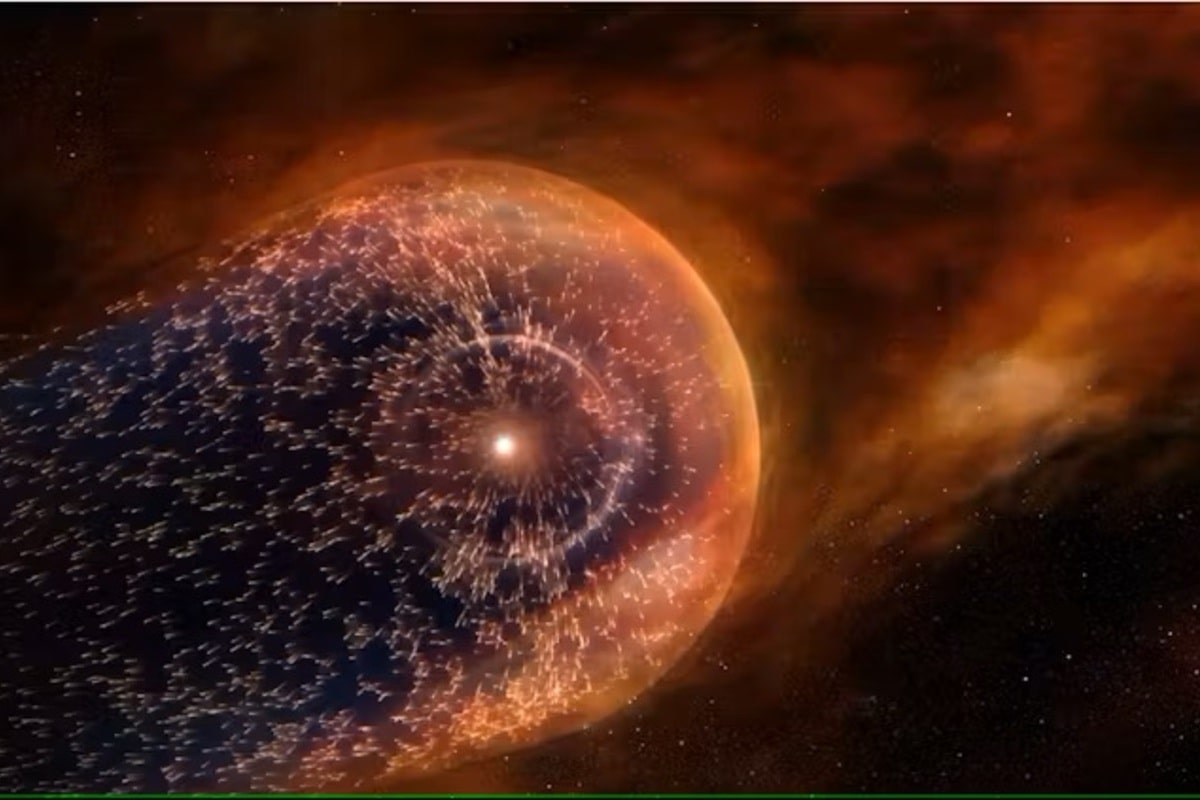
The heliosphere is a vast bubble-like region of cosmic space that surrounds our Solar System and protects it from the interstellar medium. This magnetic shield is created by the continuous flow of charged particles from the Sun, known as the solar wind. The heliosphere extends far beyond the orbit of Pluto and is one of the largest structures in our planetary system. The study of this cosmic boundary reveals incredible facts about how our stellar system interacts with galactic space. Learn about the fascinating features of the heliosphere that you may not have known about.
- The heliosphere extends approximately 18 billion kilometers from the Sun in the direction of the Solar System’s movement through the Milky Way. In the opposite direction, it can reach more than 200 astronomical units or about 30 billion kilometers. Such an asymmetric shape arises due to the pressure of the interstellar medium, which compresses the heliosphere from one side. The dimensions of the heliosphere constantly change depending on the Sun’s activity and conditions in interstellar space.
- The solar wind that creates the heliosphere moves at speeds from 400 to 800 kilometers per second. This stream consists predominantly of protons, electrons, and alpha particles that fly out from the Sun’s corona. Every second, the Sun emits about one million tons of matter in the form of solar wind. This process occurs continuously and will continue for billions of years while the Sun remains an active star.
- The termination shock is the first boundary of the heliosphere, where the solar wind suddenly slows from supersonic to subsonic speed. This occurs as a result of the collision of the solar wind with the interstellar medium. The Voyager 1 spacecraft crossed the termination shock in 2004 at a distance of about 94 astronomical units from the Sun. Voyager 2 reached this boundary in 2007 at a somewhat smaller distance due to the asymmetric shape of the heliosphere.
- The heliopause is the outer boundary of the heliosphere, where the pressure of the solar wind is balanced by the pressure of the interstellar medium. This is the true boundary of the Sun’s influence and the frontier between solar and interstellar plasma. In August 2012, Voyager 1 became the first human-made object to cross the heliopause and enter interstellar space. Voyager 2 reached this historic boundary in November 2018, confirming the data from its predecessor.
- The heliosphere protects Earth and other planets from high-energy galactic cosmic rays. Without this protection, the flux of cosmic rays on Earth would be several times greater. This could seriously affect the planet’s atmosphere, climate, and the possibility of life’s existence. The magnetic field of the heliosphere deflects about 90 percent of cosmic rays from beyond the Solar System.
- The shape of the heliosphere resembles a comet with a head in front and a long tail behind. The head is called the bow shock wave or heliospheric sheath, and the tail can extend for hundreds of astronomical units. The heliosphere acquires such a shape due to the Solar System’s movement through the interstellar medium at a speed of about 25 kilometers per second. The long tail of the heliosphere is called the heliotail and can stretch to a distance of more than 1000 astronomical units.
- Between the termination shock and the heliopause is a region called the heliosheath or heliosphere layer. In this zone, the solar wind becomes turbulent and heats up to temperatures of millions of degrees. The thickness of the heliosheath ranges from 40 to 50 astronomical units. It is in this region that the most intense interaction between solar and interstellar plasma occurs.
- The heliosphere is not a static structure and constantly pulsates similarly to how a living being breathes. These pulsations are associated with the 11-year cycle of solar activity. During the solar maximum, the heliosphere expands, and during the minimum, it contracts. Size fluctuations can reach several billion kilometers.
- Neutral hydrogen from the interstellar medium penetrates through the heliopause and spreads throughout the Solar System. This phenomenon creates the so-called hydrogen wall at the boundary of the heliosphere. Studying the distribution of this neutral hydrogen helps scientists better understand the structure and dynamics of the heliosphere. The Hubble Space Telescope and other observatories use observations of this hydrogen for mapping the boundaries of the heliosphere.
- Anomalous cosmic rays are a special type of particles that form directly in the heliosheath. They arise when neutral atoms from interstellar space enter the heliosphere, become ionized, and accelerated. These particles have intermediate energies between the solar wind and galactic cosmic rays. Their discovery was a surprise for astrophysicists and forced a revision of some models of the heliosphere.
- Research from the Voyager mission showed that the magnetic field at the boundary of the heliosphere has a complex structure with numerous magnetic bubbles. These bubbles can reach sizes from 150 million to a billion kilometers in diameter. They form through the reconnection of magnetic field lines of the solar wind. The discovery of these structures changed scientists’ ideas about what the outer boundary of our planetary system looks like.
- The heliosphere interacts with the local interstellar cloud through which the Solar System is currently moving. This cloud is a relatively warm and rarefied region of interstellar space. The Solar System has been in this cloud for about 100 thousand years and will probably remain in it for another 10-20 thousand years. The properties of this cloud directly affect the shape and size of the heliosphere.
- Various models predict that the heliosphere may have both a smooth rounded shape and a more complex structure with numerous folds. Data from the Voyagers and other spacecraft continue to refine our ideas about the true shape of the heliosphere. Some scientists believe that the heliosphere may periodically change its shape due to changes in the interstellar medium. Only direct measurements from different points in space can ultimately resolve this question.
- The IBEX mission, launched by NASA in 2008, creates maps of the heliosphere using observations of energetic neutral atoms. These atoms form at the boundary of the heliosphere and carry information about conditions in these distant regions. IBEX discovered a mysterious ribbon of high-energy particles in the sky, which may indicate the direction of the magnetic field of the interstellar medium. This discovery forced scientists to revise some basic assumptions about the interaction of the heliosphere with galactic space.
- The heliosphere of other stars may have a completely different appearance depending on the star’s activity and the density of the surrounding interstellar medium. Younger and more active stars have larger astrospheres, while older stars may have significantly smaller protective bubbles. Some stars have no astrospheres at all if they are moving through very dense interstellar medium. The study of astrospheres of other stars helps better understand the uniqueness or typicality of our own heliosphere.
The heliosphere remains one of the most fascinating and complex structures to study in astronomy. Incredible facts about this magnetic shield demonstrate how complex the interaction between our star and the galactic environment is. Each new mission to the outer boundaries of the Solar System brings interesting discoveries about the nature of the heliosphere. Understanding this cosmic boundary is key to realizing how Earth and life on it are protected from the harsh conditions of interstellar space.


